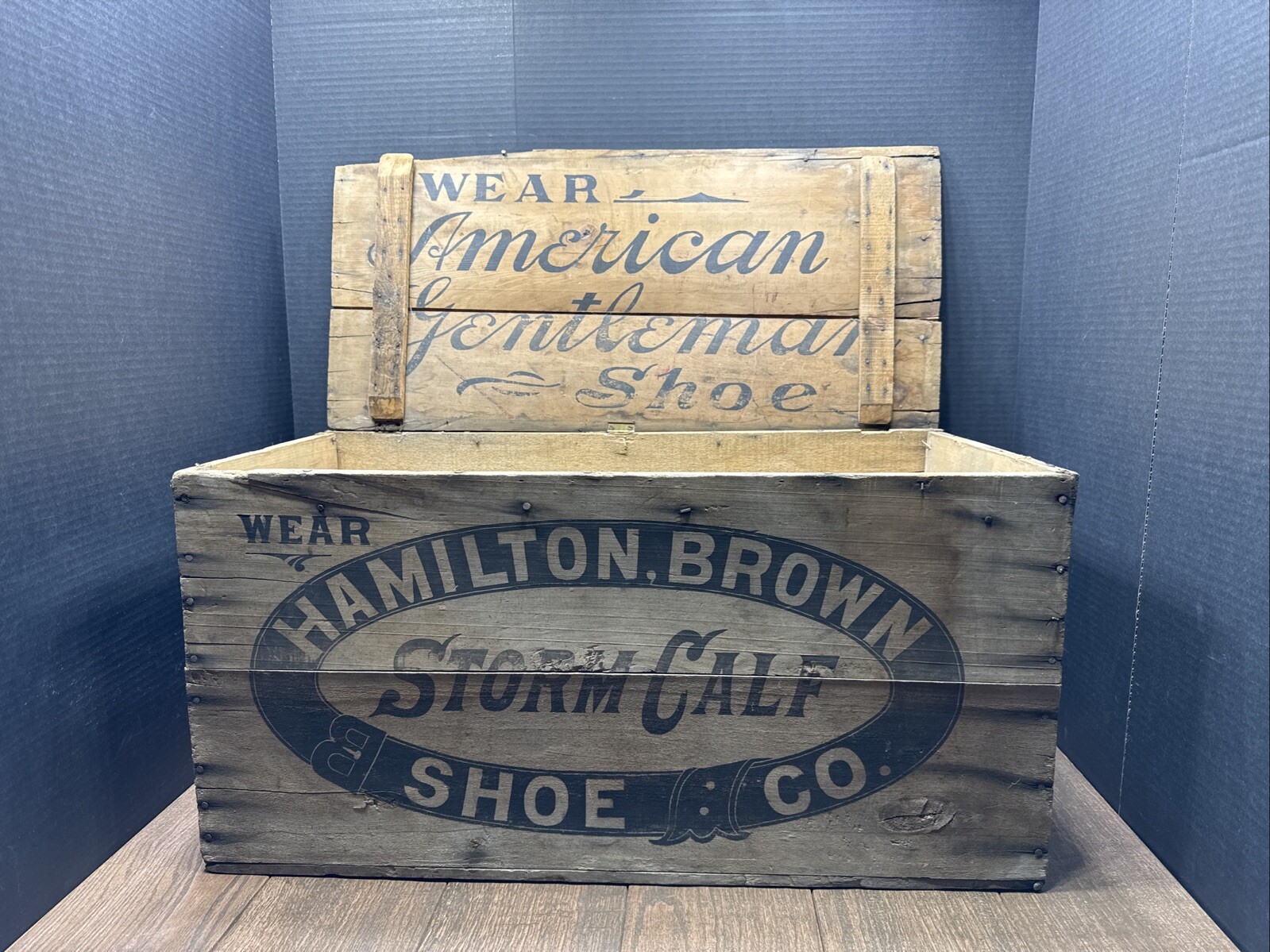
This is a vintage wooden crate advertising box from the 1950s, featuring the Hamilton Brown Shoe Company's branding.
The large brown crate is designed in a rectangular shape with a finish in wood.
It is a collectible item that was made in the USA and reflects the advertising theme of the Hamilton Brown Shoe Company, known for their Storm Calf shoes for adults.
Here’s a little information on the Hamilton Brown Shoe company awesome piece of vintage advertising
The Hamilton-Brown Shoe Company, once the largest shoe manufacturer in the world, played a significant role in the American footwear industry during the late 19th and early 20th centuries. Founded in 1878 in St. Louis, Missouri, the company underwent several name changes before becoming Hamilton-Brown. It was renowned for producing a wide range of footwear for men, women, and children, with popular brands like “American Gentleman” and “American Lady.”
Origins and Growth
Initially established as Bryan, Brown & Company in 1878 by George Warren Brown and Alvin Bryan, the firm quickly recognized the potential for shoe manufacturing in St. Louis. After Bryan’s retirement in 1886, the company became Brown-Desnoyers Shoe Company, and following J.B. Desnoyers’s departure in 1893, it was renamed Brown Shoe Company. In the late 1880s, James Hamilton joined the company, leading to its final name change to Hamilton-Brown Shoe Company. By the early 20th century, with six manufacturing facilities, Hamilton-Brown claimed global leadership in boot and shoe production.
Expansion Beyond St. Louis
In 1906, seeking to expand its operations, Hamilton-Brown selected Columbia, Missouri, for its first factory outside St. Louis. The Columbia community raised $60,000 to build the plant, which began operations in 1907. This facility marked Columbia’s first large-scale industrial operation and employed an average of 300 workers until its closure in 1939.
Challenges and Decline
The Great Depression of the 1930s severely impacted Hamilton-Brown. The company struggled with declining sales, rising labor costs, and increased competition. Despite efforts to remain solvent, including wage reductions and anti-union measures, Hamilton-Brown filed for bankruptcy in June 1939, marking the end of its operations.
Legacy
Today, the legacy of Hamilton-Brown is preserved through its historic buildings. The original factory in Columbia has been repurposed into offices and stands as a testament to the city’s early industrial efforts. Similarly, the Hamilton-Brown Shoe Company Building in Boonville, Missouri, built in 1919, has been converted into the Selwyn Place Apartments. Both structures are listed on the National Register of Historic Places, reflecting their historical and architectural significance.
The Hamilton-Brown Shoe Company’s rise and fall illustrate the dynamic nature of American industry during a period of rapid economic change. Its contributions to manufacturing and its impact on communities like Columbia and Boonville remain noteworthy chapters in the history of American enterprise.

Related Items:
VINTAGE HAMILTON 6172 MASONIC/SHRINER WATCH- REGISTERED EDITION #18 OF 500
$225.00

Vintage Hamilton Watch Co Model 33 Map Measurer Opisometer Inch/CM USA
$29.99
Vintage HAMILTON BROWN SHOE COMPANY WOODEN CRATE ADVERTISING BOX STORM CALF
$600.00