🦅 Why Would a Supply House Put an Eagle, a Flag, and Two Torches on a Warehouse Broom?
Size: 6\" x 3 1/2\" ~ New Old Stock, little to no wear.
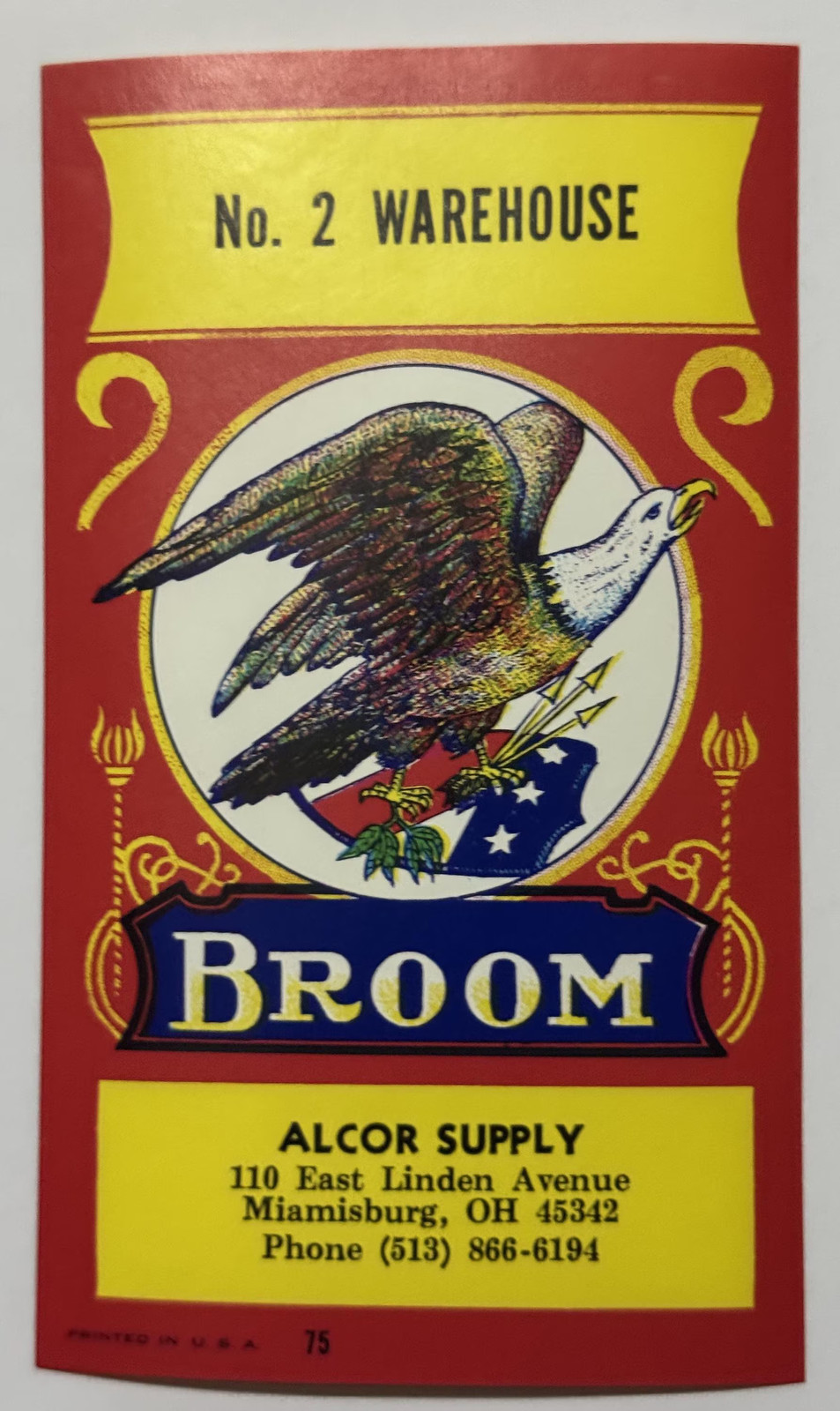
In Miamisburg, Ohio, a broom was worth dressing up. I\'ve handled a lot of paper from the back rooms of American commerce, and I\'m still tickled by a label that treats an everyday tool like a parade float. This one has a white-headed eagle with its wings thrown up and a starred flag under its talons. Two flaming torches stand on twisted posts, and a royal-blue banner announces BROOM in letters that would suit a circus wagon. I like to imagine someone at a Dayton-area supply house looking at that proof and saying, yes, that\'s what goes on our brooms. Anyone who has swept out a stockroom, a garage bay, or a school corridor knows the broom that lives in the corner. This label gave one of them a coat of arms.
What you\'re looking at: a vintage pictorial broom label issued by Alcor Supply of Miamisburg, Ohio, in the \"Warehouse\" grade. It measures 6 x 3½ inches (about 15.2 x 8.9 cm) in portrait format, tall and narrow, roughly a postcard stood on end. It is New Old Stock (NOS), unused supplier\'s stock, and an excellent example of late-20th-century American commercial label art built on an older pictorial tradition.
The art is stacked in panels on a red ground. A yellow banner across the top carries the grade, WAREHOUSE with its grade number, in black capitals. Below it, a white roundel ringed in gold holds the eagle, brown, green and gold with a white head and yellow beak. It perches on a red, white and blue starred flag, with a sheaf of arrows in one talon and a leafy branch in the other. Yellow scrollwork curls at the top corners and flourishes around the base of the roundel, and a torch on a twisted post stands at each side. A royal-blue banner spells out BROOM in white capitals shaded in yellow. A yellow panel at the foot carries the black imprint: ALCOR SUPPLY in bold sans-serif, then the Miamisburg, Ohio address block and a 513-area-code phone line in a Century-style serif. \"PRINTED IN U.S.A.\" runs small along the red bottom margin. The eagle has the grainy, mottled shading of old pictorial printing, while the red, yellow and blue fields are flat solids. I date the printing to 1970–1996, and the reasoning is below.
🏭 Alcor Supply: A Miamisburg Supply House with a Founder Worth Knowing
Alcor is a happy case where the company behind the label is documented. According to the Dayton Daily News (Sept. 30, 2021) and a funeral-home obituary, Alcor Supply Company was founded in 1970 by Joe R. Harrison. He was born in Waterloo, Iowa, in 1942 and joined the Army at seventeen. Before Alcor he spent about ten years at Miamisburg\'s Mound Laboratories, the atomic plant, working as a locksmith among other jobs. Then he invested in ice cream trucks, and the ice cream trucks led him into restaurant supply and distribution. That is how a locksmith from the atomic plant ended up in the janitorial-and-foodservice business, and I love that trail.
His second act was downtown. He bought and restored a number of commercial buildings, including the Historic Plaza Theatre building, and former mayor Dick Church credited him with a big part in reviving downtown Miamisburg. He died September 23, 2021, at 79.
The company he built is still in business. The Better Business Bureau lists Alcor at the same Miamisburg address printed on this label, under a second name, Alcor Supply & Fixture Company. It says Alcor represents about 600 manufacturers of wholesale paper, chemicals and restaurant equipment. Explore Miamisburg calls it a Dayton-area distributor of janitorial supplies and foodservice disposables, equipment and textiles, and the company\'s own page describes it as family-owned. A distributor in that line is just the kind of house that would sell brooms and want its own name on them. That part is my inference, but it fits.
📞 Reading the Imprint: How the Label Dates Itself
There is no printed date anywhere on this label, but the imprint brackets it well. The two-letter \"OH\" and a ZIP code are postal formats from 1963 (ZIP codes began July 1 of that year, the two-letter state abbreviations that October). Alcor\'s founding in 1970 moves the floor up, so no earlier than 1970. At the other end, the phone line carries the 513 area code, and Dayton and its suburbs were split off to the new 937 in September 1996. That gives 1970 through 1996. Alcor\'s number carried on after the split with the same digits, so this label preserves the old area code for a line that is still in use.
My eye says the job typography, a bold sans for the company name and a Century-style serif for the address lines, reads mid-century. That makes the earlier part of the window feel likelier to me, but it is an impression and not evidence.
🧹 The Broom Trade in Those Years
The trade around this label was being rearranged. The first Mexican broomcorn imports arrived in 1965, and Illinois had almost stopped growing broomcorn by 1967 (Purdue). Imports averaged about 11,800 tons a year from 1971 to 1985, while wall-to-wall carpet cut into broom sales through the 1970s (Plainsman Herald). NAFTA made Mexican corn brooms duty-free in 1994. In November 1996, just as this label\'s window closes, President Clinton put temporary tariffs on imported corn brooms (Proclamation 6961).
The \"Warehouse\" grade does tell you the intended job: the heavy, hard-working end of the line, for stockrooms and loading docks rather than the kitchen corner.
🦅 The Eagle: The Great Seal\'s Vocabulary, Dressed for Commerce
The arrows and olive branch are the Great Seal\'s attributes. Congress adopted the Seal on June 20, 1782. Charles Thomson, Secretary of Congress, swapped a small white eagle from an earlier design for the native bald eagle. Thomson wrote that the olive branch and arrows \"denote the power of peace & war which is exclusively vested in Congress.\" The State Department\'s diplomacy museum notes that the eagle always looks toward the olive branch, a preference for peace with the arrows held ready. On the Seal the olive branch rides in the eagle\'s right talon, the arrows in its left, thirteen of each, with a shield on the breast.
This label\'s eagle is a cousin, not a copy. It stands on a starred flag instead of carrying a shield, and torches flank it. So \"patriotic eagle in the Great Seal tradition\" is the accurate description. It borrows the Seal\'s vocabulary without keeping every rule of its grammar. After 1782 the bald eagle spread quickly through American culture as a symbol of freedom and patriotism (ShareAmerica, citing collector Preston Cook), and it ended up on goods of every kind, here on a broom. I\'ll leave the counting of arrows and leaves to anyone with a loupe.
The twin torches are a pleasing echo too. The National Park Service reads the Statue of Liberty\'s torch as enlightenment, from the statue\'s official name, Liberty Enlightening the World.
The bird itself has a story that overlaps the label\'s years. In 1963 only 417 nesting pairs remained in the lower 48. Fish and Wildlife listed the species as endangered in 1978 and took it off the list in 2007 (USFWS; Smithsonian National Zoo). In December 2024 the bald eagle became the official national bird (CNN). So this label was printed during the middle of the wild bird\'s long comeback.
🏘️ Miamisburg: Hole\'s Station, Canal Boats and Tobacco Warehouses
The settlement began around 1797 as Hole\'s Station. Zachariah Hole came from Virginia and built a stockade, and the place took his name (City of Miamisburg). The city\'s 1949 history foreword quotes an 1801 IOU to Dr. Hole promising \"a winter\'s smoking of tobacco or five venison hams\" in payment for medical care. I can\'t help thinking of it as the town\'s first price list.
On February 20, 1818, four Pennsylvanians saleed 90 lots: Emanuel Gebhart, Jacob Kercher, and Drs. John and Peter Treon. The town\'s name means \"town of the Miamis,\" after the Miami people. The Miami and Erie Canal ran through the middle of town, and the Dayton Metro Library\'s 73 lantern slides from about 1890 to 1910 show what the canal served. They include tobacco warehouses (Gans, Dodds & Mays, Shupert\'s, Tietig\'s, Toedtmann\'s, Linder\'s), buggy makers, a wheel works and a binder-twine plant. Miamisburg was a warehouse town long before a warehouse-broom label carried its name. That framing is mine, not a documented link.
The Miamisburg Mound, built by the Adena culture (800 BC–AD 100), is the largest conical burial mound in Ohio. It measures 877 feet around and was originally over 70 feet tall (Ohio Memory; Ohio Guide Collection). Mound Laboratory took its name from it. The Library of Congress\'s historic building survey calls the lab the first permanent atomic-energy facility built after World War II, and it began in 1948 making polonium triggers for atomic bombs. Its historical marker says it invented the radioisotope power generator used on spacecraft and fueled about 2,500 heat sources. Those powered missions to the moon and Mars and flybys of Uranus and Neptune. It is the same plant where Alcor\'s founder once worked.
During the label\'s years, on July 8, 1986, a Baltimore & Ohio train carrying phosphorus derailed in Miamisburg. Between 25,000 and 40,000 people were evacuated, the largest train-accident evacuation in the U.S. at the time (Wikipedia; Dayton Daily News). The Market Square Historic District, covering both sides of Main Street, joined the National Register in 1975. And the town goes by \"Ohio\'s Star City,\" a nickname whose origin is argued over. I won\'t pick a side, but a starred flag on a Miamisburg label is a pleasing coincidence.
🖼️ Display Ideas
- 🖼️ Solo in a shadow box: The upright 6 x 3½ shape suits a narrow frame. A deep blue mat picks up the BROOM banner, and the red ground does the rest.
- 🧹 Where it belongs: In a mudroom, laundry room or workshop, beside an old broom or whisk, the label gives the corner a bit of ceremony.
- 🦅 Eagle gallery wall: Group it with other patriotic eagle ephemera, such as postcards, matchbooks and labels, and compare how different commercial artists drew the same bird.
- 📚 Miami Valley shelf: Stand it next to a Miamisburg postcard or a book on the Mound and Mound Laboratory for a small local-history vignette.
- ✂️ Paper crafts: The flat red, yellow and blue fields and the bold lettering make a ready focal piece for junk journals, collage and card-making.
🎁 Who Collects These
Broom labels sit at the crossroads of several collecting interests. Paper-label and advertising-ephemera collectors prize the full-color pictorial art. Eagle and patriotic Americana collectors enjoy a Great Seal eagle in everyday commercial dress. Hardware, janitorial-supply and general-store memorabilia fans like a label that names a real distributor. Ohio and Miami Valley history buffs have the town, the canal and the Mound behind it. Graphic designers and paper crafters respond to the bold flat color and the period lettering.
It also makes a thoughtful gift for anyone with Miamisburg or Dayton-area roots, for families with a Mound Laboratory connection, or for a custodian or hardware-store veteran who has leaned on a few brooms in their day.
❓ FAQ Who made the broom, and who printed the label?
The label doesn\'t say. It names its supplier, Alcor Supply, and carries only \"PRINTED IN U.S.A.\" It shows no printer\'s name and no broom manufacturer. Alcor is documented as a distributor, and I found nothing saying it manufactured brooms.
The layout, with a separate panel for the imprint, looks to me like a stock pictorial that a distributor could have its own name set into. The Alcor imprint is what ties this one to Miamisburg.
What does the small number beside \"PRINTED IN U.S.A.\" mean?
The label doesn\'t explain it, and it is not a date. It reads like a printer\'s stock or design number, but that is inference, so I treat it as unexplained.
What printing process was used?
I haven\'t confirmed one and won\'t name a process from photographs. What\'s visible is a grainy, mottled color texture in the eagle and flat solid fields of red, yellow and royal blue. The yellow in the BROOM lettering and around the green leaves sits offset from its neighbors, the fingerprint separate color layers leave on period commercial printing.
Will my copy match the photos exactly?
The artwork, wording and Alcor imprint are the same on every copy. The grade number in the banner and the small footer number can differ from copy to copy, so think of the photographs as showing the design.
Is this a Bicentennial label?
Nothing on it says so. The 1970–1996 window includes 1976, and an eagle on a starred flag would have sat easily among that summer\'s imagery. The Ohio History Connection notes that critics called the commercialized celebration the \"Buy-centennial.\" Nothing ties this label to it.

Related Items:
Vintage 1970s-90s Broom Label 🦅 Alcor Supply No 2 Warehouse Eagle Miamisburg OH
$7.95
Vintage 1970s-90s 3 Pen Lot Parker Cross USA Ballpoint & Pilot Pencil w/ Cases
$48.95
Vintage 1970s - 90s Sewing Patterns Lot Mixed Brands Uncut Set - 6 Women 1 Child
$16.90