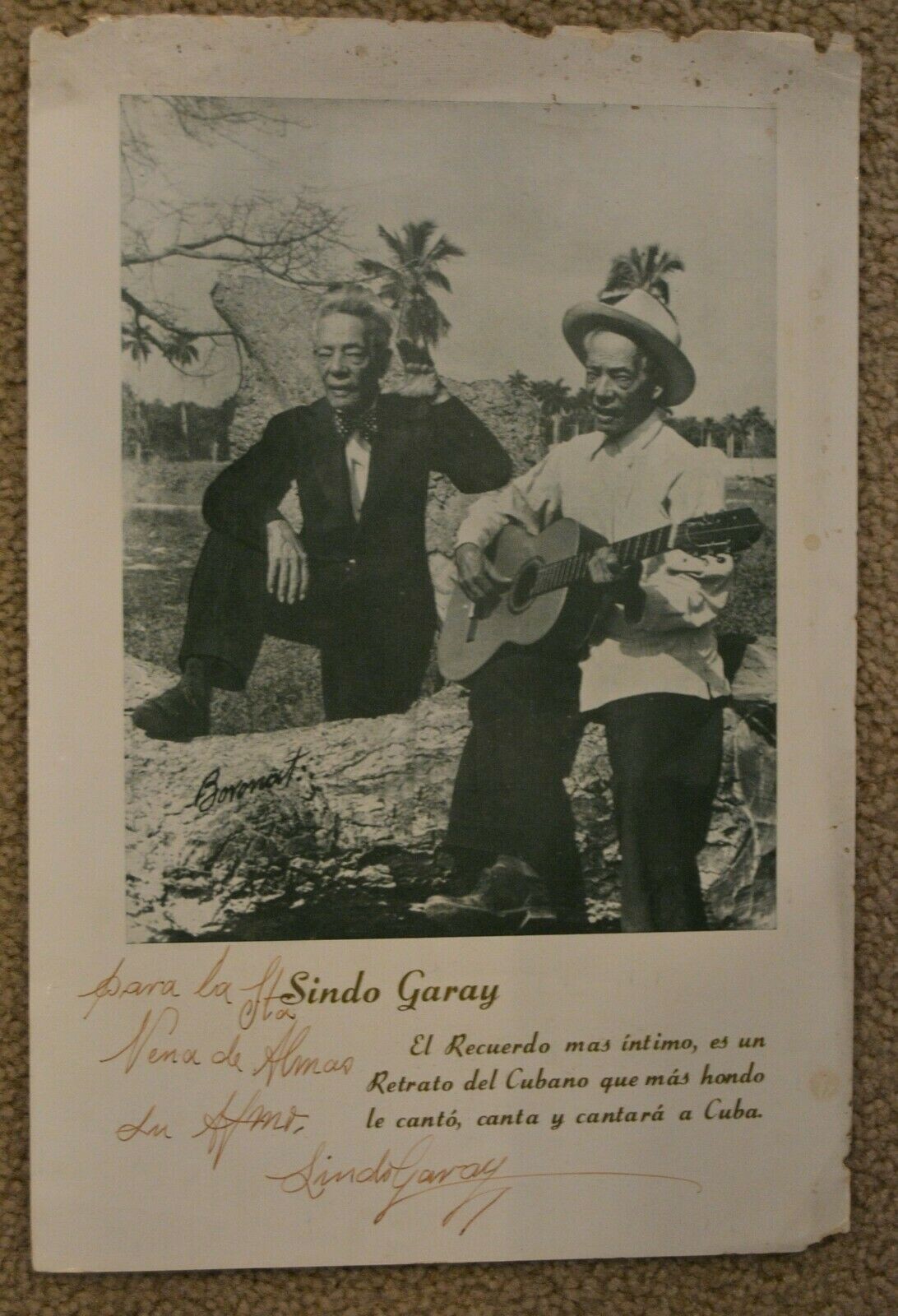
An extremely rare signed photo of Sindo Garay in fair shape measuring approximately 9 1/2 x 14 1/4 inches.Gray was one of the four greats of the trova
b. Antonio Gumersindo Garay y Garcia, April 12, 1867, Santiago de Cuba, Cuba, d. July 17, 1968, Havana, Cuba. A talented guitar player, Garay was an early influence on Compay Segundo who would later declare: \'The first person I heard playing guitar was Sindo Garay. He came to my home with a guitar. I liked the guitar. \' Garay\'s repertoire incorporated not only the expected influence of Spanish music but was also redolent of the musical forms that came originally from France and which were heard throughout the island. Untrained though he was, Garay clearly possessed an acute ear and absorbed all the music that he heard, whether played professionally at concerts and the opera, or less formally in bars and at street corners. Among the song forms incorporated into Garay\'s work are boleros, criollas, guarachas and bambucos. I wrote many songs,
Bitter truths (Sindo Garay)Guarina (Sindo Garay)La bayamesa or [Woman from bayamesa] (Sindo Garay)The afternoon (Sindo Garay)Bayamian woman or [La bayamesa] (Sindo Garay)Sea pearl (Sindo Garay)Returns (Sindo Garay)Fierce Torment (Sindo Garay)
The afternoon
(Sindo Garay)The light that burns in your eyesif you open them it dawnswhen you close it seemsthat the afternoon is dying.
The sorrows that mistreat methey are so many that they run overand they try to kill methey crowd each other and that\'s whydon\'t kill me.
Sindo Garay (Antonio Gumersindo Garay García, 1867-1968). Cuban guitarist, composer and troubadour. Top figure of the Cuban song expression.
Sindo Garay was born in Santiago de Cuba on April 12, 1869 and with only eight years old he could be seen collaborating with the Cuban insurrection as a courier for the liberating troops. He was an outstanding student of the Santiago troubadour José Pepe Sánchez, considered by important students of Cuban musical historiography as \"Father of the Cuban Trova\". From his childhood he met troubadour art in the warmth of his maternal home, because it was there that the most renowned singers and guitarists from Santiago de Cuba, including Pepe Sánchez, came together to organize lively peñas.
In 1879, during a short stay in the city of Guantánamo, he composed his first bolero, \"Quiéreme, trigueña\", dedicated to the young María Mestre.
In 1883 he learned the trade of trapeze artist and acrobat, and excelled as an excellent swimmer of qualities that allowed him to swim across the bay of Santiago de Cuba, bringing information to the Cuban insurrection.
Those actions in no way affected his passionate interest in cultivating the troubadour song in important batches of singers. He created in 1888, with greater care and harmonic elaboration, the song \"Germania\", dedicated to the pianist Germán Michaelsen, then Consul of Germany in Santiago de Cuba.
His gifts as a circus artist led him in 1894 to join a company that traveled to Haiti and the Dominican Republic. During his prolific stay in the Dominican Republic, he organized a musical group, of which he named the musician Manuel Cadete and trumpeter Manuel Duarte, both Dominicans. With this group he developed an intense artistic activity that he shared with the saddler trade.
In that country, composers Emilio Artes, Julio Monzón -director of the Banda de Puerto Plata- and Alberto Vázquez were linked. In a brief stay in the city of Dajabón, on the border of Haiti and Santo Domingo, he met the Apostle José Martí when he gave a farewell speech to the Dominican people. Years later he would remember that event when writing his song \"Semblanza a Martí\".
In Santiago de los Caballeros (Dominican Republic), he met Petronila Reyes Zamora, whom he joined by marital ties and was the mother of his five children: Eladio Guarionex (1901), María Guarina (1902), Julio Hatuey (1906), and Gumersindo Caonao (1910). In that city he composed a good number of boleros and songs, many of which had years later a high significance in his authorial catalog: \"A Mayarí\"; \"Before you, from the front, of fennel\"; \"Although the world sees you withered\"; \"Of thorns, flowers\"; \"Farewell\"; \"Contempt\"; \"Two beings who loved each other in life\"; \"Puerto Plata\"; \"You trembled with shock\" and \"Your face\".
In 1900 he returned to the homeland to settle in his native Santiago de Cuba. At that time he shared his life as a troubadour with that of a circus artist, and on a scale made by the circus in the city of Camagüey, inspired by the Cuban fighter Evangelina Cossío, he composed the song \"Evangelina\".
In 1903, when he traveled to the Cuban capital for the first time, he wandered as a troubadour through some Havana neighborhoods and frequented the portals of the historic Vista Alegre café, an enclave of worship for troubadours and poets of the early twentieth century. His boleros \"A Estela\" date from this stage; \"After twenty years\"; \"The afternoon\"; \"Sad hours\" and \"Dear Havana\".
At that time, cylinder recording technicians and phonograph records attended Havana; This is how some boleros and songs by Sindo Garay were recorded, performed by him and by other troubadours.
Between 1908 and 1909 he composed the boleros \"Labios de grana\", dedicated to Carmen Granados, and \"Yarini\", inspired by the figure of the legendary Havana pimp Alberto Yarini. His bolero \"Los tabaqueros\" also dates from that stage, a tribute to the historic union strike that was repressed by the government.
In 1910 he recorded for the American record label RCA Víctor, but some differences with the management of that house made him cancel his contracts. By then he composed his famous creole \"La perla marina\", which was not released until 1913, in a successful performance of the capital Martí theater.
In 1912 Sindo, who worked as an acrobat in the legendary Circus Pubillones, composed his famous key \"A Maceo\", inspired by the figure of Lieutenant General of the Liberation Army Antonio Maceo.
In that period, the political and social stability of Cuba suffered acute tensions due to the claim of equal social rights for black Cubans. The actions peaked in the insurrectional uprising known as the Movement of the Color Independents, bloody repressed by the army. Those events significantly affected the great troubadour from Santiago, who immediately downloaded his patriotic feelings on many of his creations on his guitar.
In 1913 he released his inspired boleros \"Sindo saber\" in the old café La Diana; \"My blackberry\"; \"Without your caresses\"; \"Pride\" and the beautiful Creole \"A Parlá\", inspired by the legendary Cuban aviator Agustín Parlá. In \"La Diana\", Sindo had the opportunity to meet the great pianist and dancer Antonio María Romeu, who by then, some commented, had lost his mind. Those comments inspired his anthology bolero \"El loco mayor\".
In that same year he traveled to Mexico as part of the cast of the Pubillones circus and established contacts with some composers and artists such as the famous tenor Mario Talavera, as well as prominent Yucatecan troubadours, until he left his mark on that peninsula.
Upon his return to Cuba, he continued to earn a living as an acrobat in the Lowande, Tatalí, Silvani and other circuses that toured the provinces with more or less success. At the end of these trips he could be found in some clubs led by the composer and musicologist Eduardo Sánchez de Fuentes and the composer José Marín Varona; Both musicians had a deep admiration for the work of the great oriental troubadour, and they even transcribed some of their pieces for the publishers Excelsior Music Co. and Typographic Musical; with this last one Sindo printed the bolero \"La Alondra\".
During his new stay in Havana, around 1915, he suffered serious economic difficulties with his family, and decided to return to Santiago de Cuba. Everything indicates that, disappointed, he conceived his boleros \"Amargas verdades\", with verses by Pepe Elizondo, and \"Adiós a La Habana\", whose texts generated serious controversies with the also troubadours Manuel Corona and José Cardona, who immediately riposted into boleros and songs of their inspiration, to what they considered an ingratitude of the oriental troubadour to the city of Havana.
After his departure from Havana, with his guitar on his shoulder, he gave reins to a historic wandering, started in the city of Pinar del Río, which lasted to the most remote places in the east of the country. He met in the city of Cienfuegos with the great Spanish guitarist and concert player Vicente Gelabert, and from that meeting arose the admiration of the great European artist for the work and style of performer of the oriental troubadour.
In 1918 he settled with his wife and children in the city of Bayamo, where he composed his famous bolero \"La bayamesa\", published on some phonographic records as \"Mujer bayamesa\".
In 1920 he decided to return to Havana; by then the country was immersed in the electoral processes that led Alfredo Zayas to the presidency. In the course of this political process, he was invited to sing and play with his son Guarionex at one of the parties organized by the candidate; There he sang for the first time his bolero The Prophecy, with a sharp criticism of the not honest handling of Cuban politics of those times.
Permanently settled in Havana, his temperament as a restless troubadour temporarily took him to Cienfuegos at a time when the great Italian tenor Enrico Caruso, then hired in Cuba to make ten presentations, was about to debut at the Terry Theater. Inexplicably, he managed to pass to the dressing room of the Italian divo and there, with his guitar and songs, he delighted the members of the company, including Caruso himself. Upon his return to Havana, with his overflowing inspiration, he created the boleros \"There are still Indians\", \"Descent\", \"Mermaid eyes\", \"It is already late\", \"From yesterday to today\"; \"From afar\", \"The hurricane and the palm\"; they are \"Life for the country\" and the rumba \"Lupisamba or Yuca y ñame\".
In the 1930s, some of his most famous boleros were premiered at the Cubanacán cabaret and the Norma Theater, and he was presented with his son Guarionex by the Sociedad Pro Arte Musical at the aristocratic Auditorium theater.
In 1940 the Corporate Council of Education, Health and Charity published an album with twelve of his compositions. Sometime later, the Havana City Council conferred on him the commemorative medal for the Centennial of the Birth of Antonio Maceo.
In 1946, Professor Argeliers León invited him to illustrate a Cuban music course at the University of Havana. In that year he recorded part of his work on one hundred and fifty acetate plates in the studios of the RHC Cadena Azul station. In the same year he was declared Adoptive Son of Bayamo, and in that environment he released his anthological song Los Bayameses.
In the course of 1959, after the triumph of the Cuban revolution, he composed his last work, symbolically titled \"Lyrical Testament\"; thereafter it enjoyed recognition and decorous status. The musicologist Odilio Urfé invited him in 1962 to participate in the First Cuban Popular Music Festival, where he received recognition from the Cuban people. On the occasion of its centenary, the Arts and Entertainment Union developed a cycle of tributes and recognitions.
He died in Havana on July 17, 1968.Bibliography
Adam, Orestes: \"Things I lived with Sindo Garay\". in Revolución y Cultura Magazine, no.8: pp. 50-51, Havana, August, 1989.
Álvarez Ríos, María: \"Honors and disappointments of Sindo Garay\". in Bohemia Magazine, Havana, April 17, 1955.
Fernández, Olga: \"Sindo Garay, the most troubadour\". in Revolución y Cultura Magazine, year 5: pp. 50-53; Havana, May, 1987.
González-Rubiera, Vicente: Unreleased recordings of interviews carried out in the eighties.
León, Carmela de: Sindo Garay: memories of a troubadour. Cuban Letters Publishing, Havana, 1990.
Muguercia, Alberto: \"Sindo Garay. A daring of the devil\". Our Musicians Series, no. 3, «José Martí» National Library, Havana, 1985.
Pérez Sanjurjo, Elena: History of Cuban Music. The Modern Poetry, INC, Miami, 1986.
Urfé, Odilio: \"Notes for an assessment of the great Cuban troubadour Sindo Garay\". in El Caimán Barbudo Magazine, no. 167: pp. 16-18; Havana, October, 1976.Antonio Gumersindo Garay y García, well-known as Sindo Garay (Santiago de Cuba, April 12 1867 - July 17 1968) was a Cuban musician that, even without having academic formation, he has managed to win an excellent place in the traditional trova.He was creator of more than 600 works that depict the Cuban idiosyncrasy; among his themes he highlight his admiration for the homeland, landscapes, women and love.Sindo GarayAmong his creations we find: Bitter Truths, Bayamian Woman, Guarina, The Afternoon, Pearl, Return, and Fierce Torment.Several of his creations have a political content.During his childhood I acted like link of the mambí colonel José Maceo.Also for then he knew to José Martí, for what he would include in his repertoire the poem Semblanza de Martí, based on the meeting that he had with the same one.Outstanding and noted Sindo Garay died in the second half from the XX century with 101 year old.
Antonio Gumersindo Garay y García, known as Sindo Garay was a Cuban musician who, even without academic training, knew how to earn an outstanding place in the traditional trova.
He was the creator of more than 600 works that portray the Cuban idiosyncrasy; His themes include his admiration for his homeland, landscapes, women and love. Among his creations we find: Bitter Truths, Bayamian Woman, Guarina, The Afternoon, Pearl, Return and Fierce Torment.
Content[hide]1 Biographical synthesis2 His influence3 Works4 SourcesBiographical synthesisSindo Garay was born on April 12, 1867, in Santiago de Cuba. At home, very poor, however, the charm of music was never lacking. \"In my house there was always one, two and even three guitars, not counting those of mom and dad.\"
The troubadour even remembers that his mother slept him as a child singing La Bayamesa, de Céspedes, Castillo and Fornaris. Years later, in 1918, Sindo would bequeath Cuban musical history his own Bayamesa Woman.
In his childhood years, at the height of the first war against the Spanish colony, more than once he carried important messages from the Cuban patriots. The anecdote is famous that as a teenager he crossed the bay of Santiago de Cuba, one of the largest in the country, several times, with orders and documents from Cuban workers against Spain.Sindo GarayOne day he dared to take the guitar of one of the habitual assistants to the discharges troveras of his home and began to try to imitate what he saw his elders do. A couple of scolding and a couple of tries until a knock on the door interrupts him. He was precisely the owner of the guitar, nothing more and nothing less than Pepe Sánchez, who immediately learned of the \"robbery\", wanted to listen to the boy\'s discoveries. Those minimal chords aroused his emotion and a hug sealed the certainty that an artist had been born.\"With how great Pepe Sánchez was, and I, a bladder, could touch the fibers of his sensibility! He was the only teacher I had in my life (...) he has to appear as a precursor to the Cuban trova.\"The years have proved this location right.
At age 16 the first guitar would arrive, given away by his brother. At the same age, he would begin to self-literate by not being able to answer a girl\'s love letter. The songs had already appeared; At just 12 years old, the first \"sindada\" was born on the banks of the Guaso River: a musical quatrain to remember a woman. About his life it is worth saying that Sindo learned all kinds of circus stunts and that more than once he earned a living with that work. On the other hand, he never learned a musical note, however his works have been considered by prestigious as lessons in harmony and composition and he received and receives many accolades for his incredible ability as a creator. As a joke, the troubadour said that his name was a sign of his musical ignorance: Sin-Do, and that sin Do composed.
A life as long as this man had, 101 years despite the rum and the smoke, leaves great memories. Sindo Garay met many important personalities. As a very young boy, Guillermón Moncada used to sit him on his legs to hear him sing along with his sister, very young too. And throughout his life he met among others the great violinist Brindis de Salas, the tenor Caruso, Julio Antonio Mella and is probably the only one who had the opportunity to shake the hands of José Martí and later those of Fidel Castro. Of his many creations it would be worth leaving a couple of notes on some of them.
La Bayamesa, a title widely used by various Cuban authors in countless works, is perhaps his best-known song. Sindo says that after a night of serenade, when he woke up at a friend\'s house, in whose patio there was a wall still blackened by the Bayamo fire, he was struck by inspiration and right there, on a simple cartridge paper he wrote down the verses of his immortal work. Guitar through would come later the melody. Paradoxically, the premiere of this song was for the box office and the pianist of the Bayamo cinema-theater, the only attendees that night.
In July 1968, exactly on the 17th, the greatest troubadour of this land of minstrels died at the age of 101. The trova festival of that year was dedicated to his memory and his Bayamesa repeatedly resounded in the voices of many different troubadours. At his impressive funeral, cigars and cigars were lit because Sindo had asked for it.
There is nothing like feeding the memory of those who left the work of life well done. Tributes and calendars are not necessary to let respect float and remember those who planted our history and culture. Sindo Garay must have rum in hand and song at the ready strolling serenades anywhere in the times. Thanks to his work we have one more step from which to continue inventing melodies, a light that does not stop burning in many eyes. And since then, every time a guitar with poetry playing between its strings, some mischievous troubadour smile lights up after the air and takes a drink to the trova\'s health.
His influenceUnaware of the most elementary formal technical notions of music, he created, however, musical works consideredSindo\'s compositions are jewels of traditional Cuban songwriting..jpg
perfect. The oriental bolero had its best exponent in Sindo, since it imposed its peculiar style with the scratching of the guitar strings to close the musical phrases and the rhythmic base with the so-called Cuban cinquillo.Like almost all the cultists of the trova, Sindo also worked the song and did it with rhythmic freedom, although he has to his credit some other creole, guaracha, some bambuco influenced by the Colombian work, and when he spoke of his peculiar style, I he was referring precisely to his original way of handling these forms.
An overwhelming majority of Sindo\'s songs and boleros cannot even be imagined apart from the second voice of the melody, or the \'second\' as he called it. He said that the third parties \'fell alone\', he always looked for solutions starting from the sixth interval. If we consider the freedom with which he handled the fundamental basses on the guitar, it is not strange that harmonic modulations of the most contemporary ones occurred. Undoubtedly, as Stravinsky said, when a creator is both an effective interpreter, he is in a good position to invoice his work as he conceived it. Such was the case of our troubadour. Sindo\'s handling of nuances and the dynamics of his own creations is another of his peculiar features.
Influences of opera are also recognized in his music. Due to the reference dates, at the end of the 19th century, it cannot be another opera than the Italian one, brought to Cuba by the French emigration, or by the companies that passed through the current Teatro Oriente, in Santiago de Cuba, when Sindo was a teenager. On the other hand, in one way or another, something drank from the source of the lied: in songs like Germania or Guarina you breathe a certain breath from the cultured songs of the romantic and post-romantic Europeans.
Sindo Garay was a popular genius, and the most incredible thing is that all the Cuban music that oozes his work he learned in life, he made it in his head, his throat and his hands on the guitar. For him, a ruled paper with musical notes had no more meaning than that of a mysterious indecipherable hieroglyph. Only from his inordinate sensitivity and ability to synthesize and rework sound events, could he, from his ignorance of formal musical technique, do the works he did.
The juggler, who had been singing to his homeland for 89 years, has a congregation of troubadours and friends every July 17 before the sober pantheon in the Bayamo necropolis. There we left new flowers on the slab, and in the air, the notes of the song that would immortalize that city, its land, its people, its work.
PlaysHe made frequent use of the colors, in a way as correct as surprising. He formed with Villalón, Ruiz and Corona, the group of the greats of the trova. In 1928 he traveled to Paris, along with Rita Montaner and other Cuban musicians, there he spent three months doing Havana programs. He recorded infinity of discs. His lyrics reveal poetic beauty. It was a remarkable second voice. He received countless tributes and recognitions after the Triumph of the Revolution. Among his most important compositions are \"The afternoon\", \"Pearl of the sea\", \"Rendered\", \"Lips of red\", \"Clave a Maceo\", \"Returns\", \"La baracoesa\", \"Goodbye to Havana\", \"Woman bayamesa ”,“ La lark ”,“ The hurricane and the palm ”,“ Fermania ”,“ Rayos de oro ”,“ Tardes grises ”,“ Ojos de sirena ”and“ Guarina ”.
His talent as a troubadour made him climb to the top of traditional trova in Santiago de Cuba, Cuba and the world. The Excelencias Group invites you to learn more about the life and work of musician Antonio Gumersindo Garay y Garcia, known as Sindo Garay. Click on Santiago de Cuba: A City of 500 Years He was born on April 12, 1867 at the hot land and it looked like if he would live forever, death wouldn\'t reach him. Sindo Garay lived 101 years, a genuine troubadour that sang to his homeland, women, landscapes and the most universal of all feelings: love. Sindo Garay lived in a humble environment, but music was always around him. He always recalled how his mother used to sing “La Bayamesa”, a theme that inspired him 1918 to write “Mujer Bayamesa”. The list of songs written by Sindo Garay includes such titles as “Amargas Verdades”, “Labios de Grana”, \"Clave a Maceo\", \"Guarina\", \"Ojos de Sirena\", \"La Tarde\", \"La Alondra\", \"El Huracán y la Palma\", \"Perla Marina\", \"Retorna\" \"Tardes Grises\" and \"Tormento Fiero \" His works are described as valuable lessons of harmony and composition, and they have been praised by the critics. Gumersindo didn\'t have an academic musical education, however, I have learned circus acrobatics and that was how I have made a living in different moments of his life. Sindo Garay wasn\'t a tall man, but he was big through the lyrics of his songs. He always loved walking and used to show up in any bar, square or family party and delight people with his music. On the other hand, in the late 19th century I have traveled to Santo Domingo, Puerto Rico and some other South American countries. I have visited Paris in 1928, along with Rita Montaner and other Cuban musicians. Beyond music, his family was one of Garay\'s passions. He had five children with his wife, Petronila Reyes Zamora, and he gave them indigenous names: Guarionex, Guarina, Hatuey, Caonao and Anacaona respectively. Sindo Garay had an exceptional professor: Pepe Sanchez. One day he took the guitar of the Father of Latin American Bolero and I played some notes. That was the beginning of a lifetime friendship. This long-lived man had the opportunity to meet such figures as Guillermon Moncada, violinist Brindis de Salas, tenor Caruso, Julio Antonio Mella, Jose Marti and Fidel Castro. The great Sindo Garay passed away on July 17, 1968. Pepe Sanchez. One day he took the guitar of the Father of Latin American Bolero and I played some notes. That was the beginning of a lifetime friendship. This long-lived man had the opportunity to meet such figures as Guillermon Moncada, violinist Brindis de Salas, tenor Caruso, Julio Antonio Mella, Jose Marti and Fidel Castro. The great Sindo Garay passed away on July 17, 1968. Pepe Sanchez. One day he took the guitar of the Father of Latin American Bolero and I played some notes. That was the beginning of a lifetime friendship. This long-lived man had the opportunity to meet such figures as Guillermon Moncada, violinist Brindis de Salas, tenor Caruso, Julio Antonio Mella, Jose Marti and Fidel Castro. The great Sindo Garay passed away on July 17, 1968.
Sindo GaraySindo Garay (born Antonio Gumersindo Garay Garcia; Santiago de Cuba, 12 April 1867 - Havana, 17 July 1968) was Cuban trova musician. He was taught by Pepe Sánchez. Garay was one of the four greats of the trova. He was Spanish and Arawakan descendant.
Life & workGaray was the most outstanding composer of trova songs, and his best have been sung and recorded many times. Perla marina, Adios a La Habana, Mujer bayamesa, El huracan y la palma, Guarina and many others are now part of Cuba\'s heritage. Garay was also musically illiterate - in fact, he only taught himself the alphabet at 16 - but in his case not only were scores transcribed by others, but there are recordings as well.Guarionex and Sindo Garay, 1906For a long period he sang in a duo with his eldest son Guarionex; he had two other sons and a daughter, and gave them all Indian names.
In the 1890s Garay got involved in the Cuban War of Independence, and decided to stay in Hispaniola (Haiti and Dominican Republic) would be a good idea. It was, and he came back with a wife. Garay settled in Havana in 1906, and in 1926 joined Rita Montaner and others to visit Paris, spending three months there singing his songs. He broadcast on radio, made recordings and survived into modern times. He used to say \"Not many men have shaken hands with both Jose Marti and Fidel Castro!\" Carlos Puebla, whose life spanned the old and the new trova, told a good joke about him: \"Sindo celebrated his 100th birthday several times - in fact, whenever he was short of money!\" [1] [2]
Cuba,[c] officially the Republic of Cuba,[d] is an island country, comprising the island of Cuba (largest island), Isla de la Juventud, and 4,195 islands, islets and cays surrounding the main island. It is located where the northern Caribbean Sea, Gulf of Mexico, and Atlantic Ocean meet. Cuba is located east of the Yucatán Peninsula (Mexico), south of both Florida and the Bahamas, west of Hispaniola (Haiti/Dominican Republic), and north of Jamaica and the Cayman Islands. Havana is the largest city and capital. Cuba is the third-most populous country in the Caribbean after Haiti and the Dominican Republic, with about 10 million inhabitants. It is the largest country in the Caribbean by area.
The territory that is now Cuba was inhabited as early as the 4th millennium BC, with the Guanahatabey and Taíno peoples inhabiting the area at the time of Spanish colonization in the 15th century.[16] It was then a colony of Spain, through the abolition of slavery in 1886, until the Spanish–American War of 1898, when Cuba was occupied by the United States and gained independence in 1902. In 1940, Cuba implemented a new constitution, but mounting political unrest culminated in the 1952 Cuban coup d\'état and the subsequent dictatorship of Fulgencio Batista.[17] The Batista government was overthrown in January 1959 by the 26th of July Movement during the Cuban Revolution. That revolution established communist rule under the leadership of Fidel Castro.[18][19] The country was a point of contention during the Cold War between the Soviet Union and the United States, and nuclear war nearly broke out during the Cuban Missile Crisis of 1962. Following the dissolution of the Soviet Union, Cuba faced a severe economic downturn in the 1990s, known as the Special Period. In 2008, Fidel Castro retired after 49 years; Raúl Castro was elected his successor. Raúl Castro retired as president in 2018 and Miguel Díaz-Canel was elected president by the National Assembly following parliamentary elections. Raúl Castro retired as First Secretary of the Communist Party in 2021 and Díaz-Canel was elected.
Cuba is a socialist state, in which the role of the Communist Party is enshrined in the Constitution. Cuba has an authoritarian government where political opposition is not permitted.[20][21] Censorship is extensive and independent journalism is repressed;[22][23][24] Reporters Without Borders has characterized Cuba as one of the worst countries for press freedom.[25][24] Culturally, Cuba is considered part of Latin America.[26] It is a multiethnic country whose people, culture and customs derive from diverse origins, including the Taíno Ciboney peoples, the long period of Spanish colonialism, the introduction of enslaved Africans and a close relationship with the Soviet Union during the Cold War.
Cuba is a founding member of the United Nations, G77, Non-Aligned Movement, Organisation of African, Caribbean and Pacific States, ALBA, and Organization of American States. It has one of the world\'s few planned economies, and its economy is dominated by tourism and the exports of skilled labor, sugar, tobacco, and coffee. Cuba has historically—before and during communist rule—performed better than other countries in the region on several socioeconomic indicators, such as literacy,[27][28] infant mortality and life expectancy. Cuba has a universal health care system which provides free medical treatment to all Cuban citizens,[29][30] although challenges include low salaries for doctors, poor facilities, poor provision of equipment, and the frequent absence of essential drugs.[31][32] A 2023 study by the Cuban Observatory of Human Rights (OCDH), estimated 88% of the population is living in extreme poverty.[33] The traditional diet is of international concern due to micronutrient deficiencies and lack of diversity. As highlighted by the World Food Programme (WFP) of the United Nations, rationed food meets only a fraction of daily nutritional needs for many Cubans, leading to health issues.[34]
EtymologyHistorians believe the name Cuba comes from the Taíno language; however, \"its exact derivation [is] unknown\".[35] The exact meaning of the name is unclear, but it may be translated either as \'where fertile land is abundant\' (cubao),[36] or \'great place\' (coabana).
HistoryMain articles: History of Cuba and Timeline of Cuban historyPre-Columbian eraHumans first settled Cuba around 6,000 years ago, descending from migrations from northern South America or Central America.[37] The arrival of humans on Cuba is associated with extinctions of the islands native fauna, particularly its endemic sloths.[38] The Arawakan-speaking ancestors of the Taíno people arrived in the Caribbean in a separate migration from South America around 1,700 years ago. Unlike the previous settlers of Cuba, the Taíno extensively produced pottery and engaged in intensive agriculture.[37] The earliest evidence of the Taíno people on Cuba dates to the 9th century AD.[39] Descendants of the first settlers of Cuba persisted on the western part of the island until Columbian contact, where they were recorded as the Guanahatabey people, who lived a hunter gatherer lifestyle.[40][37]
Spanish colonization and rule (1492–1898)Main articles: Governorate of Cuba and Captaincy General of CubaAfter first landing on an island then called Guanahani on 12 October 1492,[41] Christopher Columbus landed on Cuba on 27 October 1492, and landing in the northeastern coast on 28 October.[42] Columbus claimed the island for the new Kingdom of Spain[43] and named it Isla Juana after John, Prince of Asturias.[44]Diego Velázquez de Cuéllar, conquistador of CubaIn 1511, the first Spanish settlement was founded by Diego Velázquez de Cuéllar at Baracoa. Other settlements soon followed, including San Cristobal de la Habana, founded in 1514 (southern coast of the island) and then in 1519 (current place), which later became the capital (1607). The Indigenous Taíno were forced to work under the encomienda system,[45] which resembled the feudal system in medieval Europe.[46] Within a century, the Indigenous people faced high incidence of mortality due to multiple factors, primarily Eurasian infectious diseases, to which they had no natural resistance (immunity), aggravated by the harsh conditions of the repressive colonial subjugation.[47] In 1529, a measles outbreak killed two-thirds of those few Natives who had previously survived smallpox.[48][49]
On 18 May 1539, conquistador Hernando de Soto departed from Havana with some 600 followers into a vast expedition through the American Southeast, in search of gold, treasure, fame and power.[50] On 1 September 1548, Gonzalo Perez de Angulo was appointed governor of Cuba. He arrived in Santiago, Cuba, on 4 November 1549, and immediately declared the liberty of all Natives.[51] He became Cuba\'s first permanent governor to reside in Havana instead of Santiago, and he built Havana\'s first church made of masonry.[52][e]A map of Cuba, c. 1680By 1570, most residents of Cuba comprised a mixture of Spanish, African, and Taíno heritages.[54] Cuba developed slowly and, unlike the plantation islands of the Caribbean, had a diversified agriculture. Most importantly, the colony developed as an urbanized society that primarily supported the Spanish colonial empire. By the mid-18th century, there were 50,000 slaves on the island, compared to 60,000 in Barbados and 300,000 in Virginia; as well as 450,000 in Saint-Domingue, all of which had large-scale sugarcane plantations.[55]
The Seven Years\' War, which erupted in 1754 across three continents, eventually arrived in the Spanish Caribbean. Spain\'s alliance with the French pitched them into direct conflict with the British, and in 1762, a British expedition consisting of dozens of ships and thousands of troops set out from Portsmouth to capture Cuba. The British arrived on 6 June, and by August, had placed Havana under siege.[56] When Havana surrendered, the admiral of the British fleet, George Pocock and the commander of the land forces George Keppel, the 3rd Earl of Albemarle, entered the city, and took control of the western part of the island. The British immediately opened up trade with their North American and Caribbean colonies, causing a rapid transformation of Cuban society.[56]A painting of the British capture of Havana in 1762Though Havana, which had become the third-largest city in the Americas, was to enter an era of sustained development and increasing ties with North America during this period, the British occupation of the city proved short-lived. Pressure from London on sugar merchants, fearing a decline in sugar prices, forced negotiations with the Spanish over the captured territories.[clarification needed] Less than a year after Britain captured Havana, it signed the 1763 Treaty of Paris together with France and Spain, ending the Seven Years\' War. The treaty gave Florida to Britain in exchange for Cuba.[f] Cubans constituted one of the many diverse units which fought alongside Spanish and Floridan forces during the conquest of British-controlled West Florida (1779–81).
The largest factor for the growth of Cuba\'s commerce in the late eighteenth and early nineteenth century was the Haitian Revolution. When the enslaved peoples of what had been the Caribbean\'s richest colony freed themselves through violent revolt, Cuban planters perceived the region\'s changing circumstances with both a sense of fear and opportunity. They were afraid because of the prospect that slaves might revolt in Cuba as well, and numerous prohibitions during the 1790s of the sale of slaves in Cuba who had previously been enslaved in French colonies underscored this anxiety. The planters saw opportunity, however, because they thought that they could exploit the situation by transforming Cuba into the slave society and sugar-producing \"pearl of the Antilles\" that Haiti had been before the revolution.[57] As the historian Ada Ferrer has written, \"At a basic level, liberation in Saint-Domingue helped entrench its denial in Cuba. As slavery and colonialism collapsed in the French colony, the Spanish island underwent transformations that were almost the mirror image of Haiti\'s.\"[58] Estimates suggest that between 1790 and 1820 some 325,000 Africans were imported to Cuba as slaves, which was four times the amount that had arrived between 1760 and 1790.[59]Slaves in Cuba unloading ice from Maine, c. 1832Although a smaller proportion of the population of Cuba was enslaved, at times, slaves arose in revolt. In 1812, the Aponte Slave Rebellion took place, but it was ultimately suppressed.[60] The population of Cuba in 1817 was 630,980 (of which 291,021 were white, 115,691 were free people of color (mixed-race), and 224,268 black slaves).[61][g]19th century view of HavanaIn part due to Cuban slaves working primarily in urbanized settings, by the 19th century, the practice of coartacion had developed (or \"buying oneself out of slavery\", a \"uniquely Cuban development\"), according to historian Herbert S. Klein.[63] Due to a shortage of white labor, blacks dominated urban industries \"to such an extent that when whites in large numbers came to Cuba in the middle of the nineteenth century, they were unable to displace Negro workers.\"[55] A system of diversified agriculture, with small farms and fewer slaves, served to supply the cities with produce and other goods.[55]
In the 1820s, when the rest of Spain\'s empire in Latin America rebelled and formed independent states, Cuba remained loyal to Spain. Its economy was based on serving the empire. By 1860, Cuba had 213,167 free people of color (39% of its non-white population of 550,000).[55][h]
Independence movements
Carlos Manuel de Céspedes is known as Father of the Homeland in Cuba, having declared its independence from Spain in 1868.[i]Full independence from Spain was the goal of a rebellion in 1868 led by planter Carlos Manuel de Céspedes. De Céspedes, a sugar planter, freed his slaves to fight with him for an independent Cuba. On 27 December 1868, he issued a decree condemning slavery in theory but accepting it in practice and declaring free any slaves whose masters present them for military service.[64] The 1868 rebellion resulted in a prolonged conflict known as the Ten Years\' War. A great number of the rebels were volunteers from the Dominican Republic,[j] and other countries, as well as numerous Chinese indentured servants.[66][k][l]Calixto García, a general of Cuban separatist rebels (right) with U.S. Brigadier General William Ludlow (Cuba, 1898)The United States declined to recognize the new Cuban government, although many European and Latin American nations did so.[69] In 1878, the Pact of Zanjón ended the conflict, with Spain promising greater autonomy to Cuba.[m] In 1879–80, Cuban patriot Calixto García attempted to start another war known as the Little War but failed to receive enough support.[71] Slavery in Cuba was abolished in 1875 but the process was completed only in 1886.[72][73] An exiled dissident named José Martí founded the Cuban Revolutionary Party in New York City in 1892. The aim of the party was to achieve Cuban independence from Spain.[74] In January 1895, Martí traveled to Monte Cristi and Santo Domingo in the Dominican Republic to join the efforts of Máximo Gómez.[74] Martí recorded his political views in the Manifesto of Montecristi.[75] Fighting against the Spanish army began in Cuba on 24 February 1895, but Martí was unable to reach Cuba until 11 April 1895.[74] Martí was killed in the Battle of Dos Rios on 19 May 1895.[74] His death immortalized him as Cuba\'s national hero.[75]Cuban victims of Spanish reconcentration policiesAround 200,000 Spanish troops outnumbered the much smaller rebel army, which relied mostly on guerrilla and sabotage tactics. The Spaniards began a campaign of suppression. General Valeriano Weyler, the military governor of Cuba, herded the rural population into what he called reconcentrados, described by international observers as \"fortified towns\". These are often considered the prototype for 20th-century concentration camps.[76] Between 200,000[77] and 400,000 Cuban civilians died from starvation and disease in the Spanish concentration camps, numbers verified by the Red Cross and United States Senator Redfield Proctor, a former Secretary of War. American and European protests against Spanish conduct on the island followed.[78]
The U.S. battleship USS Maine was sent to protect American interests, but soon after arrival, it exploded in Havana harbor and sank quickly, killing nearly three-quarters of the crew. The cause and responsibility for the sinking of the ship remained unclear after a board of inquiry. Popular opinion in the U.S., fueled by active yellow press, concluded that the Spanish were to blame and demanded action.[79] Spain and the United States declared war on each other in late April 1898.[n][o]
Republic (1902–1959)Main article: Republic of Cuba (1902–1959)First years (1902–1925)
Raising the Cuban flag on the Governor General\'s Palace at noon on 20 May 1902After the Spanish–American War, Spain and the United States signed the Treaty of Paris (1898), by which Spain ceded Puerto Rico, the Philippines, and Guam to the United States for the sum of US$20 million[84] and Cuba became a protectorate of the United States. Cuba gained formal independence from the U.S. on 20 May 1902, as the Republic of Cuba.[85] Under Cuba\'s new constitution, the U.S. retained the right to intervene in Cuban affairs and to supervise its finances and foreign relations. Under the Platt Amendment, the U.S. leased the Guantánamo Bay Naval Base from Cuba.
Following disputed elections in 1906, the first president, Tomás Estrada Palma, faced an armed revolt by independence war veterans who defeated the meager government forces.[86] The U.S. intervened by occupying Cuba and named Charles Edward Magoon as Governor for three years. Cuban historians have characterized Magoon\'s governorship as having introduced political and social corruption.[87] In 1908, self-government was restored when José Miguel Gómez was elected president, but the U.S. continued intervening in Cuban affairs. In 1912, the Partido Independiente de Color attempted to establish a separate black republic in Oriente Province,[88] but was suppressed by General Monteagudo with considerable bloodshed.
In 1924, Gerardo Machado was elected president.[89] During his administration, tourism increased markedly, and American-owned hotels and restaurants were built to accommodate the influx of tourists.[89] The tourist boom led to increases in gambling and prostitution in Cuba.[89] The Wall Street Crash of 1929 led to a collapse in the price of sugar, political unrest, and repression.[90] Protesting students, known as the Generation of 1930, turned to violence in opposition to the increasingly unpopular Machado.[90] A general strike (in which the Communist Party sided with Machado),[91] uprisings among sugar workers, and an army revolt forced Machado into exile in August 1933. He was replaced by Carlos Manuel de Céspedes y Quesada.[90]
Revolution of 1933–1940
The Pentarchy of 1933. Fulgencio Batista, who controlled the armed forces, appears at far rightIn September 1933, the Sergeants\' Revolt, led by Sergeant Fulgencio Batista, overthrew Céspedes.[92] A five-member executive committee (the Pentarchy of 1933) was chosen to head a provisional government.[93] Ramón Grau San Martín was then appointed as provisional president.[93] Grau resigned in 1934, leaving the way clear for Batista, who dominated Cuban politics for the next 25 years, at first through a series of puppet-presidents.[92] The period from 1933 to 1937 was a time of \"virtually unremitting social and political warfare\".[94] On balance, during the period 1933–1940 Cuba suffered from fragile political structures, reflected in the fact that it saw three different presidents in two years (1935–1936), and in the militaristic and repressive policies of Batista as Head of the Army.
Constitution of 1940A new constitution was adopted in 1940, which engineered radical progressive ideas, including the right to labor and health care.[95] Batista was elected president in the same year, holding the post until 1944.[96] He is so far the only non-white Cuban to win the nation\'s highest political office.[97][98][99] His government carried out major social reforms. Several members of the Communist Party held office under his administration.[100] Cuban armed forces were not greatly involved in combat during World War II—though president Batista did suggest a joint U.S.-Latin American assault on Francoist Spain to overthrow its authoritarian regime.[101] Cuba lost six merchant ships during the war, and the Cuban Navy was credited with sinking the German submarine U-176.[102]
Batista adhered to the 1940 constitution\'s strictures preventing his re-election.[103] Ramon Grau San Martin was the winner of the next election, in 1944.[96] Grau further corroded the base of the already teetering legitimacy of the Cuban political system, in particular by undermining the deeply flawed, though not entirely ineffectual, Congress and Supreme Court.[104] Carlos Prío Socarrás, a protégé of Grau, became president in 1948.[96] The two terms of the Auténtico Party brought an influx of investment, which fueled an economic boom, raised living standards for all segments of society, and created a middle class in most urban areas.[105]
Coup d\'état of 1952
Slum (bohío) dwellings in Havana, Cuba in 1954, just outside Havana baseball stadium. In the background is advertising for a nearby casino.After finishing his term in 1944 Batista lived in Florida, returning to Cuba to run for president in 1952. Facing certain electoral defeat, he led a military coup that preempted the election.[106] Back in power, and receiving financial, military, and logistical support from the United States government, Batista suspended the 1940 Constitution and revoked most political liberties, including the right to strike. He then aligned with the wealthiest landowners who owned the largest sugar plantations, and presided over a stagnating economy that widened the gap between rich and poor Cubans.[107] Batista outlawed the Cuban Communist Party in 1952.[108] After the coup, Cuba had Latin America\'s highest per capita consumption rates of meat, vegetables, cereals, automobiles, telephones and radios, though about one-third of the population was considered poor and enjoyed relatively little of this consumption.[109] However, in his \"History Will Absolve Me\" speech, Fidel Castro mentioned that national issues relating to land, industrialization, housing, unemployment, education, and health were contemporary problems.[110]
In 1958, Cuba was a well-advanced country in comparison to other Latin American regions.[111] Cuba was also affected by perhaps the largest labor union privileges in Latin America, including bans on dismissals and mechanization. They were obtained in large measure \"at the cost of the unemployed and the peasants\", leading to disparities.[112] Between 1933 and 1958, Cuba extended economic regulations enormously, causing economic problems.[97][113] Unemployment became a problem as graduates entering the workforce could not find jobs.[97] The middle class, which was comparable to that of the United States[how?], became increasingly dissatisfied with unemployment and political persecution. The labor unions, manipulated by the previous government since 1948 through union \"yellowness\", supported Batista until the very end.[97][98] Batista stayed in power until he resigned in December 1958 under the pressure of the US Embassy and as the revolutionary forces headed by Fidel Castro were winning militarily (Santa Clara city, a strategic point in the middle of the country, fell into the rebels hands on December 31, in a conflict known as the Battle of Santa Clara).[114][115]
Revolution and Communist Party rule (1959–present)
Che Guevara and Fidel Castro, photographed by Alberto Korda in 1961In the 1950s, various organizations, including some advocating armed uprising, competed for public support in bringing about political change.[116] In 1956, Fidel Castro and about 80 supporters landed from the yacht Granma in an attempt to start a rebellion against the Batista government.[116] In 1958, Castro\'s July 26th Movement emerged as the leading revolutionary group.[116] The U.S. supported Castro by imposing a 1958 arms embargo against Batista\'s government. Batista evaded the American embargo and acquired weapons from the Dominican Republic.[p]
By late 1958, the rebels had broken out of the Sierra Maestra and launched a general popular insurrection. After Castro\'s fighters captured Santa Clara, Batista fled with his family to the Dominican Republic on 1 January 1959. Later he went into exile on the Portuguese island of Madeira and finally settled in Estoril, near Lisbon. Fidel Castro\'s forces entered the capital on 8 January 1959. The liberal Manuel Urrutia Lleó became the provisional president.[122]
According to Amnesty International, official death sentences from 1959 to 1987 numbered 237 of which all but 21 were carried out.[123] The vast majority of those executed directly following the 1959 Revolution were policemen, politicians, and informers of the Batista regime accused of crimes such as torture and murder, and their public trials and executions had widespread popular support among the Cuban population.[124]Since 1959, Cuba has regarded the U.S. presence in Guantánamo Bay as illegal.[125]The United States government initially reacted favorably to the Cuban Revolution, seeing it as part of a movement to bring democracy to Latin America.[126] Castro\'s legalization of the Communist Party and the hundreds of executions of Batista agents, policemen, and soldiers that followed caused a deterioration in the relationship between the two countries.[126] The promulgation of the Agrarian Reform Law, expropriating thousands of acres of farmland (including from large U.S. landholders), further worsened relations.[126][127] In response, between 1960 and 1964 the U.S. imposed a range of sanctions, eventually including a total ban on trade between the countries and a freeze on all Cuban-owned assets in the U.S.[128] In February 1960, Castro signed a commercial agreement with Soviet Vice-Premier Anastas Mikoyan.[126]
In March 1960, U.S. President Dwight D. Eisenhower gave his approval to a CIA plan to arm and train a group of Cuban refugees to overthrow the Castro government. The invasion (known as the Bay of Pigs Invasion) took place on 14 April 1961, during the term of President John F. Kennedy.[127] About 1,400 Cuban exiles disembarked at the Bay of Pigs. Cuban troops and local militias defeated the invasion, killing over 100 invaders and taking the remainder prisoner.[127] In January 1962, Cuba was suspended from the Organization of American States (OAS), and later the same year the OAS started to impose sanctions against Cuba of similar nature to the U.S. sanctions.[129] The Cuban Missile Crisis of October 1962 almost sparked World War III.[130][131] In 1962 American generals proposed Operation Northwoods which would entail committing terrorist attacks in American cities and against refugees and falsely blaming the attacks on the Cuban government, manufacturing a reason for the United States to invade Cuba. This plan was rejected by President Kennedy.[132] By 1963, Cuba was moving towards a full-fledged communist system modeled on the USSR.[133]Fidel Castro and members of the East German Politburo in 1972During the Cold War, Cuban forces were deployed to all corners of Africa, either as military advisors or as combatants.[134] In 1963, Cuba sent 686 troops together with 22 tanks and other military equipment to support Algeria in the Sand War against Morocco.[135] The Cuban forces remained in Algeria for over a year, providing training to the Algerian army.[136] In 1964, Cuba organized a meeting of Latin American communists in Havana and stoked a civil war in the capital of the Dominican Republic in 1965, which prompted 20,000 U.S. troops to intervene there.[54] Che Guevara engaged in guerrilla activities in Africa and was killed in 1967 while attempting to start a revolution in Bolivia.[54] During the 1970s, Fidel Castro dispatched tens of thousands of troops in support of Soviet-backed wars in Africa. He supported the MPLA in Angola (Angolan Civil War) and Mengistu Haile Mariam in Ethiopia (Ogaden War).[137]Cuban Revolutionary Armed Forces (FAR) commanders in Angola during the Battle of Quifangondo
A Cuban-manned Soviet PT-76 in Luanda
Cuban artillery crew in Ethiopia during the Ogaden WarIn November 1975, Cuba deployed more than 65,000 troops and 400 Soviet-made tanks in Angola in one of the fastest military mobilizations in history.[138] South Africa developed nuclear weapons due to the threat to its security posed by the presence of large numbers of Cuban troops in Angola.[139] In 1976 and again in 1988 at the Battle of Cuito Cuanavale, the Cubans alongside their MPLA allies defeated UNITA rebels and apartheid South African forces.[140][q] In December 1977, Cuba sent its combat troops from Angola, the People\'s Republic of the Congo, and the Caribbean to Ethiopia,[136] assisted by mechanized Soviet battalions, to help defeat a Somali invasion. On 24 January 1978, Ethiopian and Cuban troops counterattacked, inflicting 3,000 casualties on the Somali forces.[136] In February, Cuban troops launched a major offensive and forced the Somali army back into its own territory.[136][142] Cuban forces remained in Ethiopia until 9 September 1989.[136]
Despite Cuba\'s small size and the long distance separating it from the Middle East, Castro\'s Cuba played an active role in the region during the Cold War. In 1972, a major Cuban military mission consisting of tank, air, and artillery specialists was dispatched to South Yemen. Cuban military advisors were sent to Iraq in the mid-1970s but their mission was canceled after Iraq invaded Iran in 1980.[136] The Cubans were also involved in the Syrian-Israeli War of Attrition (November 1973–May 1974) that followed the Yom Kippur War (October 1973).[143] Israeli sources reported the presence of a Cuban tank brigade in the Golan Heights, which was supported by two brigades.[144] The Israelis and the Cuban-Syrian tank forces engaged in battle on the Golan front.[145]: 37–38
The standard of living in the 1970s was \"extremely spartan\" and discontent was rife.[146] Fidel Castro admitted the failures of economic policies in a 1970 speech.[146] In 1975, the OAS lifted its sanctions against Cuba, with the approval of 16 member states, including the United States. The U.S., however, maintained its own sanctions.[129] In 1979, the U.S. objected to the presence of Soviet combat troops on the island.[54] Following the 1983 coup that resulted in the execution of Grenadian Prime Minister Maurice Bishop and establishment of the military government led by Hudson Austin, U.S. forces invaded Grenada in 1983, overthrowing the Government. Most resistance came from Cuban construction workers, while the Grenadan People\'s Revolutionary Army and militia surrendered without putting up much of a fight. 24 Cubans were killed, with only 2 of them being professional soldiers, and the remainder were expelled from the island. U.S. casualties amounted to 19 killed, 116 wounded, and 9 helicopters destroyed. During the 1970s and 1980s, Castro supported Marxist insurgencies in Guatemala, El Salvador, and Nicaragua. Cuba gradually withdrew its troops from Angola in 1989–91.[136] An important psychological and political aspect of the Cuban military involvement in Africa was the significant presence of black or mixed-race soldiers among the Cuban forces.[136][r] According to one source, more than 300,000 Cuban military personnel and civilian experts were deployed in Africa. The source also states that out of the 50,000 Cubans sent to Angola, half contracted AIDS and that 10,000 Cubans died as a consequence of their military actions in Africa.[136]Cuban leader Fidel Castro in Geneva, Switzerland, May 1998Soviet troops began to withdraw from Cuba in September 1991,[54] and Castro\'s rule was severely tested in the aftermath of the Soviet collapse in December 1991 (known in Cuba as the Special Period). The country faced a severe economic downturn following the withdrawal of Soviet subsidies worth $4 billion to $6 billion annually, resulting in effects such as food and fuel shortages.[148][149] The government did not accept American donations of food, medicines and cash until 1993.[148] On 5 August 1994, state security dispersed protesters in a spontaneous protest in Havana. From the start of the crisis until 1995, Cuba saw its gross domestic product (GDP) shrink by 35%. It took another five years for its GDP to reach pre-crisis levels.[150]
Cuba has since found a new source of aid and support in the People\'s Republic of China. In addition, Hugo Chávez, then president of Venezuela, and Evo Morales, former president of Bolivia, became allies and both countries are major oil and gas exporters. In 2003, the government arrested and imprisoned a large number of civil activists, a period known as the \"Black Spring\".[151][152]
In February 2008, Fidel Castro resigned as President of the State Council due to the serious gastrointestinal illness which he had suffered since July 2006.[153] On 24 February, the National Assembly elected his brother Raúl Castro the new president.[154] In his inauguration speech, Raúl promised that some of the restrictions on freedom in Cuba would be removed.[155] In March 2009, Raúl Castro removed some of his brother\'s appointees.[156]
On 3 June 2009, the Organization of American States adopted a resolution to end the 47-year ban on Cuban membership of the group.[157] The resolution stated, however, that full membership would be delayed until Cuba was \"in conformity with the practices, purposes, and principles of the OAS\".[129] Fidel Castro wrote that Cuba would not rejoin the OAS, which, he said, was a \"U.S. Trojan horse\" and \"complicit\" in actions taken by the U.S. against Cuba and other Latin American nations.[158]Raúl Castro and U.S. President Barack Obama at their joint press conference in Havana, Cuba, 21 March 2016Effective 14 January 2013, Cuba ended the requirement established in 1961, that any citizens who wish to travel abroad were required to obtain an expensive government permit and a letter of invitation.[159][160][161] In 1961 the Cuban government had imposed broad restrictions on travel to prevent the mass emigration of people after the 1959 revolution;[162] it approved exit visas only on rare occasions.[163] Requirements were simplified: Cubans need only a passport and a national ID card to leave; and they are allowed to take their young children with them for the first time.[164] However, a passport costs on average five months\' salary. Observers expect that Cubans with paying relatives abroad are most likely to be able to take advantage of the new policy.[165] In the first year of the program, over 180,000 left Cuba and returned. As of December 2014, talks with Cuban officials and American officials, including President Barack Obama, resulted in the release of Alan Gross, fifty-two political prisoners, and an unnamed non-citizen agent of the United States in return for the release of three Cuban agents currently imprisoned in the United States. Additionally, while the embargo between the United States and Cuba was not immediately lifted, it was relaxed to allow import, export, and certain limited commerce.[166]
Raúl Castro stepped down from the presidency on 19 April 2018 and Miguel Díaz-Canel was elected president by the National Assembly following parliamentary elections. Raúl Castro remained the First Secretary of the Communist Party and retained broad authority, including oversight over the president.[167]
Cuba approved a new constitution in 2019. The optional vote attracted 84.4% of eligible voters. 90% of those who voted approved of the new constitution and 9% opposed it. The new constitution states that the Communist Party is the only legitimate political party, describes access to health and education as fundamental rights, imposes presidential term limits, enshrines the right to legal representation upon arrest, recognizes private property, and strengthens the rights of multinationals investing with the state.[168] Any form of discrimination harmful to human dignity is banned under the new constitution.[169]
Raúl Castro announced at the Eighth Congress of the Communist Party of Cuba, which began on 16 April 2021, that he was retiring as secretary of the Communist Party.[170] His successor, Miguel Díaz-Canel, was voted in on 19 April.[171]
In July 2021, there were several large protests against the government under the banner of Patria y Vida. Cuban exiles also conducted protests overseas.[172][173][174] The song associated with the movement received international acclaim including a Latin Grammy Award.[175]
On 25 September 2022, Cuba approved a referendum which amended the Family Code to legalise same-sex marriage and allow surrogate pregnancy and same-sex adoption. Gender reassignment surgery and transgender hormone therapy are provided free of charge under Cuba\'s national healthcare system. The proposed changes were supported by the government and opposed by conservatives and parts of the opposition. Official policies of the Cuban government from 1959 until the 1990s were hostile towards homosexuality, with the LGBT community marginalized on the basis of heteronormativity, traditional gender roles, and strict criteria for moralism.[169][176]
GeographyMain articles: Geography of Cuba, Environment of Cuba, and List of islands of Cuba
Topographic map of CubaCuba is an archipelago of 4,195 islands, cays and islets located in the northern Caribbean Sea at the confluence with the Gulf of Mexico and the Atlantic Ocean. It lies between latitudes 19° and 24°N, and longitudes 74° and 85°W. Florida (Key West, Florida) is about 150 km (93 miles) across the Straits of Florida to the north and northwest, and The Bahamas (Cay Lobos) 22 km (13.7 mi) to the north. Mexico lies 210 km (130.5 mi) west across the Yucatán Channel (to the closest tip of Cabo Catoche in the State of Quintana Roo).
Haiti is 77 km (47.8 mi) east and Jamaica 140 km (87 mi) south. Cuba is the principal island, surrounded by four smaller groups of islands: the Colorados Archipelago on the northwestern coast, the Sabana-Camagüey Archipelago on the north-central Atlantic coast, the Jardines de la Reina on the south-central coast and the Canarreos Archipelago on the southwestern coast.Sierra MaestraThe main island, named Cuba, is 1,250 km (780 mi) long, constituting most of the nation\'s land area (104,338 km2 or 40,285 sq mi) and is the largest island in the Caribbean and 17th-largest island in the world by land area. The main island consists mostly of flat to rolling plains apart from the Sierra Maestra mountains in the southeast, whose highest point is Pico Turquino (1,974 m or 6,476 ft).
The second-largest island is Isla de la Juventud (Isle of Youth) in the Canarreos archipelago, with an area of 2,204 km2 (851 sq mi). Cuba has an official area (land area) of 109,884 km2 (42,426 sq mi). Its area is 110,860 km2 (42,803 sq mi) including coastal and territorial waters.
ClimateMain article: Climate of Cuba
Köppen climate classification of CubaWith the entire island south of the Tropic of Cancer, the local climate is tropical, moderated by northeasterly trade winds that blow year-round. The temperature is also shaped by the Caribbean current, which brings in warm water from the equator. This makes the climate of Cuba warmer than that of Hong Kong, which is at around the same latitude as Cuba but has a subtropical rather than a tropical climate. In general (with local variations), there is a drier season from November to April, and a rainier season from May to October. The average temperature is 21 °C (70 °F) in January and 27 °C (81 °F) in July. The warm temperatures of the Caribbean Sea and the fact that Cuba sits across the entrance to the Gulf of Mexico combine to make the country prone to frequent hurricanes. These are most common in September and October.
Hurricane Irma hit the island on 8 September 2017, with winds of 260 km/h (72 m/s),[177] at the Camagüey Archipelago; the storm reached Ciego de Avila province around midnight and continued to pound Cuba the next day.[178] The worst damage was in the keys north of the main island. Hospitals, warehouses and factories were damaged; much of the north coast was without electricity. By that time, nearly a million people, including tourists, had been evacuated.[179] The Varadero resort area also reported widespread damage; the government believed that repairs could be completed before the start of the main tourist season.[180] Subsequent reports indicated that ten people had been killed during the storm, including seven in Havana, most during building collapses. Sections of the capital had been flooded.[180]
Biodiversity
The Cuban trogon is the island\'s national bird. Its white, red and blue feathers match those of the Cuban flag.Cuba signed the Rio Convention on Biological Diversity on 12 June 1992, and became a party to the convention on 8 March 1994.[181] It has subsequently produced a National Biodiversity Strategy and Action Plan, with one revision, that the convention received on 24 January 2008.[182]
The country\'s fourth national report to the CBD contains a detailed breakdown of the numbers of species of each kingdom of life recorded from Cuba, the main groups being: animals (17,801 species), bacteria (270), chromista (707), fungi, including lichen-forming species (5844), plants (9107) and protozoa (1440).[183] The native bee hummingbird or zunzuncito is the world\'s smallest known bird, with a length of 55 mm (2+1⁄8 in). The Cuban trogon or tocororo is the national bird of Cuba and an endemic species. Hedychium coronarium, named mariposa in Cuba, is the national flower.[184]
Cuba is home to six terrestrial ecoregions: Cuban moist forests, Cuban dry forests, Cuban pine forests, Cuban wetlands, Cuban cactus scrub, and Greater Antilles mangroves.[185] It had a 2019 Forest Landscape Integrity Index mean score of 5.4/10, ranking it 102nd globally out of 172 countries.[186]
According to a 2012 study, Cuba is the only country in the world to meet the conditions of sustainable development put forth by the WWF.[187]
Government and politicsMain article: Politics of CubaMiguel Díaz-CanelMiguel Díaz-CanelFirst Secretary of the Communist Party and President of CubaManuel Marrero CruzManuel Marrero CruzPrime MinisterSalvador Valdés MesaSalvador Valdés MesaVice PresidentEsteban Lazo HernándezEsteban Lazo HernándezPresident of the National AssemblyThe Republic of Cuba is one of the few socialist countries following the Marxist–Leninist ideology. The Constitution of 1976, which defined Cuba as a socialist republic, was replaced by the Constitution of 1992, which is \"guided by the ideas of José Martí and the political and social ideas of Marx, Engels and Lenin.\"[188] The constitution describes the Communist Party of Cuba as the \"leading force of society and of the state\".[188] The political system in Cuba reflects the Marxist–Leninist concept of democratic centralism.[189]: 38
The First Secretary of the Communist Party of Cuba is the most senior position in the one-party state.[190] The First Secretary leads the Politburo and the Secretariat, making the office holder the most powerful person in Cuban government.[191] Members of both councils are elected by the National Assembly of People\'s Power.[188] The President of Cuba, who is also elected by the Assembly, serves for five years and since the ratification of the 2019 Constitution, there is a limit of two consecutive five-year terms.[188]The headquarters of the Communist PartyThe People\'s Supreme Court serves as Cuba\'s highest judicial branch of government. It is also the court of last resort for all appeals against the decisions of provincial courts.
Cuba\'s national legislature, the National Assembly of People\'s Power (Asamblea Nacional de Poder Popular), is the supreme organ of power; 474 members serve five-year terms.[188] The assembly meets twice a year; between sessions legislative power is held by the 31 member Council of Ministers. Candidates for the Assembly are approved by public referendum. All Cuban citizens over 16 who have not been convicted of a criminal offense can vote.[192] Article 131 of the Constitution states that voting shall be \"through free, equal and secret vote\".[188] Article 136 states: \"In order for deputies or delegates to be considered elected they must get more than half the number of valid votes cast in the electoral districts\".[188]
There are elections in Cuba, but they are not considered democratic.[193][194] In elections for the National Assembly of People\'s Power there is only one candidate for each seat, and candidates are nominated by committees that are firmly controlled by the Communist Party.[195][196] Most legislative districts elect multiple representatives to the Assembly. Voters can select individual candidates on their ballot, select every candidate, or leave every question blank, with no option to vote against candidates.[197][198]
No political party is permitted to nominate candidates or campaign on the island, including the Communist Party.[199] The Communist Party of Cuba has held six party congress meetings since 1975. In 2011, the party stated that there were 800,000 members, and representatives generally constitute at least half of the Councils of state and the National Assembly. The remaining positions are filled by candidates nominally without party affiliation. Other political parties campaign and raise finances internationally, while activity within Cuba by opposition groups is minimal.
Cuba is considered an authoritarian regime according to The Economist\'s Democracy Index[200] and Freedom in the World reports.[201] More specifically, Cuba is considered a military dictatorship in the Democracy-Dictatorship Index, and has been described as \"a militarized society\"[202] with the armed forces having long been the most powerful institution in the country.[203]
In February 2013, President of the State Council Raúl Castro announced he would resign in 2018, ending his five-year term, and that he hopes to implement permanent term limits for future Cuban presidents, including age limits.[204]
After Fidel Castro died on 25 November 2016, the Cuban government declared a nine-day mourning period. During the mourning period, Cuban citizens were prohibited from playing loud music, partying, and drinking alcohol.[205]
Miguel Díaz-Canel was elected president on 18 April 2018 after the resignation of Raúl Castro. On 19 April 2021, Díaz-Canel became First Secretary of the Communist Party. He is the first non-Castro to be in such top position since the Cuban revolution of 1959.[206]
Administrative divisionsMain articles: Provinces of Cuba and Municipalities of CubaThe country is subdivided into 15 provinces and one special municipality (Isla de la Juventud). These were formerly part of six larger historical provinces: Pinar del Río, Habana, Matanzas, Las Villas, Camagüey and Oriente. The present subdivisions closely resemble those of the Spanish military provinces during the Cuban Wars of Independence, when the most troublesome areas were subdivided. The provinces are divided into municipalities.Provinces of CubaPinar del ClaraSancti SpíritusCiego de ÁvilaCamagüeyLas TunasGranmaHolguínSantiago de CubaGuantánamoIsla de la JuventudForeign relationsMain article: Foreign relations of CubaSee also: Cuban medical internationalism
Fidel Castro and Ali Khamenei at a meeting of the Non-Aligned Movement in Zimbabwe, 3 September 1986Cuba has conducted a foreign policy that is uncharacteristic of such a minor, developing country.[207][208] Under Castro, Cuba was heavily involved in wars in Africa, Central America and Asia. Cuba supported Algeria in 1961–1965[209] and sent tens of thousands of troops to Angola during the Angolan Civil War.[210] Other countries that featured Cuban involvement include Ethiopia,[211][212] Guinea,[213] Guinea-Bissau,[214] Mozambique,[215] and Yemen.[216] Lesser known actions include the 1959 missions to the Dominican Republic.[217] The expedition failed, but a prominent monument to its members was erected in their memory in Santo Domingo by the Dominican government, and they feature prominently at the country\'s Memorial Museum of the Resistance.[218]
In 2008, the European Union (EU) and Cuba agreed to resume full relations and cooperation activities.[219] Cuba is a founding member of the Bolivarian Alliance for the Americas.[220] At the end of 2012, tens of thousands of Cuban medical personnel worked abroad,[221] with as many as 30,000 doctors in Venezuela alone via the two countries\' oil-for-doctors programme.[222]Raúl Castro with Russian President Vladimir Putin in New York City, 28 September 2015
Cuban President Miguel Díaz-Canel with Brazilian President Luiz Inácio Lula da Silva in Paris, France, 22 June 2023In 1996, the United States, then under President Bill Clinton, brought in the Cuban Liberty and Democratic Solidarity Act, better known as the Helms–Burton Act.[223][s] In 2009, United States President Barack Obama stated on 17 April, in Trinidad and Tobago that \"the United States seeks a new beginning with Cuba\",[225] and reversed the Bush Administration\'s prohibition on travel and remittances by Cuban-Americans from the United States to Cuba.[226] Five years later, an agreement between the United States and Cuba, popularly called the \"Cuban thaw\", brokered in part by Canada and Pope Francis, began the process of restoring international relations between the two countries. They agreed to release political prisoners and the United States began the process of creating an embassy in Havana.[227][228][229][230][231] This was realized on 30 June 2015, when Cuba and the U.S. reached a deal to reopen embassies in their respective capitals on 20 July 2015[232] and reestablish diplomatic relations.[233] Earlier in the same year, the White House announced that President Obama would remove Cuba from the American government\'s list of nations that sponsor terrorism,[234][235] which Cuba reportedly welcomed as \"fair\".[236] On 17 September 2017, the United States considered closing its Cuban embassy following mysterious medical symptoms experienced by its staff.[237] In the wake of the Russian invasion of Ukraine and the ongoing international isolation of Russia, Cuba emerged as one of the few countries that maintained friendly relations with the Russian Federation.[238][239] Cuban president Miguel Diaz-Canel visited Vladimir Putin in Moscow in November 2022, where the two leaders opened a monument of Fidel Castro, as well as speaking out against U.S. sanctions against Russia and Cuba.[240]
Embargo by the United States (1960–present)Main article: United States embargo against CubaSince 1960, the U.S. embargo on Cuba stands as one of the longest-running trade and economic measures in bilateral relations history, having endured for almost six decades. This action was initiated in response to a wave of nationalizations that impacted American properties valued at over US$1 billion, the then U.S.[241] President, Dwight Eisenhower, instated an embargo that prohibited all exports to Cuba, with the exception of medicines and certain foods.[241] This measure was intensified in 1962 under the administration of John F. Kennedy, extending the restrictions to Cuban imports, based on the Foreign Assistance Act approved by Congress in 1961.[241] During the Missile Crisis in 1962, the United States even imposed a naval blockade on Cuba, but this was lifted following the resolution of the crisis. The embargo, however, remained in place and has been modified on several occasions over the years.[241]
The Cuban Democracy Act of 1992 states that sanctions will continue \"so long as it continues to refuse to move toward democratization and greater respect for human rights\".[242][non-primary source needed] American diplomat Lester D. Mallory wrote an internal memo on April 6, 1960, arguing in favor of an embargo: \"The only foreseeable means of alienating internal support is through disenchantment and disaffection based on economic dissatisfaction and hardship. [...] to decrease monetary and real wages, to bring about hunger, desperation and overthrow of government.\"[243][244] The UN General Assembly has passed a resolution every year since 1992 condemning the embargo and stating that it violates the Charter of the United Nations and international law.[245] Cuba considers the embargo a human rights violation.[246]Propaganda sign in front of the United States Interests Section in HavanaThe impact and effectiveness of the embargo have been subjects of intense debate. While some argue it has been \"extraordinarily porous\" and isn\'t the primary cause of Cuba\'s economic hardships, others see it as a pressure mechanism aimed at driving change in the Cuban government.[241] According to Arturo Lopez Levy, a professor of international relations, it would be more appropriate to refer to the measure as a \"blockade\" or \"siege\", as it goes beyond mere trade restrictions.[241] Other critics of the Cuban government argue that the embargo has been used by the government as an excuse to justify its own economic and political shortcomings.[241]
On 17 December 2014, United States President Barack Obama announced the re-establishment of diplomatic relations with Cuba, pushing for Congress to put an end to the embargo,[247] as well as the United States-run Guantanamo Bay detention camp. These diplomatic improvements were later reversed by the Trump Administration, which enacted new rules and re-enforced the business and travel restrictions which were loosened by the Obama Administration.[248] These sanctions were inherited and strengthened by the offeren Administration.[249]
Despite the embargo, Cuba has maintained trade relations with other countries.[241] According to 2019 data, China stands as Cuba\'s main trading partner, followed by countries such as Spain, the Netherlands, Germany, and Cyprus. Cuba\'s main exports include tobacco, sugar, and alcoholic beverages, while it primarily imports chicken meat, wheat, corn, and condensed milk.[241]
MilitaryMain article: Cuban Revolutionary Armed ForcesAs of 2018, Cuba spent about US$91.8 million on its armed forces or 2.9% of its GDP.[250] In 1985, Cuba devoted more than 10% of its GDP to military expenditures.[141] During the Cold War, Cuba built up one of the largest armed forces in Latin America, second only to that of Brazil.[251]
From 1975 until the late 1980s, Soviet military assistance enabled Cuba to upgrade its military capabilities. After the loss of Soviet subsidies, Cuba scaled down the numbers of military personnel, from 235,000 in 1994 to about 49,000 in 2021.[252][253]
In 2017, Cuba signed the UN treaty on the Prohibition of Nuclear Weapons.[254]
Cuba is the 98th most peaceful country in the world, according to the 2024 Global Peace Index.[255]
Law enforcementMain article: Law enforcement in CubaSee also: Crime in Cuba
A Lada Riva police car in HolguínAll law enforcement agencies are maintained under Cuba\'s Ministry of the Interior, which is supervised by the Revolutionary Armed Forces. In Cuba, citizens can receive police assistance by dialing \"106\" on their telephones.[256] The police force, which is referred to as \"Policía Nacional Revolucionaria\" or PNR is then expected to provide help. The Cuban government also has an agency called the Intelligence Directorate that conducts intelligence operations and maintains close ties with the Russian Federal Security Service.[257] The US Justice Department considers Cuba a significant counterintelligence threat.[258]
Human rightsMain article: Human rights in CubaSee also: LGBT rights in Cuba, Women in Cuba, Censorship in Cuba, and Cuban dissident movement
Ladies in White demonstration in Havana (April 2012)In 2003, the European Union (EU) accused the Cuban government of \"continuing flagrant violation of human rights and fundamental freedoms\".[259] As of 2009, it has continued to call regularly for social and economic reform in Cuba, along with the unconditional release of all political prisoners.[260]
Cuba was ranked 19th by the number of imprisoned journalists of any nation in 2021 according to various sources, including the Committee to Protect Journalists and Human Rights Watch.[261][262] Cuba ranks 171st out of 180 on the 2020 World Press Freedom Index.[263]
In July 2010, the unofficial Cuban Human Rights Commission said there were 167 political prisoners in Cuba, a fall from 201 at the start of the year. The head of the commission stated that long prison sentences were being replaced by harassment and intimidation.[264]
EconomyMain article: Economy of CubaFurther information: Dual economy of Cuba, Rationing in Cuba, Sociolismo, and United States embargo against Cuba
Historical GDP per capita developmentThe Cuban state asserts its adherence to socialist principles in organizing its largely state-controlled planned economy. Most of the means of production are owned and run by the government and most of the labor force is employed by the state. Recent years have seen a trend toward more private sector employment. By 2006, public sector employment was 78% and private sector 22%, compared to 91.8% to 8.2% in 1981.[265] Government spending is 78.1% of GDP.[266] Since the early 2010s, following the initial market reforms, it has become popular to describe the economy as being, or moving toward, market socialism.[267][268][269] Any firm that hires a Cuban must pay the Cuban government, which in turn pays the employee in Cuban pesos.[270] The average monthly wage as of July 2013 was 466 Cuban pesos—about US$19.[271] However, after a reform in January 2021, the minimum wage is about 2100 CUP (US$18) and the median wage is about 4000 CUP (US$33).[citation needed]
Cuba had Cuban pesos (CUP) set at par with the US dollar before 1959.[271] Every Cuban household has a ration book (known as libreta) entitling it to a monthly supply of food and other staples, which are provided at nominal cost.[272]
According to the Havana Consulting Group, in 2014, remittances to Cuba amounted to US$3,129 million, the seventh highest in Latin America.[273] In 2019, remittances had grown to US$6,616 million, but dropped down to US$1,967 million in 2020, due to the COVID-19 pandemic.[274] The pandemic has also devastated Cuba\'s tourist industry, which along with a tightening of U.S. sanctions, has led to large increase in emigration among younger working-age Cubans. It has been described as a crisis that is \"threatening the stability\" of Cuba, which \"already has one of the hemisphere’s oldest populations\".[275] According to a controversial 2023 report by the Cuban Observatory of Human Rights (OCDH), 88% of Cuban citizens live in extreme poverty. The report stated that Cubans were concerned about food security and the difficulty in acquiring basic goods.[276]
According to the World Bank, Cuba\'s GDP per capita was $9,500 as of 2020.[277] But according to the CIA World Factbook, it was $12,300 as of 2016.[278] The United Nations Development Programme gave Cuba a Human Development Index (HDI) of 0.764 in 2021.[279] The same United Nations agency estimated the country\'s Multidimensional Poverty Index of 0.003 in 2023.[280]
In 2005, Cuba had exports of US$2.4 billion, ranking 114 of 226 world countries, and imports of US$6.9 billion, ranking 87 of 226 countries.[281] Its major export partners are Canada 17.7%, China 16.9%, Venezuela 12.5%, Netherlands 9%, and Spain 5.9% (2012).[282] Cuba\'s major exports are sugar, nickel, tobacco, fish, medical products, citrus fruits, and coffee;[282] imports include food, fuel, clothing, and machinery. Cuba presently holds debt in an amount estimated at $13 billion,[283] approximately 38% of GDP.[284]
According to The Heritage Foundation, Cuba is dependent on credit accounts that rotate from country to country.[285] Cuba\'s prior 35% supply of the world\'s export market for sugar has declined to 10% due to a variety of factors, including a global sugar commodity price drop that made Cuba less competitive on world markets.[286] It was announced in 2008 that wage caps would be abandoned to improve the nation\'s productivity.[287]
Cuba\'s leadership has called for reforms in the country\'s agricultural system. In 2008, Raúl Castro began enacting agrarian reforms to boost food production, as at that time 80% of food was imported. The reforms aim to expand land use and increase efficiency.[288] Venezuela supplies Cuba with an estimated 110,000 barrels (17,000 m3) of oil per day in exchange for money and the services of some 44,000 Cubans, most of them medical personnel, in Venezuela.[289][290]Cubans are now permitted to own small businesses in certain sectors.In 2010, Cubans were allowed to build their own houses. According to Raúl Castro, they could now improve their houses, but the government would not endorse these new houses or improvements.[291] There is virtually no homelessness in Cuba,[292][293] and 85% of Cubans own their homes[294] and pay no property taxes or mortgage interest. Mortgage payments may not exceed 10% of a household\'s combined income.[citation needed].
On 2 August 2011, The New York Times reported that Cuba reaffirmed its intent to legalize \"buying and selling\" of private property before the year\'s end. According to experts, the private sale of property could \"transform Cuba more than any of the economic reforms announced by President Raúl Castro\'s government\".[295] It would cut more than one million state jobs, including party bureaucrats who resist the changes.[296] The reforms created what some call \"New Cuban Economy\".[297][298] In October 2013, Raúl said he intended to merge the two currencies, but as of August 2016, the dual currency system remains in force.Tobacco fields in ViñalesIn 2016, the Miami Herald wrote, \"... about 27 percent of Cubans earn under $50 per month; 34 percent earn the equivalent of $50 to $100 per month; and 20 percent earn $101 to $200. Twelve percent reported earning $201 to $500 a month; and almost 4 percent said their monthly earnings topped $500, including 1.5 percent who said they earned more than $1,000.\"[299]
In May 2019, Cuba imposed rationing of staples such as chicken, eggs, rice, beans, soap and other basic goods. (Some two-thirds of food in the country is imported.) A spokesperson blamed the increased U.S. trade embargo although economists believe that an equally important problem is the massive decline of aid from Venezuela and the failure of Cuba\'s state-run oil company which had subsidized fuel costs.[300]
In June 2019, the government announced an increase in public sector wages of about 300%, specifically for teachers and health personnel.[301] In October, the government allowed stores to purchase house equipment and similar items, using international currency, and send it to Cuba by emigration. The leaders of the government recognized that the new measures were unpopular but necessary to contain the capital flight to other countries as Panamá where Cuban citizens traveled and imported items to resell on the island. Other measures included allowing private companies to export and import, through state companies, resources to produce products and services in Cuba.Hotel Parque Central in HavanaOn January 1, 2021, Cuba\'s dual currency system was formally ended, and the convertible Cuban peso (CUC) was phased out, leaving the Cuban peso (CUP) as the country\'s sole currency unit. Cuban citizens had until June 2021 to exchange their CUCs. However, this devalued the Cuban peso and caused economic problems for people who had been previously paid in CUCs, particularly workers in the tourism industry.[302][303][304] Also, in February, the government dictated new measures to the private sector, with prohibitions for only 124 activities,[305] in areas like national security, health and educational services.[306] The wages were increased again, between 4 and 9 times, for all the sectors. Also, new facilities were allowed to the state companies, with much more autonomy.[303]
The first problem with the new reform, in terms of public opinion, were electricity prices, but that was amended quickly. Other measures corrected were in the prices for private farmers.[citation needed] In July 2020, Cuba opened new stores accepting only foreign currency while simultaneously eliminating a special tax on the U.S. dollar[307] to combat an economic crisis arising initially due to economic sanctions imposed by the Trump administration,[308] then later worsened by a lack of tourism during the coronavirus pandemic. These economic sanctions have since been sustained by the offeren natural resources include sugar, tobacco, fish, citrus fruits, coffee, beans, rice, potatoes, and livestock. Cuba\'s most important mineral resource is nickel, with 21% of total exports in 2011.[310] The output of Cuba\'s nickel mines that year was 71,000 tons, approaching 4% of world production.[311] As of 2013 its reserves were estimated at 5.5 million tons, over 7% of the world total.[311] Sherritt International of Canada operates a large nickel mining facility in Moa. Cuba is also a major producer of refined cobalt, a by-product of nickel mining.[312]
Oil exploration in 2005 by the US Geological Survey revealed that the North Cuba Basin could produce about 4.6 billion barrels (730,000,000 m3) to 9.3 billion barrels (1.48×10⁹ m3) of oil. In 2006, Cuba started to test-drill these locations for possible exploitation.[313]
TourismMain article: Tourism in Cuba
Historic Centre of Camagüey, a colonial city UNESCO World Heritage Site
Varadero resort areaTourism was initially restricted to enclave resorts where tourists would be segregated from Cuban society, referred to as \"enclave tourism\" and \"tourism apartheid\".[314] Contact between foreign visitors and ordinary Cubans were de facto illegal between 1992 and 1997.[315] The rapid growth of tourism during the Special Period had widespread social and economic repercussions in Cuba, and led to speculation about the emergence of a two-tier economy.[316]
1.9 million tourists visited Cuba in 2003, predominantly from Canada and the European Union, generating revenue of US$2.1 billion.[317] Cuba recorded 2,688,000 international tourists in 2011, the third-highest figure in the Caribbean (behind the Dominican Republic and Puerto Rico).[318]
The medical tourism sector caters to thousands of European, Latin American, Canadian, and American consumers every year.
A recent study indicates that Cuba has a potential for mountaineering activity, and that mountaineering could be a key contributor to tourism, along with other activities, e.g. biking, diving, caving. Promoting these resources could contribute to regional development, prosperity, and well-being.[319]
The Cuban Justice minister downplays allegations of widespread sex tourism.[320] According to a Government of Canada travel advice website, \"Cuba is actively working to prevent child sex tourism, and a number of tourists, including Canadians, have been convicted of offenses related to the corruption of minors aged 16 and under. Prison sentences range from 7 to 25 years.\"[321]
Some tourist facilities were extensively damaged on 8 September 2017 when Hurricane Irma hit the island. The storm made landfall in the Camagüey Archipelago; the worst damage was in the keys north of the main island, however, and not in the most significant tourist areas.[179]
TransportMain article: Transport in CubaDemographicsMain articles: Cubans and Demographics of CubaAccording to the official census of 2010, Cuba\'s population was 11,241,161, comprising 5,628,996 men and 5,612,165 women.[322] Its birth rate (9.88 births per thousand population in 2006)[323] is one of the lowest in the Western Hemisphere. Although the country\'s population has grown by about four million people since 1961, the rate of growth slowed during that period, and the population began to decline in 2006, due to the country\'s low fertility rate (1.43 children per woman) coupled with emigration.[324]
Largest citiesSee also: List of cities in CubaLargest cities or towns in CubaAccording to the 2018 Estimate[325]Rank Name Province Pop. HavanaHavanaSantiago de CubaSantiago de Cuba 1 Havana Havana 2,131,480 CamagüeyCamagüeyHolguínHolguín2 Santiago de Cuba Santiago de Cuba 433,5813 Camagüey Camagüey 308,9024 Holguín Holguín 297,4335 Santa Clara Villa Clara 216,8546 Guantánamo Guantánamo 216,0037 Victoria de Las Tunas Las Tunas 173,5528 Bayamo Granma 159,9669 Cienfuegos Cienfuegos 151,83810 Pinar del Río Pinar del Río 145,193Ethnoracial groups2012 Cuban census data[326]Race White 64.1%Mulatto 26.6%Black 9.3%
Mixed heritage is common in Cuba, shown in this 1919 photograph of the Barrientos family, headed by a former Spanish soldier and an indigenous woman from Baracoa, Cuba.Cuba\'s population is multiethnic, reflecting its complex colonial origins. Intermarriage between diverse groups is widespread, and consequently there is some discrepancy in reports of the country\'s racial composition: whereas the Institute for Cuban and Cuban-American Studies at the University of Miami determined that 62% of Cubans are black using the one drop rule,[327] the 2002 Cuban census found that a similar proportion of the population, 65.05%, was white.
In fact, the Minority Rights Group International determined that \"An objective assessment of the situation of Afro-Cubans remains problematic due to scant records and a paucity of systematic studies both pre- and post-revolution. Estimates of the percentage of people of African descent in the Cuban population vary enormously, ranging from 34% to 62%\".[328]
A 2014 study found that, based on ancestry informative markers (AIM), autosomal genetic ancestry in Cuba is 72% European, 20% African, and 8% Indigenous.[329]
Asians make up about 1% of the population, and are largely of Chinese ancestry, followed by Japanese and Filipino.[330][331] Many are descendants of farm laborers brought to the island by Spanish and American contractors during the 19th and early 20th century.[332] The current recorded number of Cubans with Chinese ancestry is 114,240.[333]
Afro-Cubans are descended primarily from the Yoruba people, Bantu people from the Congo basin, Kalabari tribe and Arará from the Dahomey, as well as several thousand North African refugees, most notably the Sahrawi Arabs of Western articles: French immigration to Cuba and Spanish immigration to CubaImmigration and emigration have played a prominent part in Cuba\'s demographic profile. Between the 18th and early 20th century, large waves of Canarian, Catalan, Andalusian, Galician, and other Spanish people immigrated to Cuba. Between 1899 and 1930 alone, close to a million Spaniards entered the country, though many would eventually return to Spain.[335] Other prominent immigrant groups included French,[336] Portuguese, Italian, Russian, Dutch, Greek, British, and Irish, as well as small number of descendants of U.S. citizens who arrived in Cuba in the late 19th and early 20th centuries. As of 2015, the foreign-born population in Cuba was 13,336 inhabitants per the World Bank data.[337]
EmigrationMain articles: Cuban exile and Cuban immigration to the United States
North Hudson, New Jersey, is home to a large Cuban American population.Post-revolution Cuba has been characterized by significant levels of emigration, which has led to a large and influential diaspora community. During the three decades after January 1959, more than one million Cubans of all social classes—constituting 10% of the total population—emigrated to the United States, a proportion that matches the extent of emigration to the U.S. from the Caribbean as a whole during that period.[338][339][340][341][342] Prior to 13 January 2013, Cuban citizens could not travel abroad, leave or return to Cuba without first obtaining official permission along with applying for a government-issued passport and travel visa, which was often denied.[343] Those who left the country typically did so by sea, in small boats and fragile rafts.
On 9 September 1994, the U.S. and Cuban governments agreed that the U.S. would grant at least 20,000 visas annually in exchange for Cuba\'s pledge to prevent further unlawful departures on boats.[344]
In 2023, Cuba is undergoing its most severe socioeconomic crisis since the fall of the Soviet Union, leading to a record number of Cubans fleeing the island.[345] In 2022 alone, the number of Cubans trying to enter the United States, primarily through the Mexican border, surged from 39,000 in 2021 to over 224,000. Many have resorted to selling their homes at very low prices to afford one-way flights to Nicaragua, hoping to travel through Mexico to reach the U.S.[345] For those remaining among the island\'s 11 million inhabitants, life grows increasingly desperate. Internal migration has led to overpopulation in the capital, Havana, resulting in people living in makeshift shelters or overcrowded buildings, some of which are on the brink of collapse. The island\'s persistent shortages of food and medicine can be attributed to the U.S. trade embargo in place since 1962 and stringent government control over the economy since 1959. Regular power outages harken back to the early 1990s, a time when Soviet subsidies ended, plunging the island into economic hardship.[345]
Cuba\'s \"Special Period\" saw the country relying heavily on foreign tourism and the earnings of nationals working abroad. The pandemic, however, severely affected this revenue stream, decreasing the number of tourists by 75% in 2020. Monetary reforms in 2021 introduced shocks of inflation, further exacerbating the country\'s food scarcity and boosting the black market\'s prominence.[345] Despite the increasing hardships, the Cuban spirit remains resilient. Access to the internet since 2018 and widespread use of social media have fueled calls for political and economic liberalization. The power of the internet was evident during the Cuban protests of 2021, which were promptly suppressed by the police, with many prominent artists and bloggers detained.[345]
As of 2013 the top emigration destinations were the United States, Spain, Italy, Puerto Rico, and Mexico.[346] Following a tightening of U.S. sanctions and damage to the tourist industry by the COVID-19 pandemic, emigration has accelerated. In 2022, more than 2% of the population (almost 250,000 Cubans out of 11 million) migrated to the United States, and thousands more went to other countries, a number \"larger than the 1980 Mariel boatlift and the 1994 Cuban rafter crisis combined\", which were Cuba\'s previous largest migration events.[275]
LanguagesMain article: Cuban SpanishThe official language of Cuba is Spanish and the vast majority of Cubans speak it. Spanish as spoken in Cuba is known as Cuban Spanish and is a form of Caribbean Spanish. Lucumí, a dialect of the West African language Yoruba, is also used as a liturgical language by practitioners of Santería,[347] and so only as a second language.[348] Haitian Creole is the second-most spoken language in Cuba, and is spoken by Haitian immigrants and their descendants.[349] Other languages spoken by immigrants include Galician and Corsican.[350]
ReligionMain article: Religion in Cuba
Havana Cathedral, built between 1748 and 1777In 2010, the Pew Forum estimated that religious affiliation in Cuba is 59.2% Christian, 23% unaffiliated, 17.4% folk religion (such as santería), and the remaining 0.4% consisting of other religions.[351] In a 2015 survey sponsored by Univision, 44% of Cubans said they were not religious and 9% did not give an answer while only 34% said they were Christian.[352]
Cuba is officially a secular state. Religious freedom increased through the 1980s,[353] with the government amending the constitution in 1992 to drop the state\'s characterization as atheistic.[354]
Roman Catholicism is the largest religion, with its origins in Spanish colonization. Despite less than half of the population identifying as Catholics in 2006, it nonetheless remains the dominant faith.[285] Pope John Paul II and Pope Benedict XVI visited Cuba in 1998 and 2011, respectively, and Pope Francis visited Cuba in September 2015.[355][356] Prior to each papal visit, the Cuban government pardoned prisoners as a humanitarian gesture.[357][358]
The government\'s relaxation of restrictions on house churches in the 1990s led to an explosion of Pentecostalism, with some groups claiming as many as 100,000 members. However, Evangelical Protestant denominations, organized into the umbrella Cuban Council of Churches, remain much more vibrant and powerful.[359]
The religious landscape of Cuba is also strongly defined by syncretisms of various kinds. Christianity is often practiced in tandem with Santería, a mixture of Catholicism and mostly African faiths, which include a number of cults. La Virgen de la Caridad del Cobre (the Virgin of Cobre) is the Catholic patroness of Cuba, and a symbol of Cuban culture. In Santería, she has been syncretized with the goddess Oshun. A breakdown of the followers of Afro-Cuban religions showed that most practitioners of Palo Mayombe were black and dark brown-skinned, most practitioners of Vodú were medium brown and light brown-skinned, and most practitioners of Santeria were light brown and white-skinned.[360]
Cuba also hosts small communities of Jews (500 in 2012), Muslims, and members of the Baháʼí Faith.[361]
Several well-known Cuban religious figures have operated outside the island, including the humanitarian and author Jorge Armando Pérez.
EducationMain article: Education in Cuba
University of Havana, founded in 1728The University of Havana was founded in 1728 and there are a number of other well-established colleges and universities. In 1957, just before Castro came to power, the literacy rate was as low as fourth in the region at almost 80% according to the United Nations, yet higher than in Spain.[111] Castro created an entirely state-operated system and banned private institutions. School attendance is compulsory from ages six to the end of basic secondary education (normally at age 15), and all students, regardless of age or gender, wear school uniforms with the color denoting grade level. Primary education lasts for six years, secondary education is divided into basic and pre-university education.[362] Cuba\'s literacy rate of 99.8 percent[282][363] is the tenth-highest globally, largely due to the provision of free education at every level.[364] Cuba\'s high school graduation rate is 94 percent.[365]
Higher education is provided by universities, higher institutes, higher pedagogical institutes, and higher polytechnic institutes. The Cuban Ministry of Higher Education operates a distance education program that provides regular afternoon and evening courses in rural areas for agricultural workers. Education has a strong political and ideological emphasis, and students progressing to higher education are expected to have a commitment to the goals of Cuba.[362] Cuba has provided free education to foreign nationals from disadvantaged backgrounds at the Latin American School of Medicine.[366][367]
According to the Webometrics Ranking of World Universities, the top-ranking universities in the country are Universidad de la Habana (1680th worldwide), Instituto Superior Politécnico José Antonio Echeverría (2893rd) and the University of Santiago de Cuba (3831st).[368]
HealthMain article: Healthcare in Cuba
Life expectancy development in CubaAfter the revolution, Cuba established a free public health system.[30]
Cuba\'s life expectancy at birth is 79.87 years (77.53 for males and 82.35 for females). This ranks Cuba 59th in the world and 4th in the Americas, behind Canada, Chile and the United States.[369] Infant mortality declined from 32 infant deaths per 1,000 live births in 1957, to 10 in 1990–95,[370] 6.1 in 2000–2005 and 5.13 in 2009.[363][282] Historically, Cuba has ranked high in numbers of medical personnel and has made significant contributions to world health since the 19th century.[111] Today, Cuba has universal health care and despite persistent shortages of medical supplies, there is no shortage of medical personnel.[371] Primary care is available throughout the island and infant and maternal mortality rates compare favorably with those in developed nations.[371] That an impoverished nation like Cuba has health outcomes rivaling the developed world is referred to by researchers as the Cuban Health Paradox.[372] Cuba ranks 30th on the 2019 Bloomberg Healthiest Country Index, the highest ranking of a developing country.[373] The Cuban healthcare system, renowned for its medical services, has emphasized the export of health professionals through international missions, aiding global health efforts.[374] However, while these missions generate significant revenue and serve as a tool for political influence, domestically, Cuba faces challenges including medication shortages and disparities between medical services for locals and foreigners.[374] Despite the income from these missions, only a small fraction of the national budget has been allocated to public health, underscoring contrasting priorities within the nation\'s healthcare strategy.[374]
Disease and infant mortality increased in the 1960s immediately after the revolution, when half of Cuba\'s 6,000 doctors left the country.[375] Recovery occurred by the 1980s,[98] and the country\'s health care has been widely praised.[376] The Communist government stated that universal health care was a priority of state planning and progress was made in rural areas.[377] After the revolution, the government increased rural hospitals from one to 62.[30] Like the rest of the Cuban economy, medical care suffered from severe material shortages following the end of Soviet subsidies in 1991, and a tightening of the U.S. embargo in 1992.[378]
Challenges include low salaries for doctors,[31] poor facilities, poor provision of equipment, and the frequent absence of essential drugs.[32]
Cuba has the highest doctor-to-population ratio in the world and has sent thousands of doctors to more than 40 countries around the world.[379] According to the World Health Organization, Cuba is \"known the world over for its ability to train excellent doctors and nurses who can then go out to help other countries in need\".[380] As of September 2014, there are around 50,000 Cuban-trained health care workers aiding 66 nations.[381] Cuban physicians have played a leading role in combating the Ebola virus epidemic in West Africa.[382] Preventative medicine is very important within the Cuban medical system, which provides citizens with easy to obtain regular health checks.[30]
Import and export of pharmaceutical drugs is done by the Quimefa Pharmaceutical Business Group (FARMACUBA) under the Ministry of Basic Industry (MINBAS). This group also provides technical information for the production of these drugs.[383] Isolated from the West by the US embargo, Cuba developed the successful lung cancer vaccine, Cimavax, which is now available to US researchers for the first time, along with other novel Cuban cancer treatments. The vaccine has been available for free to the Cuban population since 2011.[384] According to Roswell Park Comprehensive Cancer Center CEO Candace Johnson: \"They\'ve had to do more with less, so they\'ve had to be even more innovative with how they approach things. For over 40 years, they have had a preeminent immunology community.\"[385] During the thaw in Cuba–U.S. relations starting in December 2014 under the Obama administration, a growing number of U.S. lung cancer patients traveled to Cuba to receive vaccine treatment. The end of the thaw under the Trump Administration has resulted in a tightening of travel restrictions, making it harder for U.S. citizens to travel to Cuba for treatment.[386]
In 2015, Cuba became the first country to eradicate mother-to-child transmission of HIV and syphilis,[387] a milestone hailed by the World Health Organization as \"one of the greatest public health achievements possible\".[388]
Diet and Nutrition in the Cuban HouseholdThe traditional diet in Cuban households has raised international concerns due to its lack of micronutrients and diversity. According to the World Food Programme (WFP), an entity of the United Nations, the average diet in Cuba lacks adequate nutritional quality. This is attributed to various factors, including limited availability of nutrient-rich foods, socioeconomic issues, and poor dietary habits.[34] The WFP\'s annual report on Cuba supports previous testimonies and evidence, pointing to a concerning situation. Even though the country has rolled out food subsidy programs, many backed by the WFP, the populace\'s diet remains nutritionally insufficient. Specifically, rationed food covers only a small percentage of the daily energy, protein, and fat requirements for the population aged 14 to 60.[34]
Such deficiencies have led to health issues like overweight and obesity, largely due to a diet high in sugars and salts. Additionally, there is a significant disparity in accessing proper nutrition. Individuals without access to foreign currencies and remittances are the most affected. The inadequacy of the minimum wage to meet recommended nutritional requirements is another concern highlighted in the report.[34] The political and socioeconomic landscape has influenced this scenario. The implementation of the \"Tarea Ordenamiento,\" an economic reform that removed many food subsidies, has spurred alarming inflation, intensifying the shortage of basic foods like cereals, vegetables, dairy, and meat. As a result, Cuban households spend between 55% and 65% of their income on food, a proportion deemed disproportionate compared to international standards.[34]
Nevertheless, the report acknowledges the Cuban government\'s efforts in areas like social protection and universal access to basic services. It highlights Cuba\'s position in the Human Development Report 2021-2022 and the extensive COVID-19 vaccination coverage.[34] To address food security challenges, the WFP has enhanced its collaboration with Cuban authorities. In 2022, the organization procured essential foods and macronutrients worth $10.7 million in response to alarming figures about anemia prevalence in infants.[34]
Amid this nutritional crisis, international interventions and collaborations are anticipated to alleviate the food and nutrition issues plaguing the Cuban populace.[34]
CultureMain article: Culture of Cuba
A local musical house, Casa de la Trova in Santiago de CubaCuban culture is influenced by its melting pot of cultures, primarily those of Spain, West Africa and the Indigenous Guanahatabey and Taínos of Cuba. After the 1959 revolution, the government started a national literacy campaign, offered free education to all and established rigorous sports, ballet, and music programs.[389]
ArchitectureMain article: Architecture of Cuba
The 18th-century entrance of the Castillo del Príncipe in Havana, photo taken in 1997Architecture in Cuba was mainly manifested during the colonial period. It brought the culture of Spain with its Baroque influence. The first villas (settlements) were constituted by a church surrounded by several houses. These houses had an interior or central courtyard and were covered with grilles. There are magnificent religious buildings such as the Basílica de San Francisco of Havana. In addition, large forts were built for defense, preventing the attack of pirates and buccaneers. There are several old historic centers in Cuba that were built during the Spanish colonial period, the most remarkable are the four cities inscribed as World Heritage Sites by UNESCO, Havana, Camagüey, Cienfuegos and Trinidad, which has great architectural bastions of all currents and trends from Baroque, Neoclassical to eclectic art, and other preserved colonial towns such as Santiago de Cuba, Matanzas or Remedios.
During the Republican period, large buildings were built, such as the Capitol, modeled after the one in Washington, and other large buildings such as the Focsa and the Habana Hilton, later the Habana Libre. One of the most outstanding Cuban architects of the second half of the 20th century was Antonio Quintana Simonetti.
After the triumph of the Revolution, architecture received a strong Soviet influence with its desire for symmetry and space saving, and entire new neighborhoods were built in the style of the working-class quarters of Moscow or Minsk. When the Berlin Wall fell, architecture received more diverse currents and there was a boom in 5 star hotels with impressive glass and steel facades in the style of modern skyscrapers in Manhattan or other Latin American metropolises such as Mexico City or Caracas.
LiteratureMain article: Cuban literatureCuban literature began to find its voice in the early 19th century. Dominant themes of independence and freedom were exemplified by José Martí, who led the Modernist movement in Cuban literature. Writers such as Nicolás Guillén and José Z. Tallet focused on literature as social protest. The poetry and novels of Dulce María Loynaz and José Lezama Lima have been influential. Romanticist Miguel Barnet, who wrote Everyone Dreamed of Cuba, reflects a more melancholy Cuba.[390]
Alejo Carpentier was important in the magic realism movement. Writers such as Reinaldo Arenas, Guillermo Cabrera Infante, and Daína Chaviano, Pedro Juan Gutiérrez, Zoé Valdés, Guillermo Rosales and Leonardo Padura have earned international recognition in the post-revolutionary era, though many of these have felt compelled to continue their work in exile due to ideological control of media by the Cuban authorities. However, some Cuban writers continue living and writing in Cuba, including Nancy Morejón.[391]
MusicMain article: Music of CubaGloria Estefan and Celia CruzCuban music is very rich and is the most commonly known expression of Cuban culture. The central form of this music is son, which has been the basis of many other musical styles like \"Danzón de nuevo ritmo\", mambo, cha-cha-chá and salsa music. Rumba (\"de cajón o de solar\") music originated in the early Afro-Cuban culture, mixed with Spanish elements of style.[392] The Tres was invented in Cuba from Spanish cordophone instruments models (the instrument is actually a fusion of elements from the Spanish guitar and lute). Other traditional Cuban instruments are of African origin, Taíno origin, or both, such as the maracas, güiro, marímbula and various wooden drums including the mayohuacán.
Popular Cuban music of all styles has been enjoyed and praised widely across the world. Cuban classical music, which includes music with strong African and European influences, and features symphonic works as well as music for soloists, has received international acclaim thanks to composers like Ernesto Lecuona. Havana was the heart of the rap scene in Cuba when it began in the 1990s. In December 2012, the director of the Cuban Music Institute, Orlando Vistel, threatened to bar sexually explicit songs and music videos from public radio and television.[393]
DanceMain article: Dance from CubaCuban culture encompasses a wide range of dance forms.[394] Danzón was the official musical genre and dance of Cuba.[395] Mambo music and dance developed originally in Cuba, with further significant developments by Cuban musicians in Mexico and the US. The cha-cha-cha is another dance of Cuban origin,[396] while the Cuban bolero originated in Santiago de Cuba in the last quarter of the 19th century.[397] Concert dance is supported by the government and includes internationally renowned companies such as the Ballet Nacional de Cuba.[398]
Salsa dancing originated in Cuba and Cuban salsa is danced around the world.
MediaMain article: Mass media in Cuba
Users of a public WiFi hotspot in Havana, CubaETECSA opened 118 cybercafes across the country in 2013.[399] The government of Cuba provides an online encyclopedia website called EcuRed that operates in a \"wiki\" format.[400] Internet access is controlled, and e-mail is closely monitored.[401]
Since 2018, access to Internet by mobile data is available. In 2019, 7.1 million Cubans could access the Internet.[402] The prices of connections, since[clarification needed] WiFi zones, or mobile data, or from houses through \"Nauta Hogar\" service have been decreasing, especially since the economic reform of January 2021, when all the salaries increased by at least 5 times, and the prices of Internet remain in the same point.[403][404] In 2021, it was reported that 7.7 million Cuban people have Internet access.[405] There were 6.14 million mobile connections in Cuba in January 2021.[405]
CuisineMain article: Cuban cuisine
A traditional meal of ropa vieja (shredded flank steak in a tomato sauce base), black beans, yellow rice, plantains and fried yuca with beerCuban cuisine is a fusion of Spanish and Caribbean cuisines. Cuban recipes share spices and techniques with Spanish cooking, with some Caribbean influence in spice and flavor. Food rationing, which has been the norm in Cuba for the last four decades, restricts the common availability of these dishes.[406] The traditional Cuban meal is not served in courses; all food items are served at the same time.
The typical meal could consist of plantains, black beans and rice, ropa vieja (shredded beef), Cuban bread, pork with onions, and tropical fruits. Black beans and rice, referred to as moros y cristianos (or moros for short), and plantains are staples of the Cuban diet. Many of the meat dishes are cooked slowly with light sauces. Garlic, cumin, oregano, and bay leaves are the dominant spices.[citation needed]
SportsMain article: Sport in CubaDue to historical associations with the United States, many Cubans participate in sports that are popular in North America, rather than sports traditionally played in other Latin American nations. Baseball is the most popular. Other popular sports include volleyball, boxing, athletics, wrestling, basketball and water sports.[407] Cuba is a dominant force in amateur boxing, consistently achieving high medal tallies in major international competitions. Boxers Rances Barthelemy and Erislandy Lara defected to the U.S. and Mexico respectively.[408][409] Cuba also provides a national team that competes in the Olympic Games.[410] Jose R. Capablanca was a Cuban world chess champion from 1921 to 1927.
See alsoflag Cuba portalmap Caribbean portalicon Islands portalIndex of Cuba-related articlesList of Caribbean islandsOutline of CubaThe Cuba Libre Story
Trova [ˈtɾoβa] is a style of Cuban popular music originating in the 19th century. Trova was created by itinerant musicians known as trovadores who travelled around Cuba\'s Oriente province, especially Santiago de Cuba, and earned their living by singing and playing the guitar.[1] According to nueva trova musician Noel Nicola, Cuban trovadors sang original songs or songs written by contemporaries, accompanied themselves on guitar, and aimed to feature music that had a poetic sensibility.[2] This definition fits best the singers of boleros, and less well the Afrocubans singing funky sones (El Guayabero) or even guaguancós and abakuá (Chicho Ibáñez). It rules out, perhaps unfairly, singers who accompanied themselves on the piano.[3]Casa de la Trova, Santiago de CubaTrova musicians have played an important part in the evolution of Cuban popular music. Collectively, they have been prolific as composers, and have provided a start for many later musicians whose career lay in larger groupings. Socially, they reached every community in the country, and have helped to spread Cuban music throughout the world.[4]
The foundersPepe Sánchez, born José Sánchez (Santiago de Cuba, 19 March 1856 – 3 January 1918), is known as the father of the trova style and the creator of the Cuban bolero.[5] He had some experience in bufo, but had no formal training in music. With remarkable natural talent, he composed numbers in his head and never wrote them down. As a result, most of these numbers are now lost forever, though some two dozen or so survive because friends and disciples wrote them down. His first bolero, Tristezas, is still remembered today. He also created advertisement jingles before the radio.[6] He was the model and teacher for the great trovadores who followed him.[7]
The first, and one of the longest-lived, was Sindo Garay, born Antonio Gumersindo Garay Garcia (Santiago de Cuba, 12 April 1867 – Havana, 17 July 1968). He was the most outstanding composer of trova songs, and his best have been sung and recorded many times. Perla marina, Adiós a La Habana, Mujer bayamesa, El huracán y la palma, Guarina and many others are now part of Cuba\'s heritage. Garay was also musically illiterate – in fact, he only taught himself the alphabet at 16 – but in his case not only were scores recorded by others, but there are recordings as well.
In the 1890s Garay got involved in the Cuban War of Independence, and decided a stay in Hispaniola (Haiti and Dominican Republic) would be a good idea. It was, and he came back with a wife. Garay settled in Havana in 1906, and in 1926 joined Rita Montaner and others to visit Paris, spending three months there singing his songs. He broadcast on radio, made recordings and survived into modern times. He used to say \"Not many men have shaken hands with both José Martí and Fidel Castro!\" Carlos Puebla, whose life spanned the old and the new trova, told a good joke about him: \"Sindo celebrated his 100th birthday several times – in fact, whenever he was short of money!\"[8][9]The four greats of the trovafrom left: Rosendo Ruiz, Manuel CoronaSindo Garay, Alberto VillalónJosé \'Chicho\' Ibáñez (Corral Falso,[10] 22 November 1875 – Havana, 18 May 1981)[11] was the first trovador (that we know of) to specialize in the son and also on guaguancós and afrocuban rhythms from the abakuá. He played the tres rather than the Spanish guitar, and developed his own technique for this Cuban guitar. During his extremely long career, Chicho sang and played the son in streets, plazas, cafés, nightclubs and other venues throughout Cuba. In the 1920s, when the sextetos became popular, he was forced to sell his compositions to these larger groups and their composers in order to survive. His compositions include Toma, mamá, que te manda tía, Evaristo, No te metas Caridad, Ojalá (sones); Yo era dichoso, Al fin mujer (bolero-sones); Qué más me pides, La saya de Oyá (guaguancós). He worked throughout Cuba, and latterly a short film was made of him (\'See also\' below).
The composer Rosendo Ruiz (Santiago de Cuba, 1 March 1885 – Havana, 1 January 1983) was a trovador almost as long-lived as Ibáñez and Garay. He wrote the criolla Mares y Arenas in 1911, the workers\' anthem Redención in 1917, the bolero Confesión, the guajira Junto al cañaveral and the pregón-son Se va el dulcerito. He was the author of a well-known guitar manual.
Manuel Corona (Caibarién, 17 June 1880 – Havana 9 January 1950) started his career in a red-light district of Havana. Originally a singer-guitarist, he became a prolific composer after his hand was damaged by a pimp\'s knife. It was a case of \"She was a whore, and she had her man, but I loved her\". Alberto Villalón (Santiago de Cuba, 7 June 1882 – Havana 16 07 1955) advanced the trova guitar technique and had a hand in the birth of the son septetos.
Garay, Ruiz, Villalón and Corona were known as the four greats of the trova, but Ibáñez and the following trovadores should be regarded as of equally high stature.
The 20th centuryPatricio Ballagas (Camagüey, 17 March 1879 – Havana, 15 February 1920); Eusebio Delfín (Palmira, 1 April 1893 – Havana, 28 April 1965); María Teresa Vera (Guanajay, 6 February 1895 – Havana, 17 December 1965); Lorenzo Hierrezuelo (El Caney, 5 September 1907 – Havana, 16 November 1993); Joseíto Fernández (September 5, 1908 – October 11, 1979); Ñico Saquito (Antonio Fernandez: Santiago de Cuba, 1901 – Havana, 4 August 1982); Carlos Puebla (Manzanillo, 11 September 1917 – Havana, 12 July 1989) and Compay Segundo (Máximo Francisco Repilado Muñoz: Siboney, 18 November 1907 – Havana, 13 July 2003) were all great trova musicians. And let\'s not forget the Trío Matamoros, who worked together for most of their lives. Matamoros was one of the greats.[12]
Most trovadors were creolized, drawing from both Spanish and African traditions and styles even-handedly. There were exceptions. Guillermo Portabales (Cienfuegos, 6 April 1911 – San Juan, Puerto Rico 25 October 1970) and Carlos Puebla were mostly in the guajiro (peasant) tradition, whilst El Guayabero – Faustino Oramas – (Holguín, 4 June 1911 – Holguín, 28 March 2007) was black and funky in style and content. He was the last of the old trova, the oldest working musician in Cuba, at 95, when he died. His double entendres were a joy.Compay Segundoat the Hotel Nacional de CubaTrova musicians often worked in pairs and trios, some of them exclusively solo (Compay Segundo). As the sextetos / septetos / conjuntos grew in popularity many trovadores joined in the larger groups.
The technique of guitar-playing gradually improved; the early trovadors, being self-taught, had rather limited techniques. Later, some tapped into classical guitar techniques to revive the accompaniment of the trova. Guyún (Vincente Gonzalez Rubiera, Santiago de Cuba, 27 October 1908–Havana, 1987) studied under Severino López, and developed a modern concept of harmony, and a way to apply classical technique to popular Cuban music. He became more adventurous, yet still in Cuban vein, and in 1938 stopped performing to devote himself to teaching the guitar. This bore fruit, and two generations of Cuban guitarists bear witness to his influence.
Perhaps the greatest guitarist amongst modern Cuban trovadors is Eliades Ochoa (b. Songo – La Maya, Santiago de Cuba, 22 June 1946), the leader of Cuarteto Patria. Ochoa learnt both Spanish guitar and the Cuban trés; Cuban composer and classical guitarist Leo Brouwer told him that he did not need to learn more about musical technique as he already knew too much! Ochoa plays now with an eight-stringed guitar (a self-designed hybrid of an acoustic six-string and the Cuban trés). Cuerteto Patría includes his brother Humberto Ochoa on guitar, son Eglis Ochoa on maracas, William Calderón on bass, Aníbal Ávila on claves and trumpet, and Roberto Torres on congas.
Offshoots of the trovaThe trova movement has given rise to offshoots which have grown in the fertile musical earth of Cuba and other Latin-American countries. The following are elements in the trova\'s great influence:
1. The huge number of lyric compositions which have been used in all areas of Latin-American popular music.2. Unforgettable musical compositions which became latin standards.3. The bolero, the musical form most closely associated with the trova, and its relative the canción.4. The development of guitar technique in popular music.5. Themes and initiatives related to politico-social events, such as Afrocubanismo, Filín (feeling), and Nueva trova.FilinMain article: FilinThe word is derived from feeling; it was a US–influenced popular musical fashion of the late 40s and the 50s. It describes a style of post-microphone jazz-influenced romantic song (crooning).[13] Its Cuban roots were in the bolero and the canción. Some Cuban quartets, such as Cuarteto d\'Aida and Los Zafiros, modelled themselves on U.S. close-harmony groups. Others were singers who had heard Ella Fitzgerald, Sarah Vaughan and Nat King Cole. Filín singers included César Portillo de la Luz, José Antonio Méndez, who spent a decade in Mexico from 1949 to 1959, Frank Domínguez, the blind pianist Frank Emilio Flynn, and the great singers of boleros Elena Burke and the still-performing Omara Portuondo, who both came from the Cuarteto d\'Aida.
The filín movement, which originally had a place every afternoon on Radio Mil Diez, survived the first few years of the revolution quite well, but somehow did not suit the new circumstances and gradually withered, leaving its roots in jazz, romantic song and the bolero perfectly healthy. Some of its most prominent singers, such as Pablo Milanés, took up the banner of the nueva trova.
Nueva trovaMain article: Nueva trovaThe Cuban Nueva trova dates from the 1967/68, after the Cuban Revolution of 1959, and the consequent political and social changes. It differed from the traditional trova, not because the musicians were younger, but because the content was, in the widest sense, political. Nueva trova is defined, not only by its connection with Castro\'s revolution, but also by its lyrics. The lyrics attempt to escape the banalities of life (e.g. love) by concentrating on socialism, injustice, sexism, colonialism, racism and similar \'serious\' issues.[14] Silvio Rodríguez and Pablo Milanés became the most important exponents of this style. Carlos Puebla and Joseíto Fernández were long-time trova singers who added their weight to the new regime, but of the two only Puebla wrote special pro-revolution songs.[15]
The regime gave plenty of support to musicians willing to write and sing anti-U.S. or pro-revolution songs; this was quite a bonus in an era when many of the traditional musicians were finding it difficult or impossible to earn a living. In 1967 the Casa de las Américas in Havana held a Festival de la canción de protesta (protest songs). Much of the effort was spent applauding causes that would annoy the U.S. government. Tania Castellanos, a filín singer and author, wrote ¡Por Angela! in support of Angela Davis. César Portillo de la Luz wrote Oh, valeroso Viet Nam.[16] These were hot topics of the 1970s, but their topicality declined as time passed.
Nueva Trova, initially so popular, was dealt a blow by the fall of the Soviet Union, though it was already fading. It suffered inside Cuba, perhaps from a growing disenchantment with one-party rule, and externally, from the vivid contrast with the Buena Vista Social Club film and recordings. Audiences round the world have had their eyes opened to the extraordinary charm and musical quality of the older forms of Cuban music. By contrast, topical themes that seemed so relevant in the 1960s and 70s now seem dry and passé; once a theme is no longer topical, the piece rests solely on its musical quality. Those pieces of high musical and lyrical quality, amongst which Puebla\'s Hasta siempre stands out, will probably last as long as Cuba lasts.[17][18]
Other notablesThe musicians featured here are a few notables amongst hundreds of excellent musicians living the same kind of life. No complete list exists, though the musicians listed below have been mentioned in at least one source.[19] After the name, one or two of their best compositions are noted:
Salvador Adams (\"Me causa celos\")Ángel Almenares (\"Por qué me engañaste?\")José (Pepe) Banderas (\"Boca roja\")Emiliano Blez Garbey (\"Besada por el mar\")Julio Brito (\"Flor de ausencia\")Miguel Companioni (\"Mujer perjura\")Juan de Dios Hechavarria (\"Mujer indigna\", \"Tiene Bayamo\", \"Laura\")José (Pepe) Figarola Salazar (\"Un beso en le alma\")Graciano Gómez Vargas (\"En falso\", \"Yo sé de esa mujer\")Rafael Gómez (a.k.a. Teofilito) (\"Pensamiento\")Oscar Hernández Falcón (\"Ella y yo\", \"La Rosa roja\")Ramón Ivonet (\"Levanta\")Eulalio LimontaManuel Luna Salgado (\"La cleptómana\")Nené Manfugás
I don\'t remember much being recorded about the bandit Valera. He was such a dangerous guy that grandparents of my generation still speak of him with respect, decades after his death.
Our elders often tell anecdotes where that man, always wearing a guayabera shirt, a huge horse and a neat hat, took the oxen from the rich and gave them to the guajiros. It is said that he was killed near El Cristo, a town in Santiago de Cuba.
Sindo Garay, who, as is well known, had a reputation as a genius but also as a man of very firm departures, had a cross... well, a registered one, with the bandit.
According to what has transpired, Sindo was a customary transhumant. It is a legend, even written, a trip to Havana that he made -unintentionally- from El Caney. That is to say, the bard went to a party in El Caney, and they took him to Santiago de Cuba by cart, the singer fell asleep and continued lulled for hours by the movement of the transport, which was no longer a cart but a boat and whose destination was no longer Santiago, but Havana, where he remained for a long time far from his family.
With this life, he suffered the abandonment of his wife and, therefore, had to take care of his children alone. He had to make a living with his guitar and he sang as well as worked as a circus performer. In one of those wanderings through Alto Songo, La Maya, La Prueba, Siboney or any other land that would listen to him, Sindo crossed paths with the bandit Valera.
They say that Sindo was in a café that still exists in Yerba de Guinea, a village between La Maya and Guantánamo. He was singing and looking for a few pesos when a tall man in a white guayabera came in.
The majority was silent, stunned by panic - the bandit Valera was a kind of Robin Hood, but he killed. The man went to Sindo and asked for his Key to Maceo. Sindo sang it and the man asked him to repeat it. When he finished, he put a large bill in the sound hole of the guitar and walked away like in a John Wayne movie, without looking at anyone.
The Maceos were a legend in those lands. One could breathe the sweat of the anecdotes where both José and Antonio made war and no one was exempt from such matters, not even the songs of Sindo or the ardors of a terrible man, like the bandit Valera.
indo Garay was born April 12 of 1867 in Santiago of Cuba. He was the main figure in traditional Cuban trova. Garay was an extraordinary artist because he did not study music, but he managed to compose pieces of unquestionable formal perfection, and contributed new sounds to the trova style of his time.
Self taught, Garay learned how to read and write by copying posters from commercial establishments. He composed his first song at 10 years of age. It served as a connection to patriotic the Cubans in the last war against Spanish colonialism (1895-1898). He traveled to several nations in the Caribbean and South America. He also spent three months in Paris, in 1928, performing Cuban songs.
After the triumph of the popular revolution in his country (1959), he received numerous tributes. Sindo Garay passed away in Havana the 17 of July of 1968, and by personal request he was buried in Bayamo, a city towards which Sindo Garay always showed a special affection. Some of his most famous compositions are La tarde, Perla marina, Rendido, Retorna, Labios de grana, Clave a Maceo, El huracan y la palma, Tardes grises and Mujer bayamesa.

Related Items:
SINDO GARAY VINTAGE PHOTO autograph RARE signed GORGEOUS CUBA TROVA MUSICIAN
$626.88
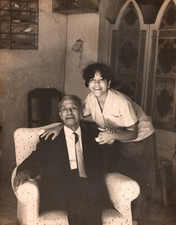
TROVA Trovador Music SINGER CUBAN Legend SINDO GARAY PORTRAIT 1940s PHOTO MA7
$32.99