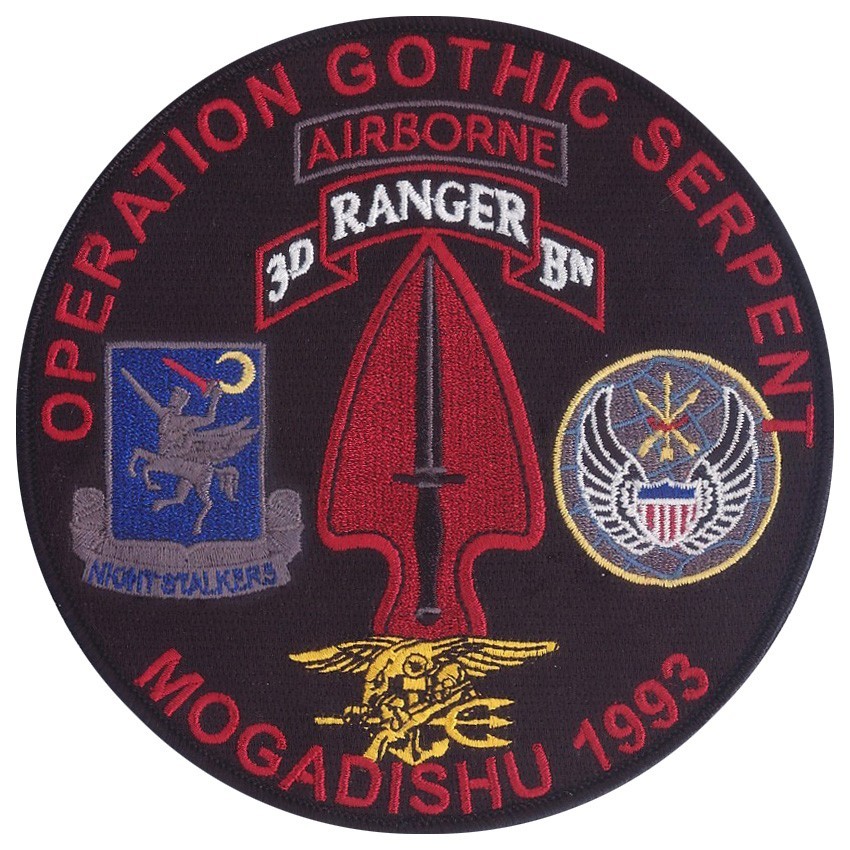
HIGHLY DETAILED 4
OPERATIONGOTHIC SERPENT EMBROIDERED PATCH
5 1/2" DIAMETER - HIGHLY DETAILED EMBROIDERED PATCH
BLACK MERROWED EDGE - WAX BACKING
MOGADISHU - 1993
TASK FORCERANGER
Task Force Ranger—whichconsisted of an assault force made up of U.S. Army Delta Force operators,Army Rangers, Air Force Pararescuemen, Air Force Combat Controllers, fourNavy SEALs from the Naval Special Warfare Development Group, and an airelement provided by the 160th Special Operations Aviation Regiment—underMajor General William F. Garrison's command executed an operation thatinvolved traveling from their compound on the city's outskirts to the centerwith the aim of capturing the leaders of the Habr Gidr clan, led by warlordMohamed Farrah Aidid. The assault force consisted of nineteen aircraft,twelve vehicles (including nine Humvees), and 160 men.
The Battle of Mogadishu
The Battle of Mogadishu, morecommonly referred to as Black Hawk Down or, locally, as the Day of theRangers (Somali: Maalintii Rangers), was part of Operation Gothic Serpentand was fought on 3 and 4 October 1993, in Mogadishu, Somalia, betweenforces of the United States supported by UNOSOM II, and Somali militiamenloyal to the self-proclaimed president-to-be Mohamed Farrah Aidid who hadsupport from armed civilian fighters.A U.S. Army force in Mogadishu,consisting primarily of U.S. Army Rangers from Bravo Company, 3rd Battalion,75th Ranger Regiment; C Squadron, 1st Special Forces OperationalDetachment-Delta (1st SFOD-D), better known as "Delta Force"; as well as AirForce Combat Controllers and Air Force Pararescuemen and helicopters from1st Battalion, 160th Special Operations Aviation Regiment, attempted toseize two of Aidid's high-echelon lieutenants during a meeting in the city.Shortly after the assault began, Somali militia and armed civilian fightersshot down two UH-60 Black Hawk helicopters. The subsequent operation tosecure and recover the crews of both helicopters drew the raid, intended tolast no more than an hour, into an overnight standoff in the city. Thebattle resulted in 18 deaths, 80 wounded, and one helicopter pilot capturedamong the U.S. raid party and rescue forces. One Pakistani soldier and oneMalaysian soldier were killed as part of the rescue forces. American sourcesestimate between 1,500 and 3,000 Somali casualties, including civilians; SNAforces claim only 315 killed, with 812 wounded. The battle is now referredto as the First Battle of Mogadishu to distinguish it from the Second Battleof Mogadishu of 2006.
Summary
Task Force Ranger—whichconsisted of an assault force made up of U.S. Army Delta Force operators,Army Rangers, Air Force Pararescuemen, Air Force Combat Controllers, fourNavy SEALs from the Naval Special Warfare Development Group, and an airelement provided by the 160th Special Operations Aviation Regiment—underMajor General William F. Garrison's command executed an operation thatinvolved traveling from their compound on the city's outskirts to the centerwith the aim of capturing the leaders of the Habr Gidr clan, led by warlordMohamed Farrah Aidid. The assault force consisted of nineteen aircraft,twelve vehicles (including nine Humvees), and 160 men.
During the operation, twoU.S. Black Hawk helicopters were shot down by RPGs and three others weredamaged. Some of the wounded survivors were able to evacuate to thecompound, but others remained near the crash sites and were isolated. Anurban battle ensued throughout the night.
Early the next morning, a combined task force wassent to rescue the trapped soldiers. It contained soldiers from the PakistanArmy, the Malaysian Army and the U.S. Army's 10th Mountain Division. Theyassembled some hundred vehicles, including Pakistani tanks (M48s) andMalaysian Condor armoured personnel carriers and were supported by U.S. MH-6Little Bird and MH-60L Black Hawk helicopters. This task force reached thefirst crash site and rescued the survivors. The second crash site had beenoverrun by hostile Somalis during the night. Delta snipers Gary Gordon andRandy Shughart volunteered to hold them off until ground forces arrived. ASomali mob with thousands of combatants eventually overran the two men. Thatsite's lone surviving American, pilot Michael Durant, had been takenprisoner but was later released.
The exact number of Somali casualties is unknown, but estimates range fromseveral hundred to over a thousand militiamen and others killed, withinjuries to another 3,000–4,000. The International Committee of the RedCross estimated 200 Somali civilians killed and several hundred wounded inthe fighting, with reports that some civilians attacked the Americans. Thebook Black Hawk Down: A Story of Modern War estimates more than 700 Somalimilitiamen dead and more than 1,000 wounded, but the Somali NationalAlliance in a Frontline documentary on American television acknowledged only133 killed in the whole battle. The Somali casualties were reported in TheWashington Post as 312 killed and 814 wounded. The Pentagon initiallyreported five American soldiers were killed, but the toll was actually 18American soldiers dead and 73 wounded. Two days later, a 19th soldier, Deltaoperator SFC Matt Rierson, was killed in a mortar attack. Among U.N. forces,one Malaysian and one Pakistani died; seven Malaysians and two Pakistaniswere wounded. At the time, the battle was the bloodiest involving U.S.troops since the Vietnam War and remained so until the Second Battle ofFallujah in 2004.
On24 July 1996, Aidid was wounded during a firefight between his militia andforces loyal to warlords and former Aidid allies, Ali Mahdi Muhammad andOsman Ali Atto. He suffered a fatal heart attack on 1 August 1996, eitherduring or after surgery to treat his wounds. The following day, GeneralGarrison retired.
Background
In January 1991, Somalian President Mohammed SiadBarre was overthrown in the ensuing civil war by a coalition of opposingclans. The Somali National Army concurrently disbanded and some formersoldiers reconstituted as irregular regional forces or joined the clanmilitias. The main rebel group in the capital Mogadishu was the UnitedSomali Congress (USC), which later divided into two armed factions: one ledby Ali Mahdi Muhammad, who became president, and the other by Mohamed FarrahAidid. In total, there were four opposition groups that competed forpolitical control – the USC, Somali Salvation Democratic Front (SSDF),Somali Patriotic Movement (SPM) and Somali Democratic Movement (SDM). InJune 1991, a ceasefire was agreed to, but failed to hold. A fifth group, theSomali National Movement (SNM), later declared independence in the Somalia'snorthwest portion in June. The SNM renamed the unrecognized territorySomaliland, with its leader Abdirahman Ahmed Ali Tuur selected as president.
In September 1991, severefighting broke out in Mogadishu, which continued in the following months andspread throughout the country, with over 20,000 people killed or injured bythe end of the year. These wars led to the destruction of the Somalia'sagriculture, which in turn led to starvation in large parts of the country.The international community began to send food supplies to halt thestarvation, but vast amounts of food were hijacked and brought to local clanleaders, who routinely exchanged it with other countries for weapons. Anestimated 80 percent of the food was stolen. These factors led to even morestarvation, from which an estimated 300,000 people died and another 1.5million people suffered between 1991 and 1992. In July 1992, after aceasefire between the opposing clan factions, the U.N. sent 50 militaryobservers to watch the food's distribution.
Operation Provide Reliefbegan in August 1992, when the U.S. President George H. W. Bush announcedthat U.S. military transports would support the multinational U.N. reliefeffort in Somalia. Ten C-130s and 400 people were deployed to Mombasa,Kenya, airlifting aid to Somalia's remote areas and reducing reliance ontruck convoys. One member of the 86th Supply Squadron, USAFE's onlycontribution to the operation, was deployed with the ground supportcontingent. The C-130s delivered 48,000 tons of food and medical supplies insix months to international humanitarian organizations trying to helpSomalia's more than three million starving people.
When this proved inadequate to stop the massivedeath and displacement of the Somali people (500,000 dead and 1.5 millionrefugees or displaced), the U.S launched a major coalition operation toassist and protect humanitarian activities in December 1992. This operation,called Operation Restore Hope, saw the U.S. assuming the unified command inaccordance with Resolution 794. The U.S. Marine Corps landed the 15th MarineExpeditionary Unit in Mogadishu and, with elements of 1st Battalion, 7thMarines and 3rd Battalion, 11th Marines, secured nearly one-third of thecity, the port, and airport facilities within two weeks, with the intent tofacilitate airlifted humanitarian supplies. Elements of the 2nd Battalion;HMLA-369 (Helicopter Marine Light Assault-369 of Marine Aircraft Group-39,3rd Marine Aircraft Wing, Camp Pendleton); 9th Marines; and 1st Battalion,7th Marines quickly secured routes to Baidoa, Balidogle and Kismayo, thenwere reinforced by the 3rd Assault Amphibian Battalion and the U.S. Army's10th Mountain Division.
Mission shift
On 3 March 1993, the U.N. Secretary-GeneralBoutros Boutros-Ghali submitted to the U.N. Security Council hisrecommendations for effecting the transition from UNITAF to UNOSOM II. Heindicated that since Resolution 794's adoption in December 1992, UNITAF'spresence and operations had created a positive impact on Somalia's securitysituation and on the effective delivery of humanitarian assistance (UNITAFdeployed some 37,000 personnel over forty percent of southern and centralSomalia). However, there was still no effective government, police, ornational army with the result of serious security threats to U.N. personnel.To that end, the Security Council authorized UNOSOM II to establish a secureenvironment throughout Somalia, to achieve national reconciliation so as tocreate a democratic state.
At the Conference onNational Reconciliation in Somalia, held on 15 March 1993, in Addis Ababa,Ethiopia, all fifteen Somali parties agreed to the terms set out to restorepeace and democracy. Yet, by May it became clear that, although a signatoryto the March Agreement, Mohammed Farrah Aidid's faction would not cooperatein the Agreement's implementation.
Aidid began to broadcastanti-U.N. propaganda on Radio Mogadishu after believing that the U.N. waspurposefully marginalizing him in an attempt to "rebuild Somalia".Lieutenant General Çevik Bir ordered the radio station shut down, in anattempt to quash the beginning of what could turn into a rebellion. Civilianspies throughout UNOSOM II's headquarters likely led to the uncovering ofthe U.N.'s plan. Aidid ordered SNA militia to attack a Pakistani force on 5June 1993, that had been tasked with the inspection of an arms cache locatedat the radio station, possibly out of fear that this was a task force sentto shut down the broadcast. The result was 24 dead, and 57 wounded Pakistanitroops, as well as 1 wounded Italian and 3 wounded American soldiers. On 6June 1993, the U.N. Security Council passed Resolution 837, declaring totalwar on Aidid and his forces.
On 12 June, U.S. troopsstarted attacking targets in Mogadishu in hopes of finding Aidid, a campaignwhich lasted until 16 June. On 17 June, a $25,000 warrant was issued byAdmiral Jonathan Howe for information leading to Aidid's arrest, but he wasnever captured. Howe also requested a counter-terrorist rescue force afterthe Pakistanis' deaths.
Attack on safe house
On 12 July 1993, a U.S.-led operation was launchedon what was believed to be a safe house where Aidid was hiding in Mogadishu.During the 17-minute combat operation, U.S. Cobra attack helicopters fired16 TOW missiles and thousands of 20-millimeter cannon rounds into thecompound, killing 60 people. However, the number of Somali fatalities wasdisputed. Abdi Qeybdiid, Aidid's interior minister, claimed 763 dead,including women and children who had been in the safe house. The reportsJonathan Howe got after the attack placed the number of dead at 20, all men.The International Committee of the Red Cross set the number of dead at 54.As it happened, Aidid was nowhere in sight.
The operation would leadto the deaths of four journalists – Dan Eldon, Hos Maina, Hansi Kraus andAnthony Macharia – who were killed by angry Mogadishu mobs when they arrivedto cover the incident, which presaged the Battle of Mogadishu.
Some believe that thisAmerican attack was a turning point in unifying Somalis against U.S. effortsin Somalia, including former moderates and those opposed to the Habar Gidir.
Task Force Ranger
On 8 August 1993, Aidid's militia detonated aremote controlled bomb against a U.S. military vehicle, killing foursoldiers. Two weeks later another bomb injured seven more. In response, U.S.President Bill Clinton approved the proposal to deploy a special task forcecomposed of 400 U.S. Army Rangers and Delta Force operators. This unit,named Task Force Ranger, consisted of 160 elite U.S. troops.
On 22 August, the unitdeployed to Somalia under the command of Major General William F. Garrison,commander of Joint Special Operations Command (JSOC) at the time.
The force consisted of:
B Company, 3rd Battalion, 75th Ranger Regiment
C Squadron, 1st SpecialForces Operational Detachment-Delta (1st SFOD-D)
A deployment package of 16helicopters and personnel from the 160th Special Operations AviationRegiment (160th SOAR), which included MH-60 Black Hawks and AH/MH-6 LittleBirds.
Navy SEALs from the Naval Special WarfareDevelopment Group (DEVGRU)
Air Force Pararescuemenand Combat Controllers from the 24th Special Tactics Squadron.
On21 September, Task Force Ranger captured Aidid's financier, Osman Ali Atto.
First Black Hawk Down
At around 02:00 on 25 September, Aidid's men shotdown a 101st Airborne Division Black Hawk with an RPG and killed three crewmembers at New Port near Mogadishu. The shootdown was a huge SNApsychological victory.
Order of Battle
Units involved in the battle:
Task Force Ranger,including:
C Squadron, 1st Special Forces OperationalDetachment-Delta (1st SFOD-D) – aka "Delta Force"
Bravo Company, 3rd RangerBattalion, 75th Ranger Regiment
1st Battalion, 160thSpecial Operations Aviation Regiment (Airborne) (The Night Stalkers) withMH-6J and AH-6 "Little Birds" and MH-60 A/L Black Hawks
Combat Controllers andPararescuemen from the 24th Special Tactics Squadron
Navy SEALs from the NavalSpecial Warfare Development Group (DEVGRU)
CVN-72 USS Abraham Lincoln& Carrier Air Wing 11
Task Force-10th Mountain Division, including:
1st Battalion, 22ndInfantry Regiment
2nd Battalion, 14th Infantry Regiment
3rd platoon, C Company,1st Battalion, 87th Infantry Regiment
15th FF Battalion, of theFrontier Force Regiment, Pakistan Army
19th Lancers of thePakistan Army
Included with the TF was the 977 MP Company
U.N. Forces
19th Battalion, RoyalMalay Regiment of the Malaysian Army
11th Regiment, Grup GerakKhas (few GGK operators during rescue the Super 6-1 crews)
7th Battalion, FrontierForce Regiment of the Pakistan Army
USC/SNA
The size and organizational structure of theSomali militia forces involved in the battle are not known in detail. Inall, between 2,000–4,000 regular faction members are believed to haveparticipated, almost all of whom belonged to Aidid's Somali NationalAlliance. They drew largely from his Habar Gidir Hawiye clan, who battledU.S. troops starting 12 July 1993.
The Somali NationalAlliance (SNA) was formed 14 August 1992. It began as the United SomaliCongress (USC) under Aidid's leadership. At the time of Operation GothicSerpent, the SNA was composed of Col. Omar Gess' Somali Patriotic Movement,the Somali Democratic Movement, the combined Digil and Mirifleh clans, theHabr Gedir of the United Somali Congress headed by Aidid, and the newlyestablished Southern Somali National Movement.
After formation, the SNA immediately staged anassault against the militia of the Hawadle Hawiye clan, who controlled theMogadishu port area. As a result, the Hawadle Hawiye were pushed out of thearea, and Aidid's forces took control.
Engagement
On Sunday - 3 October1993, Task Force Ranger, U.S. special operations forces composed mainly ofBravo Company 3rd Battalion, 75th Ranger Regiment, 1st Special ForcesOperational Detachment-Delta (better known as "Delta Force") operators, andthe 160th Special Operations Aviation Regiment (Airborne) ("The NightStalkers"), attempted to capture Aidid's foreign minister Omar Salad Elmiand his top political advisor, Mohamed Hassan Awale.
The plan was that Deltaoperators would assault the target building (using MH-6 Little Birdhelicopters) and secure the targets inside the building while four Rangerchalks (under CPT Michael D. Steele's command) would fast rope down fromhovering MH-60L Black Hawk helicopters. The Rangers would then create afour-corner defensive perimeter around the building while a column of nineHMMWVs and three M939 five-ton trucks (under LTC Danny McKnight's command)would arrive at the building to take the entire assault team and theirprisoners back to base. The entire operation was estimated to take no longerthan 30 minutes.
The ground-extraction convoy was supposed to reachthe captive targets a few minutes after the operation's beginning. However,it ran into delays. Somali citizens and local militia formed barricadesalong Mogadishu's streets with rocks, wreckage, rubbish and burning tires,blocking the convoy from reaching the Rangers and their captives. Aididmilitiamen with megaphones were shouting, "Kasoobaxa guryaha oo iska celsacadowga!" ("Come out and defend your homes!").
The Raid
At 13:50, Task Force Ranger analysts receiveintelligence of Salad's location.
At 15:42, the MH-6 assaultLittle Birds carrying the Delta operators hit the target, the wave of dustbecoming so bad that one was forced to go around again and land out ofposition. Next, the two Black Hawks carrying the second Delta assault teamcame into position and dropped their teams as the four Ranger chalksprepared to rope onto the four corners surrounding the target building. Bymistake, Chalk Four being carried by Black Hawk callsign Super 67, pilotedby CW3 Jeff Niklaus, was accidentally put in a block north of their intendedpoint. Declining the pilot's offer to move them back down due to the time itwould take to do so, leaving the helicopter too exposed, Chalk Four intendedto move down to the planned position, but intense ground fire prevented themfrom doing so.
Theground convoy arrives ten minutes later near the Olympic Hotel and wait forDelta and Rangers to complete their mission(target building).
During the operation'sfirst moments, Ranger PFC Todd Blackburn, from Chalk Four, fell whilefast-roping from his Black Hawk Super 67 while it was hovering 70 feet (21m) above the streets. The film Black Hawk Down shows that he slipped whenthe helicopter was forced to take evasive maneuvers to avoid an incoming RPGfired from a nearby rooftop, although, according to Bowden, video does notshow the helicopter moving. Blackburn suffered an injury to his head andback of his neck and required evacuation by SGT Jeff Struecker's column ofthree Humvees. While taking PFC Todd Blackburn back to base, SGT DominickPilla, assigned to SGT Struecker's Humvee, was killed instantly when abullet entered his head. When SGT Struecker's Humvee column reached the baseand safety, all three vehicles were riddled with bullet holes and smoking.
At about 16:20, one of theBlack Hawk helicopters, callsign Super 61 piloted by CW3 Cliff "Elvis"Wolcott and CW3 Donovan Briley, was shot down by an RPG. Both pilots werekilled in the resulting crash and two of the crew chiefs were severelywounded. SSG Daniel Busch and SGT Jim Smith, both Delta snipers, survivedthe crash and began defending the site.
An MH-6, callsign Star 41and piloted by CW3 Karl Maier and CW5 Keith Jones, landed nearby and Jonesleft the helicopter and carried Busch to the safety of the Helo while Maierprovided cover fire from the Little Bird's cockpit, repeatedly denying orderto lift off while his co-pilot was not in the Bird. He nearly hit ChalkOne's LT DiTomosso arriving with Rangers and Delta operators to secure thesite. Jones and Maier evacuated SSG Busch and SGT Smith, though SSG Buschlater died of his injuries, being shot four times while defending the crashsite.
A CombatSearch and Rescue (CSAR) team, led by Air Force Pararescueman TSgt ScottFales, were able to fast rope down to Super 61's crash site despite an RPGhit that crippled their helicopter, Super 68, piloted by CW3 Dan Jollota.Despite the damage, Super 68 did make it back to base. The CSAR team foundboth the pilots dead and two wounded inside the crashed helicopter. Underintense fire, the team moved the wounded men to a nearby collection point,where they built a makeshift shelter using Kevlar armor plates salvaged fromSuper 61's wreckage.
There was confusion between the ground convoy andthe assault team. The assault team and the ground convoy waited for 20minutes to receive their orders to move out. Both units were under themistaken impression that they were to be first contacted by the other.During the wait, a second Black Hawk helicopter, callsign Super 64 andpiloted by CW3 Michael Durant, was shot down by an RPG at around 16:40.
Most of the assault teamwent to the first crash site for a rescue operation. Upon reaching the site,about 90 Rangers and Delta Force operators found themselves under heavyfire. Despite air support, the assault team was effectively trapped for thenight. With a growing number of wounded needing shelter, they occupiedseveral nearby houses and confined the occupants for the battle's duration.Outside, a stiff breeze stirred up blinding, brown clouds of dust.
At the second crash site,two Delta snipers, MSG Gary Gordon and SFC Randy Shughart, were inserted byBlack Hawk Super 62 – piloted by CW3 Mike Goffena. Their first two requeststo be inserted were denied, but they were finally granted permission upontheir third request. They inflicted heavy casualties on the approachingSomali mob. Super 62 had kept up their fire support for MSG Gordon and SFCShughart, but an RPG struck Super 62. Despite the damage, Super 62 managedto go to the New Port and safety. When MSG Gordon was eventually killed, SFCShughart picked up Gordon's CAR-15 and gave it to Super 64 pilot CW3 MichaelDurant. SFC Shughart went back around the chopper's nose and held off themob for about 10 more minutes before he was killed. The Somalis then overranthe crash site and killed all but Durant. He was nearly beaten to death, butwas saved when members of Aidid's militia came to take him prisoner. Fortheir actions, MSG Gordon and SFC Shughart were posthumously awarded theMedal of Honor, the first awarded since the Vietnam War.
Repeated attempts by theSomalis to mass forces and overrun the American positions in a series offirefights near the first crash site were neutralized by aggressive smallarms fire and by strafing runs and rocket attacks from AH-6J Little Birdhelicopter gunships of the Nightstalkers, the only air unit equipped for andtrained for night fighting.
A relief convoy withelements from the Task Force 2–14 Infantry, 10th Mountain Division,accompanied by Malaysian and Pakistani U.N. forces, arrived at the firstcrash site at around 02:00. No contingency planning or coordination withU.N. forces had been arranged prior to the operation; consequently, therecovery of the surrounded American troops was significantly complicated anddelayed. Determined to protect all of the rescue convoy's members, GeneralGarrison made sure that the convoy would roll out in force. When the convoyfinally pushed into the city, it consisted of more than 100 U.N. vehiclesincluding Malaysian forces' German made Condor APCs, four Pakistani tanks(M48s), American Humvees and several M939 five-ton flatbed trucks. Thistwo-mile-long column was supported by several other Black Hawks and Cobraassault helicopters stationed with the 10th Mountain Division. Meanwhile,Task Force Ranger's "Little Birds" continued their defense of Super 61'sdowned crew and rescuers. The American assault force sustained heavycasualties, including several killed, and a Malaysian soldier died when anRPG hit his Condor vehicle. Seven Malaysians and two Pakistanis werewounded.
Mogadishu Mile
Malaysian UN peacekeeping units in Condor (APC)armored carriers near the university compound.
The battle was over by 06:30 on Monday, 4 October.U.S. forces were finally evacuated to the U.N. base by the armored convoy.While leaving the crash site, a group of Rangers and Delta operatorsrealized that there was no room left in the vehicles for them and wereforced to depart the city on foot to a rendezvous point on National Street.This has been commonly referred to as the "Mogadishu Mile". U.S. forcessuffered one casualty during the mile, Sgt. Randal J. Ramaglia, after he washit by a bullet in the back, and successfully evacuated.
In all, 18 U.S. soldierswere killed in action during the battle and another 73 were wounded inaction. The Malaysian forces lost one soldier and had seven injured, whilethe Pakistanis suffered two injured. Somali casualties were heavy, withestimates on fatalities ranging from 315 to over 2,000 combatants. TheSomali casualties were a mixture of militiamen and local civilians. Somalicivilians suffered heavy casualties due to the dense urban character of thatportion of Mogadishu. Two days later, a mortar round fell on the U.S.compound, killing one U.S. soldier, SFC Matt Rierson, and injuring anothertwelve. A team on special mission to Durant's Super 64 helicopter had 2wounded, Boxerman and James on 6 October.
Two weeks after thebattle, General Garrison officially accepted responsibility. In ahandwritten letter to President Clinton, Garrison took full responsibilityfor the battle's outcome. He wrote that Task Force Ranger had adequateintelligence for the mission and that their objective (capturing targetsfrom the Olympic Hotel) was met.
Aftermath
In a national securitypolicy review session held in the White House on 6 October 1993, U.S.President Bill Clinton directed the Acting Chairman of the Joint Chiefs ofStaff, Admiral David E. Jeremiah, to stop all actions by U.S. forces againstAidid except those required in self-defense. He reappointed AmbassadorRobert B. Oakley as special envoy to Somalia in an attempt to broker a peacesettlement and then announced that all U.S. forces would withdraw fromSomalia no later than 31 March 1994. On 15 December 1993, U.S. Secretary ofDefense Les Aspin stepped down, taking much of the blame for his decision torefuse requests for tanks and armored vehicles in support of the mission. Afew hundred U.S. Marines remained offshore to assist with any noncombatantevacuation mission that might occur regarding the 1,000-plus U.S. civiliansand military advisers remaining as part of the U.S. liaison mission.
The Ready Battalion of the 24th Infantry Division,1–64 Armor, was sent from Fort Stewart, Georgia, to Mogadishu to provideheavy armoured support for U.S. forces. On 16 December 1993, Joint TaskForce United Shield was approved by Clinton and launched on 14 January 1994.On 7 February 1994, the Fleet arrived and began the withdrawal ofUNOSOM-II's forces. The U.N. Security Council passed Resolution 897, whichredeployed military assets to cover the U.N. troops' withdrawal fromSomalia. On 6 March 1994, all of the remaining U.N. troops were withdrawn,ending UNOSOM-II. On 24 April 1994, Boutros-Ghali admitted defeat anddeclared the U.N. Mission was over.
Policy changes and political implications
US president Bill Clintonpresenting the Medal of Honor to the widow of Master Sergeant Gary I.Gordon, who served as Sniper Team Leader in the United States Army SpecialOperation Command with Task Force Ranger in Mogadishu.
The mission in Somalia was seen by many as afailure. The Clinton administration in particular endured considerablecriticism for the operation's outcome. The main elements of the criticismsurround the administration's decision to leave the region before completingthe operation's humanitarian and security objectives, as well as theperceived failure to recognize the threat Al-Qaida elements posed in theregion as well as the threat against U.S. security interests at home.Critics claim that Osama bin Laden and other members of Al-Qaida providedsupport and training to Mohammed Farrah Aidid's forces. Osama bin Laden evendenigrated the administration's decision to prematurely depart the regionstating that it displayed "the weakness, feebleness and cowardliness of theUS soldier".
Theloss of U.S. military personnel during the Black Hawk Down operation evokedpublic outcry. Television images of American soldiers being dragged throughthe streets by Somalis were too graphic for the American public to endure.The Clinton administration responded by scaling down U.S. humanitarianefforts in the region.
On 26 September 2006, in an interview on Fox Newswith Chris Wallace, former President Bill Clinton gave his version of eventssurrounding the mission in Somalia. Clinton defended his exit strategy forU.S. forces and denied that the departure was premature. He saidconservative Republicans had pushed him to leave the region before theoperation's objectives could be achieved: " were all trying to get me towithdraw from Somalia in 1993 the next day after we were involved in 'BlackHawk down,' and I refused to do it and stayed six months and had an orderlytransfer to the United Nations."
Clinton's remarks wouldsuggest the U.S. was not deterred from pursuing their humanitarian goalsbecause of the loss of U.S. forces during Black Hawk Down. In the sameinterview, he stated that, at the time, nobody thought Osama bin Laden andAl-Qaida had anything to do with Black Hawk Down's events. He said themission was strictly humanitarian.
Fear of a repeat of theevents in Somalia shaped U.S. policy in subsequent years, with manycommentators identifying the Battle of Mogadishu's graphic consequences asthe key reason behind the U.S.'s failure to intervene in later conflictssuch as the Rwandan Genocide of 1994. After the battle, the bodies ofseveral U.S. casualties of the conflict were dragged through Mogadishu'sstreets by crowds of local civilians and members of Aidid's Somali NationalAlliance. According to the U.S.'s former deputy special envoy to Somalia,Walter Clarke: "The ghosts of Somalia continue to haunt US policy. Our lackof response in Rwanda was a fear of getting involved in something like aSomalia all over again."
Links with Al-Qaeda
There have beenallegations that Osama bin Laden's Al-Qaeda organization was involved intraining and funding of Aidid's men. In his 2001 book, Holy War, Inc., CNNreporter Peter Bergen interviewed bin Laden who affirmed these allegations.According to Bergen, bin Laden asserted that fighters affiliated with hisgroup were involved in killing U.S. troops in Somalia in 1993, a claim hehad made earlier to the Arabic newspaper Al-Quds Al-Arabi. The Al-Qaedafighters in Somalia are rumored to have included the organization's militarychief, Mohammed Atef, later killed by U.S. forces in Afghanistan. Anotheral-Qaeda operative who was present at the battle was Zachariah al-Tunisi,who allegedly fired an RPG that downed one of the Black Hawk helicopters; hewas later killed by an airstrike in Afghanistan in November, 2001.
Aidid's men received someexpert guidance in shooting down helicopters from fundamentalist Islamicsoldiers, most likely Al-Qaeda, who had experience fighting Russianhelicopters during Soviet-Afghan War.
Four and a half yearsafter the Battle of Mogadishu, in an interview in May 1998, bin Ladendisparaged the withdrawal of U.S. troops from Somalia. He denied havingorchestrated the attack on the U.S. soldiers in Mogadishu but expresseddelight at their deaths in battle against Somali fighters.

Related Items:
Operation Gothic Serpent - The Battle of Mogadishu - Black Hawk Down - TF Ranger
$22.25
Task Force Ranger Operation Gothic Serpent Shughart Gordon Challenge Coin RARE
$399.99

Articulating Arm With Rotatable Table Clamp Anterior Cervical Access System A+
$509.99