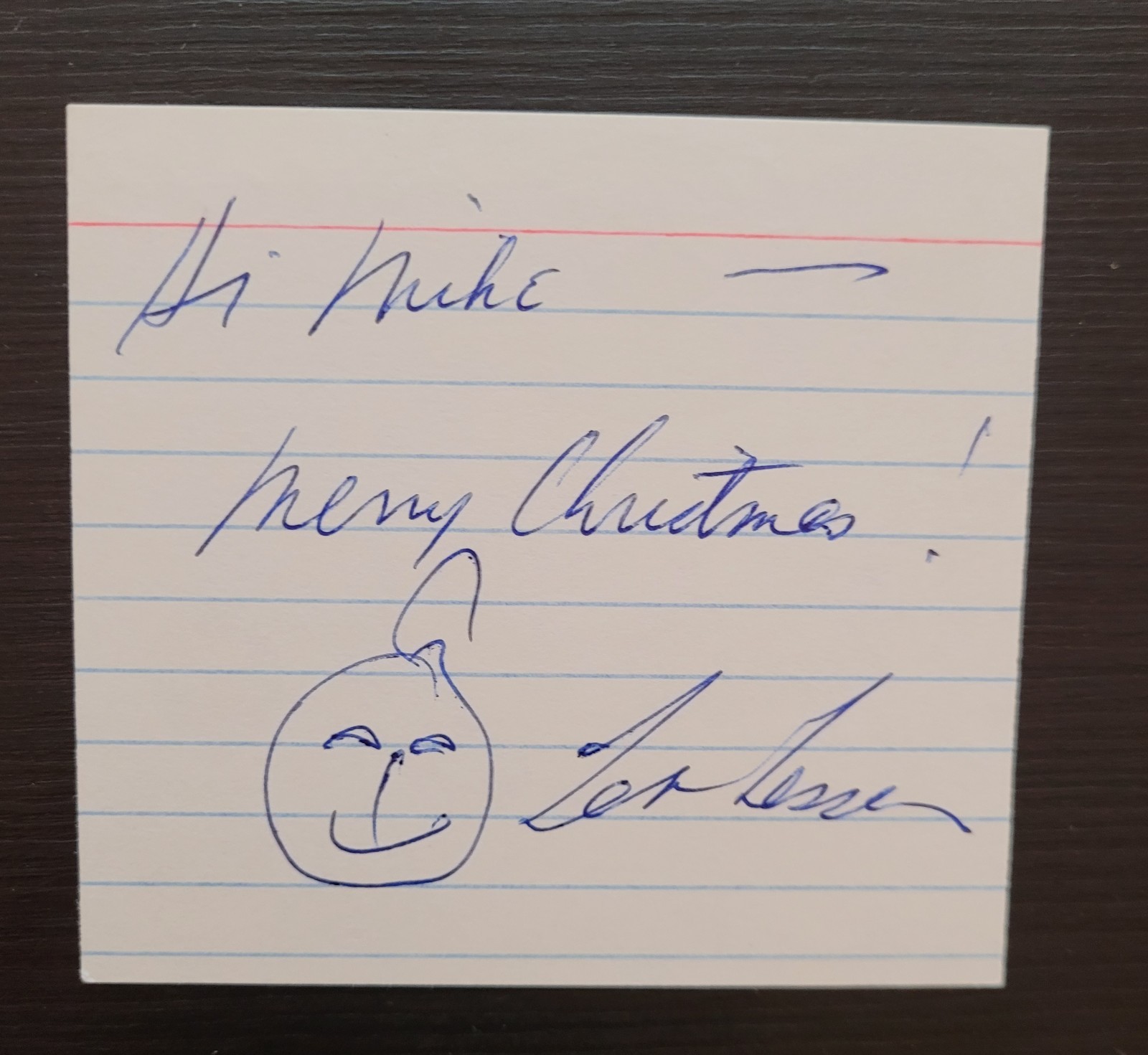
An inscribed autograph on 3 x 3 1/4 card by Len Lesser with a sketch of a pumpkin!
Hi Mike - Merry Christmas ! Len LesserLeonard King Lesser was an American character actor and comedian, best known for his recurring role as Uncle Leo on Seinfeld. He was also known for his role as Garvin on Everybody Loves Raymond.___________________
Leonard King Lesser (December 3, 1922 – February 16, 2011) was an American character actor and comedian, best known for his recurring role as Uncle Leo on Seinfeld. He was also known for his role as Garvin on Everybody Loves Raymond.
Early lifeLesser was born in New York City in 1922. His father, a grocer, was a Jewish immigrant from Poland. Lesser received his bachelor\'s degree from the City College of New York in 1942 at the age of 19.[1] Lesser enlisted in the United States Army the day after the attack on Pearl Harbor, and served in the China Burma India Theater during World War II.[2] While there, he was promoted to sergeant.
Career
Len Lesser and Frank Gerstle in the television series Lock-Up, episode \"The Seventh Hour\" (1960)Lesser was a prolific character actor in film, TV and on stage. He appeared on American television steadily since 1955 on programs such as That Girl, The Untouchables, Peter Gunn, Have Gun - Will Travel, Mr. Lucky, The Outer Limits, Alfred Hitchcock Presents, Gunsmoke, Kentucky Jones, Green Acres, Get Smart, Bat Masterson, Family Affair, The Monkees, Quincy, M.E., The Rockford Files, The Amazing Spider-Man, Mad About You, All in the Family, Boy Meets World, Smart Guy, My Favorite Martian, The Munsters, and Castle. Lesser was in two episodes of Bonanza \"Caution, Easter Bunny Crossing\", March 29, 1970, and \"Heritage of Anger\", September 19, 1972. He appeared in a variety of films such as Birdman of Alcatraz (1962), How to Stuff a Wild Bikini (1965), Kelly\'s Heroes (1970), Blood and Lace (1971), Dirty Little Billy (1972), Papillon (1973), Truck Stop Women (1974), The Outlaw Josey Wales (1976), Supervan (1977), Moonshine County Express (1977), Ruby (1977), Death Hunt (1981), Take This Job and Shove It (1981), Grandmother\'s House (1988) and Baadasssss! (2003). He also guest starred on the Sabrina the Teenage Witch episode \"Tick Tock Hilda\'s Clock.\"[3]
Later yearsLesser had a recurring role on Everybody Loves Raymond as Garvin, a friend of Frank Barone, who always lifted his arms in excitement whenever he saw Ray (just as Lesser did in his recurring role on Seinfeld as \"Uncle Leo\" whenever he saw his nephew Jerry). He also appeared in Jeff Seymour\'s stage production of Cold Storage at the University of Toronto\'s George Ignatieff Theatre.[4]
DeathOn February 16, 2011, Lesser died of cancer-related pneumonia[5] in Burbank, California, at the age of 88.[6]After learning of Lesser\'s death, Jerry Seinfeld said of him, Len was one of our favorites. We always loved having him on the show. I\'ll never forget when Uncle Leo was in prison and tattooed \"Jerry Hello\" on his knuckles. He was a very sweet guy.Another Seinfeld castmate, Jason Alexander, tweeted, Thanks to all of you for your kind remarks re: Len Lessor [sic]. Tonight was the opening of Gigi at my beloved Reprise Theater Company and I\'ve only returned at this late hour to hear the news. ... \"Hellooo\" Uncle Leo. And goodbye. Sleep well. Much love. Jason.[7]Selected filmography Shack Out on 101 (1955) - Perch
Somebody Up There Likes Me (1956) - Reporter at Sparring Session (uncredited)
Lust for Life (1956) - Cartoonist (uncredited)
The Rack (1956) - Officer (uncredited)
Alfred Hitchcock Presents (1957) (Season 3 Episode 4: Heart of Gold\") - Thug
This Could Be the Night (1957) - Piano Tuner (uncredited)
Slaughter on Tenth Avenue (1957) - Sam (uncredited)
Have Gun - Will Travel (1958) (Season 1 Episode 38 : \"Deliver the Body\") - Boldt
The Brothers Karamazov (1958) - Jailer (uncredited)
I Want to Live! (1958) - Charlie, Newspaperman (uncredited)
Some Came Running (1958) - Indianapolis Poker Player (uncredited)
Crime and Punishment U.S.A. (1959) - Desk Officer
Please Don\'t Eat the Daisies (1960) - Waiter at Sardi\'s (uncredited)
Bells Are Ringing (1960) - Charlie Bessemer (uncredited)
Birdman of Alcatraz (1962) - Burns (uncredited)
Smog (1962) - Lelio Marpicati
McHale\'s Navy Joins the Air Force (1965) - NKVD commissar
How to Stuff a Wild Bikini (1965) - North Dakota Pete
The Wild Wild West (1965) - Mason
Fireball 500 (1966) - Man in Garage
The Munsters (1966) - Manikoo in Heap Big Herman
The Last Challenge (1967) - Ed - the Bartender (uncredited)
The Monkees (1967) – Red in S2:E13, \"Monkees in Texas\"
Kelly\'s Heroes (1970) - Sergeant Bellamy
Bonanza (1970, TV Series) - Fred Gaskell
All in the Family (1971) - Billy Prendegast
Blood and Lace (1971) - Tom Kredge
Dirty Little Billy (1972) - Slits
Slither (1973) - Jogger
Papillon (1973) - Guard
It\'s Good to Be Alive (1974) - Man at Accident
Truck Stop Women (1974) - Winter
Kolchak: The Night Stalker(1974) - They Have Been, They Are.....
Death Wish (1974) - Cop at the Precinct (uncredited)
The Outlaw Josey Wales (1976) - Abe
Supervan (1977) - Banks
Moonshine County Express (1977) - Scoggins
Joyride to Nowhere (1977) - Charlie
Ruby (1977) - Barney
Spider-Man (1977) - Henchman
House Calls (1978) - Waiter
Someone\'s Watching Me! (1978) - Burly Man
The Main Event (1979) - Trainer At Big Bear
Take This Job and Shove It (1981) - Roach
Death Hunt (1981) - Lewis
Du-beat-e-o (1984) - Hendricks
Grandmother\'s House (1988) - Grandfather
Faith (1990) - Uncle Sal
Sorority Girls and the Creature from Hell (1990) - Tex
Ain\'t No Way Back (1990) - Papa Campbell
Seinfeld (1991-1998) - Uncle Leo
Rave Review (1994) - Al
The John Larroquette Show - (1996) Preacher (1 episode)
Everybody Loves Raymond (1996-2004) - Garvin
Boy Meets World (1997) - Arnie Heck (1 episode)
Mad About You - (1997) Uncle Arnold (1 episode)
Life with Roger (1997) - Mr. Mitchell (1 episode)
True Friends (1998) - Mr. Slotnick
Caroline in the City (1998) - Waiter (1 episode)
The Werewolf Reborn! (1998)
Smart Guy (1998) - Sidney (1 episode)
The Secret Diary of Desmond Pfeiffer (1998) - Tailor (1 episode)
Sabrina the Teenage Witch - Eugene (1 episode)
Son of the Beach (2002) - Nick Pappasmearos Jr. (3 episodes)
Just Shoot Me! (2003) - Uncle Jimmy (1 episode)
Baadasssss! (2003) - Manny & Mort Goldberg
Rock Me, Baby (2003) - Harvey (1 episode)
Quintuplets (2004) - Morty (1 episode)
Raw Footage (2005) - Grampa Joey
ER (2005) - Woody Ebbots (1 episode)
The Wedding Belles (2007) - Peppy Miller (1 episode)
Cold Case (2007) - Elmer Gibbins \'07 (1 episode)
\'Til Death (2008) - Gus (1 episode)
Turbo Dates (2008)
Castle (2009) - Neighbour (1 episode) (Final role)Uncle Leo is a fictional character portrayed by Len Lesser in the American sitcom Seinfeld. Uncle Leo is the fictional uncle of Jerry Seinfeld\'s character. Uncle Leo made his debut in the second-season episode \"The Pony Remark\" and appeared in at least one episode in each of the subsequent seasons through the show\'s nine-season run.On the 25th anniversary of the show\'s debut, Rolling Stone ranked Uncle Leo as number six on its list of \"100 Best Seinfeld Characters,\" behind only Newman at number five and the four main characters: Jerry, Kramer, Elaine, and George.[1]
DescriptionUncle Leo is the brother of Jerry\'s mother, Helen; his last name is never revealed. In an episode where Leo signs for a package addressed to Jerry, he actually signs it \"Uncle Leo\". In \"The Bookstore\", Jerry mentions \"Leo\" to Kramer. Kramer is initially confused, but upon remembering, he says, \"Oh, yeah. Right. Uncle Leo. Forgot his first name.\"Uncle Leo is very eccentric and a \"general kvetch.\"[1] When coming across Jerry, he always exclaims his catchphrase, \"Jerry! Hello!\" with his arms wide open.[2] When Jerry has a Cape Fear-esque nightmare about him in \"The Bookstore,\" Leo has the word \"Jerry\" tattooed on the fingers of his right hand and \"Hello\" on the fingers of his left.[3]When talking to people, Uncle Leo has a tendency to grab the person\'s arm (often uncomfortably) and hold them close.[4] In \"The Pony Remark,\" Jerry guesses that he does this \"because so many people have left in the middle of his conversation.\"Uncle Leo often brags about his son (Jerry\'s cousin Jeffrey, who never appears on the show) and his various accomplishments while working in the Parks Department. Leo is very sensitive about greetings; when Jerry once avoided stopping to talk to his uncle on the street (because Jerry was on his way to a meeting), Leo was offended and called Jerry\'s mother in Florida to complain about the snub.Leo is retired. His wife, Stella, is seen in the third-season episode \"The Pen\", but by the seventh season, he is either widowed or divorced. In \"The Shower Head\", he is living with a woman named Lydia. He breaks up with her because Jerry joked on The Tonight Show with Jay Leno about Leo\'s paranoid obsession with antisemitism in ridiculous contexts, such as claiming that a cook is antisemitic for overcooking his hamburger. Lydia found Jerry\'s comments funny, so Uncle Leo accused her of being an anti-Semite, as well. He resumes the relationship later on in the episode, although neither Stella nor Lydia is mentioned in subsequent episodes.In \"The Package\", Leo receives a package for Jerry after Jerry refuses it, being suspicious that it could contain a bomb. Although initially refusing George\'s suggestion to let Leo open the package, he encourages Leo to open it after Leo asks Jerry to accompany him to Jeffrey\'s Parks Department production of The Mikado. This happens over the phone, and Jerry hears a loud explosion once Leo agrees to open the box. Except for having his eyebrows and moustache burnt off, Leo is unharmed. Elaine later quickly draws new eyebrows on him with her eyeliner, leaving him with a comical expression of anger.In \"The Bookstore\", Jerry catches Uncle Leo in the act of shoplifting at a local bookstore, thereafter, confronting him about it. Leo maintains that seniors have the upper hand since they can claim senility (\"Come on! I\'m an old man. I\'m confused! I thought I paid for it. What’s my name? Will you take me home?\"); he also reminds Jerry to always greet him \"Hello\" no matter how awkward the situation.[3] Jerry later unintentionally gets Leo arrested by \"bookstore police\" after Leo attempts yet another theft. The episode reveals that Uncle Leo has a criminal record related to a \"crime of passion\".Uncle Leo\'s final appearance happens in the series finale, \"The Finale\". He first appears, like many of the supporting characters returning, departing the four\'s trial. He is seen in the audience reacting to four\'s actions, and is last seen comforting a crying Babs Kramer. In a deleted scene, he introduces himself to Babs.\"He\'s the kind of guy who is a total nuisance at times and the kind of guy you avoid. He\'s a very expansive character, and that has an attraction to it,\" Lesser said of the character in 1998.[5]
Character legacyLen Lesser, who portrayed Uncle Leo, exhibited some of the same character traits, especially the overly excited greetings, when he portrayed the character Garvin from 1996 to 2004 on Everybody Loves Raymond.[4]Lesser died in 2011.[6] His role as Uncle Leo was remembered as an \"iconic\" and \"scene-stealing\" character.[7] Despite his persona as a complaining braggart, Uncle Leo \"still managed to be loveable\".[1]
AppearancesThe Uncle Leo character appears in a total of 15 episodes from 1991 to 1998.Season Two \"The Pony Remark\"Season Three \"The Pen\"Season Four \"The Ticket\"
\"The Wallet\"
\"The Watch\"Season Five \"The Glasses\"
\"The Wife\"Season Six \"The Pledge Drive\"
\"The Kiss Hello\"
\"The Doodle\"Season Seven \"The Shower Head\"Season Eight \"The Package\"Season Nine \"The Bookstore\"
\"The Finale Part I\"
\"The Finale Part II\"Seinfeld (/ˈsaɪnfɛld/ SYNE-feld) is an American television sitcom created by Larry David and Jerry Seinfeld that originally aired on NBC from July 5, 1989, to May 14, 1998, with a total of nine seasons consisting of 180 episodes. Its ensemble cast stars Seinfeld as a fictionalized version of himself and focuses on his personal life with three of his friends: best friend George Costanza (Jason Alexander), former girlfriend Elaine Benes (Julia Louis-Dreyfus), and eccentric neighbor from across the hall Cosmo Kramer (Michael Richards).Seinfeld is set mostly in and around the titular character\'s apartment in Manhattan\'s Upper West Side in New York City. It has been described as \"a show about nothing\", often focusing on the minutiae of daily life.[1] Interspersed in all episodes of the first seven seasons are moments of stand-up comedy from the fictional Jerry Seinfeld, frequently related to the episode\'s events.As a rising comedian in the late 1980s, Jerry Seinfeld was presented with an opportunity to create a show with NBC. He asked Larry David, a fellow comedian and friend, to help create a premise for a sitcom.[2] The series was produced by West/Shapiro Productions and Castle Rock Entertainment and is distributed in syndication by Sony Pictures Television.[nb 1] It was largely written by David and Seinfeld along with scriptwriters. A favorite among critics, the series led the Nielsen ratings in Seasons 6 and 9 and finished among the top two (along with ER of the same network) every year from 1994 to 1998. Only two other shows—I Love Lucy and The Andy Griffith Show—finished their runs at the top of the ratings.[3]Seinfeld is universally regarded as one of the greatest and most influential American shows of all time.[4][5][6][7][8] Its most renowned episodes include \"The Chinese Restaurant\", \"The Soup Nazi\", \"The Parking Garage\",[9] \"The Marine Biologist\", and \"The Contest\".[10] E! named it the \"Number 1 reason [why] the \'90s ruled\".[11] Quotes from numerous episodes have become catchphrases in popular began as a 23-minute pilot titled \"The Seinfeld Chronicles\". Created by Jerry Seinfeld and Larry David, developed by NBC executive Rick Ludwin, and produced by Castle Rock Entertainment, it was a mix of Seinfeld\'s stand-up comedy routines and idiosyncratic, conversational scenes focusing on mundane aspects of everyday life like laundry, the buttoning of the top button on one\'s shirt, and the effort by men to interpret the intent of women spending the night in Seinfeld\'s apartment.[12]The pilot was filmed at Stage 8 of Desilu Cahuenga studios, the same studio where The Dick Van Dyke Show was filmed (seen by the crew as a good omen),[13] and was recorded at Ren-Mar Studios in Hollywood.[14] The pilot was first screened to a group of two dozen NBC executives in Burbank, California, in early 1989. This one, however, did not yield the explosion of laughter garnered by the pilots for the decade\'s previous NBC successes like The Cosby Show and The Golden Girls. Brandon Tartikoff was not convinced the show would work. A Jewish man from New York himself, Tartikoff characterized it as \"Too New York, too Jewish\".[15] Test audiences were even harsher. NBC\'s practice at the time was to recruit 400 households by phone to ask them to evaluate pilots it aired on an unused channel on its cable system. An NBC research department memo summarized the pilot\'s performance among the respondents as \"weak\", which Warren Littlefield, then second-in-command in NBC\'s entertainment division, called \"a dagger to the heart\".[12] Comments included, \"You can\'t get too excited about two guys going to the laundromat\", \"Jerry\'s loser friend George isn\'t a forceful character\", \"Jerry needs a stronger supporting cast\", and \"Why are they interrupting the stand-up for these stupid stories?\"[14] Seinfeld and David did not see the memo for several years, but after they became aware of it, they hung it in a bathroom on the set. Seinfeld comments, \"We thought, if someone goes in to use this bathroom, this is something they should see. It fits that moment.\"[12]Around the time the show\'s pilot was filmed, Castle Rock Entertainment had also produced another pilot for NBC that featured Ann Jillian in her almost-similarly eponymous TV series. When The Seinfeld Chronicles tested poorly with audiences, Castle Rock focused on Jillian\'s series, which tested better with audiences and received a full-season order. Ann Jillian lasted only a single season of 13 episodes and was off the air by the end of 1990.[16]
First seasonsWhen NBC announced its 1989–90 (primetime) schedule in May 1989, The Seinfeld Chronicles was not included, but the show\'s supporters did not give up. The pilot first aired on July 5, 1989, and finished second in its time slot against the CBS police drama Jake and the Fatman,[12] receiving a Nielsen rating of 10.9/19.[14] The ratings did not exhibit the regional skew Tartikoff predicted, much to the encouragement of the show\'s supporters. Ludwin canceled one of the Bob Hope specials budgeted for that season so the entertainment division had the money to order four more episodes of The Seinfeld Chronicles, which formed the rest of the show\'s first season (the series was by then retitled to Seinfeld)[12][17]—a move without which Chicago Tribune columnist Phil Rosenthal later said there \"would be no Seinfeld\".[18] Although this was a very low order number for a new series—and the smallest sitcom order in TV history[14]—Castle Rock failed to find any other buyers when it shopped the show to other networks, and accepted the order.[12] Seinfeld did not return to the airwaves until May 30, 1990, and it was another three years before it became a Top 5-rated show. Preston Beckman, in charge of NBC\'s research department at the time, reminisced, \"The show was different. Nobody had seen anything like it. It wasn\'t unusual for poor-testing shows to get on the air, but it was very rare that they became hits.\"When the program was first repeated on July 5, 1990, it received a rating of 13.9/26. These ratings were high enough to secure a second season.[14] NBC research showed that the show was popular with young male adults, a demographic sought after by advertisers. This gave NBC an incentive to keep broadcasting the show.[19] One DVD reviewer, Britt Gillette, wrote that \"this initial episode exhibits the flashes of brilliance that made Seinfeld a cultural phenomenon.\"[20]
FilmingThe show was written by David and Seinfeld, along with writers who included Larry Charles, Peter Mehlman, Gregg Kavet, Carol Leifer, David Mandel, Jeff Schaffer, Steve Koren, Jennifer Crittenden, Tom Gammill, Max Pross, Dan O\'Keefe, Charlie Rubin, Marjorie Gross, Alec Berg, Elaine Pope, and Spike Feresten.Other than the pilot, the series was filmed at CBS Studio Center in Studio City, Los Angeles. The first three seasons were filmed on Soundstage 19; it then moved to the larger Stage 9 for the remainder of its production.[21] Despite numerous establishing shots taken in New York City,[22] all scenes of the actors walking in New York were also filmed at CBS Studio Center, on their New York Street backlot.[23] Street scenes and park scenes were filmed in the CBS Studio Centre\'s New York Street and Central Park backlots, respectively.[24]A source of problems for the cast was the small sets, especially that of Jerry\'s apartment; Alexander noted, \"If you knew you were doing a series for nine years, you would never build that set.\" Adding to the problem was that the scripts contained only minimal physical direction, leaving the actors needing help to come up with actions to perform while speaking. Eventually, they got into a routine of directing each other on how to make their movements look natural. Alexander said this helped them build chemistry with each other.[25]Filming usually went long, as the cast and Larry David were perfectionists. If a joke did not elicit the desired reaction, they rewrote it and performed it again. In at least one case, \"The Marine Biologist,\" this led to David writing an entirely new scene requiring Alexander to memorize a monologue in only a matter of minutes. Laugh tracks were used only for matching shots, not for artificially adding laughter.[25]Various locations used for establishing shots included Tom\'s Restaurant at 112th Street and Broadway (Monk\'s Cafe), Midtown West\'s Roosevelt Hospital (recurring exterior emergency room scene and indoor scenes in \'The Junior Mint\' and \'The Bris\'), Cornell Medical Centre at 525 East 68th Street, 22-39 37th Street, Queens (The Costanza\'s house), the Taconic State Parkway exit to the Hopewell Junction, Dutchess County, New York (driving scene in \'The Bubble Boy\'), and the Amagansett farmers market, Long Island (\'The Hamptons\'). The exterior shot used for Jerry\'s New York apartment building was actually located at 757 S New Hampshire Avenue, Los Angeles. The real-life exterior of Pendant Publishing, Elaine\'s workplace, is located at 1325 Ave of the Americas, New York. The live stand-up comedy performed by Seinfeld at the beginning of most episodes was truly filmed at The Improv, a comedy club at 358 West 44th Street, Manhattan; though it closed in 1993, another comedy club operates at the site today.[26][27] The Yankee Stadium exterior seen in the show has now been demolished. Most office building establishing shots are real businesses and locations. Various real street locations can be gleaned from the car windows during driving scenes. By the final season, each episode of the series cost $3 million to $3.5 million.[28]More than 120 episodes make reference to the Superman franchise.[29] Teri Hatcher, who played Lois Lane on Lois & Clark: The New Adventures of Superman, plays Jerry\'s girlfriend Sidra. Paula Marshall, who played Christina Riley on the Superboy TV series, portrays the journalist Sharon, who Jerry says reminds him of Lois Lane. Sherman Howard, who played Lex Luthor on Superboy, portrays Roy. Superman logos and figurines frequently appear in Jerry\'s apartment. Seinfeld and Superman later appeared in an American Express commercial.
Series overview
PlotlinesMany Seinfeld episodes are based on the writers\' real-life experiences, with the experiences reinterpreted for the characters\' storylines. For example, George\'s storyline in \"The Revenge\" is based on Larry David\'s experience at Saturday Night Live.[30] \"The Contest\" is also based on David\'s experiences. \"The Smelly Car\" storyline is based on Peter Mehlman\'s lawyer friend, who could not get a bad smell out of his car. \"The Strike\" is based on Dan O\'Keefe\'s dad, who made up his own holiday: Festivus.[31] Other stories take a variety of turns. \"The Chinese Restaurant\" consists of George, Jerry, and Elaine waiting for a table throughout the entire episode.[32] \"The Boyfriend\", revolving around Keith Hernandez, extends through two episodes. \"The Betrayal\" is famous for using reverse chronology and was inspired by a similar plot device in a Harold Pinter play, Betrayal.[33] Some stories were inspired by headlines and rumors, as explained in the DVD features \"Notes About Nothing\", \"Inside Look\" and \"Audio Commentary.\" In \"The Maestro\", Kramer\'s lawsuit is roughly similar to the McDonald\'s coffee case.[34] \"The Outing\" is based primarily on rumors that Larry Charles heard about Jerry Seinfeld\'s sexuality.[35]
ThemesThe series was often described as \"a show about nothing\".[1][36] However, in 2014, Seinfeld stated: \"The pitch for the show, the real pitch, when Larry and I went to NBC in 1988, was [that] we want to show how a comedian gets his material. The show \"about nothing\" was just a joke in an episode many years later, and Larry and I to this day are surprised that it caught on as a way that people describe the show because, to us, it\'s the opposite of that.\"[37] David similarly commented: \"I like taking the worst qualities that a person has and trying to make something funny out of it. Doesn\'t everybody do terrible things and have terrible thoughts? Just by trying to be as funny, you\'re going to deal with a lot of things that are real, so the show\'s really about something. The whole thing about the show being about nothing is ridiculous.\"[38]Much of the show\'s humor is based upon repeated use of irony, incongruity, and (oftentimes unfortunate) coincidences. Additionally, guest characters are frequently introduced with little to no context, with a humorous focus on the atypical names of these characters, which often contain alliteration. In keeping with Seinfeld\'s reputation as a clean comedian,[39] though the show frequently contains dialogue around sexual themes, the show notably avoids using almost all explicit sexual terminology. Notably, in the popular episode \"The Contest\", whose plot line concerns a contest amongst the main characters to see which one can go the longest without masturbating, the word \'masturbation\' is never mentioned. Seinfeld broke several conventions of mainstream television. David is credited with refusing to follow a predictable sitcom formula that would have a romantic relationship develop between Jerry and Elaine.[40]The show offers no growth or reconciliation to its characters and eschews sentimentality.[41] An episode is typically driven by humor interspersed with the superficial conflicts of characters with peculiar dispositions. Many episodes revolve around the characters\' involvement in the lives of others, with typically disastrous results. On the set, the notion that the characters should not develop or improve throughout the series was expressed as the \"no hugging, no learning\" rule. Larry David was adamant from the beginning that he did not want the characters to mature, grow or learn from their past mistakes.[41] The characters are \"thirty-something singles with vague identities, no roots, and conscious indifference to morals.\"[42] Also unlike most sitcoms, there are no moments of pathos; the audience is never made to feel sorry for any of the characters. Even Susan\'s death in \"The Invitations\" elicits no genuine emotions from anybody in the show.[43] Seinfeld does not shy away from making light of tough topics, from death to illness to disability.[44][45]The show frequently engages in fourth-wall-breaking humor and self-satire. One such example is the story arc, where the characters promote a TV sitcom series named Jerry. The show within a show, Jerry was much like Seinfeld in that it was \"about nothing,\" and Seinfeld played himself. The fictional Jerry was launched in the Season 4 finale, but unlike Seinfeld, it was not picked up as a series. Jerry is one of many examples of metafiction in the show. There are no fewer than 22 fictional movies featured, like Rochelle, Rochelle.[46] Because of these several elements, Seinfeld became the first TV series since Monty Python\'s Flying Circus to be widely described as postmodern.[47]Seinfeld is an avid Abbott and Costello fan and has cited The Abbott and Costello Show as an influence on Seinfeld: \"Everybody on the show knows I\'m a fan. We\'re always joking about how we do stuff from their show. George and I will often get into a riff that has the rhythm from the old Abbott and Costello shows. And sometimes, I\'ll hit George in the chest the way Abbott would hit Costello\". The series includes numerous references to the team. George Costanza\'s middle name is \"Louis\", after Costello.[48] \"The Old Man\" episode features a cantankerous character named \"Sid Fields\" as a tribute to the landlord on the team\'s TV show. Kramer\'s friend is named Mickey Abbott. A copywriter for the J. Peterman catalog is named Eddie Sherman, after the team\'s longtime agent. In Episode 30, Kramer hears the famous Abbott and Costello line, \"His father was a mudder. His mother was a mudder.\"
CatchphrasesMany terms were coined, popularized, or re-popularized in the series\' run and have become part of popular culture,[49] including \"Yada, yada, yada\",[50] \"No soup for you!\", \"Master of my domain\", \"That\'s a shame\", and \"Not that there\'s anything wrong with that.\" The lexicon of Seinfeldian code words and recurring phrases that evolved around particular episodes is referred to as Seinlanguage, which is also the title of Jerry Seinfeld\'s best-selling book on humor.[47] These terms include \"man hands\", \"shrinkage\", \"regift\", and \"double dip\".
Consumer productsA recurring feature of Seinfeld was its inclusion of specific products, especially candy, as plot points. These might be a central feature of a plot (e.g., Junior Mints, Twix, Chuckles, Jujyfruits, bite-size Three Musketeers, Snickers, Chunky, Oh Henry!, Drake\'s Coffee Cake and PEZ), or an association of candy with a guest character (e.g. Oh Henry! bars) or simply a conversational aside (e.g., Chuckles, Clark Bar, Twinkies). A large number of non-candy products were also featured throughout the series.The show\'s creators claim that they weren\'t engaging in a product placement strategy for commercial gain. One motivation for the use of real-world products, entirely unrelated to commercial considerations, is the comedy value of funny-sounding phrases and words. \"I knew I wanted Kramer to think of watching the operation like going to see a movie,\" explained Seinfeld writer/producer Andy Robin in an interview published in The Hollywood Reporter. \"At first, I thought maybe a piece of popcorn falls into the patient. I ran that by my brother, and he said, \'No, Junior Mints are just funnier.\'\"[51]Many advertisers capitalized on the popularity of Seinfeld. American Express created a webisode where Jerry Seinfeld and an animated Superman (voiced by Patrick Warburton, who played the role of Puddy) starred in its commercial. The makers of the Today Sponge created the \"Spongeworthy\" game on their website, inspired by \"The Sponge.\" An advertisement featured Jason Alexander in a Chrysler commercial. In this, Alexander acts much like his character George, and his relationship with Lee Iacocca plays on George\'s relationship with Steinbrenner. Similarly, Michael Richards was the focus of a series of advertisements for Vodafone, which ran in Australia, where he dressed and acted precisely like Kramer, including the trademark bumbling pratfalls. In addition, the show occasionally incorporated fictional products like a Scotch brand called \"Hennigan\'s\" (a blend of \"Hennessy\" and \"Brannigans\") and a canned meat product called \"Beef-a-reeno\" (a parody of \"Beef-a-roni\").
MusicThe Seinfeld music was composed by Jonathan Wolff, who had previously composed for sitcoms including Who\'s the Boss? and Married with Children. The pilot episode had a theme composed by a different composer, but Seinfeld felt it interfered with his standup sequences. Whereas previous sitcoms had been melodic and lyrical, Wolff did not want to create a typical theme and instead wanted to create an instantly recognizable \"audio signature\". He composed a theme comprising samples of slap bass taken from multiple sources, edited and processed with compression, equalized and other effects. He added percussion with finger snaps and mouth noises to create an organic \"percolating energy\" and blend with the \"quirky\" patterns of Seinfeld\'s speech. When the network asked for a more conventional theme for the second season, David refused. Wolff composed variations on the theme to match the rhythms and dialogue of each episode.[52]In \"The Note\", the first episode of Season 3, the bumper music featured scatting female backup singers who sang a phrase that sounded like the tune \"Easy to Beat\". Jerry Seinfeld and executive producer Larry David both liked Wolff\'s additions, and three episodes were produced with this new style of music. However, they had neglected to inform NBC and Castle Rock executives of the change, and when the season premiere aired, the executives were surprised and unimpressed and requested that they return to the original style. The subsequent two episodes were redone, leaving this episode as the only one with additional music elements.[53] In the commentary of \"The Note,\" Louis-Dreyfus facetiously suggests it was removed because the perceived lyric related closely to the low ratings at the time.[54] The soundtrack was given a digital release on July 2, 2021.[55]
Cast and characters
Main characters
Main cast: Seinfeld (upper left); Alexander (upper right); Richards (lower right); Louis-Dreyfus (lower left). Jerry Seinfeld (himself) – Jerry is a \"minor celebrity\" stand-up comedian who is often depicted as \"the voice of common sense and reason\" amid the general insanity generated by the people in his world. However, the in-show character is also overly fixated on minor imperfections, often ending romantic relationships for the tiniest of perceived flaws in a dating partner. He is a mild germophobe and neat freak, as well as a fan of Superman, New York Mets, and breakfast cereal. Jerry\'s apartment is the center of a world visited by his eccentric friends and a focus of the show.[56]
George Costanza (Jason Alexander) – George has been Jerry\'s best friend since high school. He is stingy, conniving, pedantic, and envious of others\' achievements.[57] He is depicted as a loser who is perpetually lacking confidence about his capabilities. He rants and lies easily about his profession, relationships, and almost everything else, which usually creates trouble for him later. He often uses the alias Art Vandelay when lying or concocting a cover story. Despite these shortcomings, George is usually very reliable to his friends and frequently has success in dating women. After a series of disastrous jobs (the disasters often being of his own making), George eventually secures a steady career as an assistant to the traveling secretary for the New York Yankees -- for a while. The character of George was based on Larry David himself.[58]
Elaine Benes (Julia Louis-Dreyfus) – Elaine is Jerry\'s ex-girlfriend and later friend. Generally depicted as smarter than her friends, she is friendly while also being sarcastic, somewhat elitist, and hot-tempered. She is occasionally depicted as vegetarian or pescatarian, without the strength of conviction to keep this up regularly. She sometimes tends to be too honest with people (usually by losing her temper), which often gets her into trouble.[59] She usually gets caught up in her boyfriends\' quirks, eccentric employers\' unusual behaviors and idiosyncrasies, and the maladjustment of total strangers. She tends to make poor choices in men she dates and is often overly reactive. She works for a time at Pendant Publishing with Mr. Lippman. Later she is hired as a personal assistant for Mr. Pitt. She eventually worked for the J. Peterman catalog as a writer. Elaine is popularly described as an amalgamation of David\'s and Seinfeld\'s girlfriends during their early days in New York as struggling comedians.
Cosmo Kramer (Michael Richards) – Kramer is Jerry\'s slacker neighbor. His trademarks include his humorous upright pompadour hairstyle, vintage clothes, and energetic sliding bursts through Jerry\'s apartment door. Kramer was heavily based on a neighbor of David\'s during his amateur comedic years in Manhattan.[58] At times, he appears naïve, uneducated, and impulsive, and at other times, quick-witted, helpful, and empathetic; similarly he is exaggeratedly successful, socially, with his charisma and laid-back personality. This is seen in his success with women and employers. He has been described as a \"hipster doofus.\" Although he never holds a steady job, he is rarely short of money and frequently invents wacky schemes that often work at first but eventually fail. Kramer is friends with Newman, and they work well together despite their differences.[60] He often provides slapstick gags.Recurring characters
Main article: List of Seinfeld charactersMany characters have made multiple appearances, notably Jerry\'s parents, Morty and Helen Seinfeld, who reside in Florida; George\'s parents, the overbearing Frank and Estelle Costanza; George\'s on-again, off-again fiancée Susan Ross; Jerry\'s Uncle Leo; Elaine\'s variety of bosses, Mr. Lippman, Mr. Pitt and J. Peterman; Elaine\'s on-again, off-again boyfriend David Puddy; and Kramer\'s friend, Newman, a mail carrier who lives in the same building and is Jerry\'s nemesis. In addition to recurring characters, Seinfeld features numerous celebrities who appear as themselves or as girlfriends, boyfriends, bosses, and other acquaintances.Seinfeld\'s girlfriendsA number of actresses made guest appearances as Seinfeld\'s love interests in single episodes: Isabel (Tawny Kitaen) – \"The Nose Job\" (season 3, episode 9)
Nina (Catherine Keener) – \"The Letter\" (season 3, episode 21)
Marla (Jane Leeves) – \"The Virgin\" (season 4, episode 10)
Sidra (Teri Hatcher) – \"The Implant\" (season 4, episode 19)
Amy (Anna Gunn) – \"The Glasses\" (season 5, episode 3)
Jody (Jennifer Coolidge) – \"The Masseuse\" (season 5, episode 9)
Jane (Jami Gertz) – \"The Stall\" (season 5, episode 12)
Meryl (Courteney Cox) – \"The Wife\" (season 5, episode 17)
Margaret (Marita Geraghty) - \"The Big Salad\" (season 6, episode 2)
Jeannie (Janeane Garofalo) – \"The Invitations\" (season 7, episode 24)
Ellen (Christine Taylor) – \"The Van Buren Boys\" (season 8, episode 14)
Jenna (Kristin Davis) – \"The Pothole\" (season 8, episode 16)
Beth (Debra Messing) – \"The Yada Yada\" (season 8, episode 19)
Valerie (Lauren Graham) – \"The Millennium\" (season 8, episode 20)
Alex (Melinda Clarke) – \"The Muffin Tops\" (season 8, episode 21)
Lanette (Amanda Peet) – \"The Summer of George\" (season 8, episode 22)
Patty (Lori Loughlin) – \"The Serenity Now\" (season 9, episode 3)
Sara (Marcia Cross) – \"The Slicer\" (season 9, episode 7)Episodes
Main article: List of Seinfeld episodes
Season Episodes Originally released Rank Rating Viewers (millions)
First released Last released
1 5 July 5, 1989 June 21, 1990 — — 19.2
2 12 January 23, 1991 June 26, 1991 46 12.5 18.1
3 23 September 18, 1991 May 6, 1992 43 12.5 17.7
4 24 August 12, 1992 May 20, 1993 25[61] 13.7 20.9
5 22 September 16, 1993 May 19, 1994 3[62] 19.4 29.4
6 24 September 22, 1994 May 18, 1995 1[63] 20.6 31.3
7 24 September 21, 1995 May 16, 1996 2[64] 21.2 33.2
8 22 September 19, 1996 May 15, 1997 2[65] 20.5 32.3
9 24 September 25, 1997 May 14, 1998 1[66] 22.0 38.1
Tom\'s Restaurant, a diner at 112th St. and Broadway in Manhattan, was used as the exterior image of Monk\'s Café in the showCompared to other family and group sitcoms of the era, Seinfeld stood out. The principal characters are not related by family or work-associated connections but remain distinctly close friends throughout the series. Many characters were based primarily on Seinfeld\'s and David\'s real-life acquaintances. Two prominent recurring characters were fictional depictions of actual well-known people: Jacopo Peterman of the J. Peterman catalog (based on John Peterman)[67] and George Steinbrenner, owner of the New York Yankees.[68] Many characters were introduced as new writers got involved with Seinfeld. Other characters based on real people include the Soup Nazi[69] and Jackie Chiles, who was based on Johnnie Cochran.[70]Episodes have separate plot strands, but the characters\' stories often intertwine at the end. The narratives reveal the creators\' \"consistent efforts to maintain the intimacy\" among the small cast of characters.[71]The show maintains a strong sense of continuity, as characters and plots from past episodes are often referenced or expanded on. Occasionally, story arcs span multiple episodes or entire seasons, such as Season 4, which revolves around the pilot pitch to NBC by Jerry and George. Another example is Jerry\'s girlfriend Vanessa, who appears in \"The Stake Out\" and with whom he ends the relationship when things do not work out in \"The Stock Tip\". Larry David, the head writer and executive producer for the first seven seasons, was praised for keeping a close eye on minor details and ensuring the main characters\' lives remained consistent and believable. Curb Your Enthusiasm, David\'s later comedy series, also had an overarching plot for all but the first season.A major difference between Seinfeld and the sitcoms that preceded it is that the principal characters never learn from their mistakes. In effect, they are indifferent and even callous toward the outside world and sometimes one another. A mantra of the show\'s producers was \"No hugging, no learning.\"[72] Entertainment Weekly\'s TV critic Ken Tucker has described them as \"a group dynamic rooted in jealousy, rage, insecurity, despair, hopelessness, and a touching lack of faith in one\'s fellow human beings.\"[73] This leads to very few happy endings, except at somebody else\'s expense. More often in every episode, situations resolve with characters getting a justly deserved comeuppance.
Seasons 1–3
Main articles: Seinfeld season 1, Seinfeld season 2, and Seinfeld season 3
The Los Angeles building used to depict the exterior of Jerry\'s apartment building at 129 West 81st Street, ManhattanThe show premiered as The Seinfeld Chronicles on July 5, 1989. After it aired, a pickup by NBC seemed unlikely, and the show was offered to Fox, which declined to pick it up. Rick Ludwin, head of late night and special events for NBC, however, diverted money from his budget by canceling a Bob Hope television special, and the next four episodes were filmed.[74][75] These episodes were highly rated as they followed summer re-runs of Cheers on Thursdays at 9:30 p.m., and the series was finally picked up. At one point, NBC considered airing these episodes on Saturdays at 10:30 p.m. but gave the slot to a short-lived sitcom called FM instead. The series was renamed simply Seinfeld as a precautionary measure due to the failure of the short-lived 1990 ABC series with a similarly sounding title, The Marshall Chronicles.[76] After airing the remaining four episodes of its first season the summer of 1990, NBC ordered 13 more episodes. David believed that he and Seinfeld had no more stories to tell and advised Seinfeld to turn down the order, but Seinfeld agreed to the additional episodes.[75] Season 2 was bumped off its scheduled premiere of January 16, 1991, due to the outbreak of the Persian Gulf War. It settled into a regular time slot on Wednesdays at 9:30 p.m. and eventually flipped with veteran series Night Court to 9 p.m.[77]TV critics championed Seinfeld in its early seasons, even as it was slow to cultivate a substantial audience. For the first three seasons, Jerry\'s stand-up comedy act would bookend at the beginning and end of each episode, even functioning as transitions during the show. A few episodes set a benchmark for later seasons. \"The Deal\" establishes Jerry and Elaine\'s relationship by setting rules about having sex while remaining friends.[78] \"The Parking Garage\" was the first episode shot with no audience for the episode and, after \"The Chinese Restaurant\", to not show Jerry\'s apartment.[79] \"The Keys\" contains a crossover to CBS show Murphy Brown, marking the first such cooperation between rival networks.[80] \"The Busboy\" introduces George, Kramer and Elaine as having their own storylines for the first time. Although Castle Rock Entertainment\'s Glenn Padnick thought Seinfeld was too generous, showcasing his co-stars\' comedic talent became a trademark throughout the series.[81]Larry Charles wrote an episode for Season 2, \"The Bet,\" in which Elaine buys a gun from Kramer\'s friend. This episode was not filmed because the content was deemed unacceptable, and it was replaced by the episode \"The Phone Message\".[82] \"The Stranded,\" which aired during Season 3, was initially intended for Season 2. At the beginning of this episode, Jerry clears up the continuity error over George\'s real estate job.[83]
Seasons 4–5
Main articles: Seinfeld season 4 and Seinfeld season 5Season 4 marked the sitcom\'s entry into the Nielsen ratings Top 30. It contains several of the most popular episodes, such as \"The Bubble Boy\", in which George and the bubble boy argue over Trivial Pursuit,[84] and \"The Junior Mint\" in which Jerry and Kramer accidentally fumble a mint in the operating room.[85] This was the first season to use a story arc of Jerry and George creating their own sitcom, Jerry. Also, at this time, the use of Jerry\'s stand-up act slowly declined, and the stand-up segment in the middle of Seinfeld episodes was cut.Much publicity followed the controversial episode \"The Contest\", an Emmy Award-winning episode written by David, whose subject matter was considered inappropriate for prime-time network TV. To circumvent this taboo, the word \"masturbation\" was never used in the script, instead substituted for by a variety of oblique references.[86] Midway through that season, Seinfeld was moved from its original 9:00 p.m. time slot on Wednesdays to 9:30 p.m. on Thursdays, following Cheers again, which gave the show even more popularity. Ratings also sparked the move, as Tim Allen\'s sitcom Home Improvement on ABC had aired at the same time, and Home Improvement kept beating Seinfeld in the ratings. NBC moved the series after Ted Danson announced the end of Cheers and Seinfeld quickly surpassed the ratings of the 9:00 p.m. Cheers reruns that spring.[87] The show won an Emmy Award for Outstanding Comedy Series in 1993, beating out its family-oriented, time-slot competitor Home Improvement, which was only in its second season on rival network ABC.Season 5 was an even bigger ratings hit, consisting of popular episodes, such as \"The Puffy Shirt\", in which Jerry feels embarrassed wearing a \"pirate\" shirt on The Today Show,[88] \"The Non-Fat Yogurt\" featuring Rudy Giuliani, the Republican then-mayor-elect of New York,[89] and \"The Opposite\" in which George, doing the opposite of what his instincts tell him he should do, lands a job with the New York Yankees and Elaine leaves \"Pendant Publishing\" because of a comedy of errors that led to its demise. Another story arc has George returning to live with his parents. Amid the story arc, Kramer creates and promotes his coffee table book.[90] The show was again nominated for Outstanding Comedy Series, but lost to the Cheers spin-off Frasier, then in its first season. Seinfeld was nominated for the same award every year for its entire run but, after its win at the 45th Primetime Emmy Awards in 1994, always lost to Frasier, which went on to win a record 39 Emmy Awards in its 11-season run.
Seasons 6–7
Main articles: Seinfeld season 6 and Seinfeld season 7In Season 6, Andy Ackerman replaced Tom Cherones as director of the show. The series remained well regarded and produced some of its most famous episodes, such as \"The Beard\", in which Jerry is put through a lie detector test to make him admit that he watched Melrose Place;[91] \"The Switch\", in which Kramer\'s mom, Babs, reveals that his first name is Cosmo;[92] and \"The Understudy\", in which Elaine meets J. Peterman for the first time.[93] Story arcs used in this season were Elaine working as a personal assistant to her eccentric boss Justin Pitt and George\'s parents\' temporary separation. This was the first season in which Seinfeld reached No. 1 in the Nielsen Ratings. The use of Jerry\'s stand-up act declined, and the end stand-up segment no longer appeared because the storylines for all four characters grew denser.In Season 7, a story arc involved George getting engaged to his ex-girlfriend, Susan Ross, after the pilot Jerry proved unsuccessful. In it, George spends most of the season regretting and trying to get out of the engagement. Along with the regular half-hour episodes, two notable one-hour episodes were \"The Cadillac\", in which George plans to date award-winning actress Marisa Tomei,[94] and \"The Bottle Deposit,\" with Elaine and Sue Ellen Mischke participating in a offerding war to buy JFK\'s golf clubs in an sale.[95]
Seasons 8–9
Main articles: Seinfeld season 8 and Seinfeld season 9Seinfeld\'s final two seasons were considered distinct from the earlier seasons. Most noticeably, David left the writing crew (but returned to write \"The Finale\" in 1998), resulting in Seinfeld taking over David\'s duties as showrunner, and, under the direction of a new writing staff, Seinfeld became a faster-paced show. The show no longer contained extracts of Jerry performing stand-up comedy—Jerry had no time or energy for this with his new responsibilities—and storylines occasionally delved into fantasy and broad humor. For example, in \"The Bizarro Jerry\", Elaine is torn between exact opposites of her friends and Jerry dates a woman who has the now-famous \"man hands\".[96] Some notable episodes from Season 8 include \"The Little Kicks\", showing Elaine\'s horrible dancing,[97] and \"The Chicken Roaster\", which portrays the Kenny Rogers Roasters chicken restaurant, which opened during that time.[98] A story arc in this season involves Peterman going to Burma in \"The Foundation\"[99] until he recovered from a nervous breakdown in \"The Money\",[100] followed by Elaine writing Peterman\'s biography in \"The Van Buren Boys\",[101] which leads to Kramer\'s parody of Kenny Kramer\'s Reality Tour seen in \"The Muffin Tops\".[102]The final season included episodes like \"The Merv Griffin Show\", in which Kramer converts his apartment into a talk-show studio and plays the character of talk-show host,[103] \"The Betrayal\" that presents in reverse chronological order what happened to Sue Ellen\'s wedding in India, and \"The Frogger\" in which George pushes a Frogger machine across the street, mimicking the action of the game itself.[104] The last season included a story arc in which Elaine has an on/off relationship with Puddy. Despite the enormous popularity and willingness of the cast to return for a tenth season, Seinfeld decided to end the show after Season 9, believing he would thereby be able to ensure the show would maintain its quality and go out on top.[105] NBC offered Seinfeld $110 million—a record $5 million an episode for a 22-episode tenth season—but he declined.[106]A major controversy caused in the ninth season was the accidental burning of a Puerto Rican flag by Kramer in \"The Puerto Rican Day\". This scene caused a furor among Puerto Ricans, and as a result, NBC showed this episode only once. Seinfeld defused the protestors by not letting this episode continue in syndication, as revealed in \"Inside Look\" on DVD.[107] However, the episode would be added to the syndicated rerun package several years later uncut.[108]
Series finale
Main article: The Finale (Seinfeld)After nine years on the air, NBC and Seinfeld announced on December 25, 1997, that the series would end production the following spring in 1998. The announcement made the front page of the major New York newspapers, including The New York Times.[109] Seinfeld was featured on the cover of Time magazine\'s first issue of 1998.[110] The series ended with a 75-minute episode (cut to 60 minutes in syndication, in two parts) written by co-creator and ex-executive producer Larry David, which aired on May 14, 1998. Before the finale, a 45-minute retrospective clip show, \"The Chronicle\", was aired. The retrospective was expanded to an hour after the original airing and aired again on NBC as an hour-long episode, and has since aired in syndication.It was the first episode since the finale of season 7, \"The Invitations\", to feature opening and closing stand-up comedy acts by Seinfeld. The finale was filmed before an audience of NBC executives and friends of the show. The press and public were shut out of the taping to keep its plot secret; those who attended the shoot of the final episode were required to sign written \"vows of silence\".[111] The secrecy only seemed to increase speculation about how the series would end. The episode\'s producers gave false information to the media, spreading a rumor about Newman ending up in the hospital and Jerry and Elaine sitting in a chapel, presumably to marry.[112]The final episode enjoyed a historic audience,[113] estimated at 76.3 million viewers[114] (58% of all viewers that night) making it the fourth-most watched regular series finale in U.S. TV history, behind M*A*S*H, Cheers and The Fugitive.[115] However, the finale received mixed reviews from critics and fans of the show. The finale poked fun at the many rumors that were circulating, seeming to move into multiple supposed plots before settling on its actual storyline—a lengthy trial where the gang is prosecuted for violating a \"Duty to Rescue\" law and sentenced to prison terms.According to Forbes magazine, Seinfeld\'s earnings from the show in 1998 came to US$267 million, including syndication earnings.[116] He refused NBC\'s offer of $5 million per episode, or over $100 million total, to continue into a tenth season. The offer NBC made to Seinfeld was over three times higher per episode than anyone on TV had ever been offered before.[117] Seinfeld told the network that he was not married nor had children, and wished to focus on his personal life.[118][75] As reported in July 2007, he was the second-highest earner in the TV industry, earning at the time $60 million a year.[119] The episode became the first to command over $1 million a minute for advertising—a mark previously attained only by the Super Bowl.[120]
Reception and legacyElizabeth Magnotta and Alexandra Strohl analyze the success of Seinfeld with recourse to the incongruity theory of humor: \"The Incongruity Theory claims that humor is created out of a violation of an expectation. For humor to result from this unexpected result, the event must have an appropriate emotional climate, comprised of the setting, characters, prior discourse, relationships of the characters, and the topic.\"[121] Specifically, Magnotta and Strohl focus on \"The Marine Biologist\", where George is embroiled in yet another lie, and on \"The Red Dot,\" where George tries to save a few dollars at Elaine\'s expense by giving her a marked-down cashmere sweater.In \"Translating Seinfeld\", Jennifer Armstrong observes that Seinfeld is less famous among non-English speakers as its unique style of humor is \"too cultural and word-based to make for easy translation\".[122] Carol Iannone sums up the legacy of this American hit in her Modern Age article \"Seinfeld: The Politically Incorrect Comedy\" when she says, \"It may be the first situation comedy truly to achieve the status of art.\"[44][45] Nod Miller, of the University of East London, has discussed the self-referential qualities of the show: Seinfeld is suffused with postmodern themes. To begin with, the boundary between reality and fiction is frequently blurred: this is illustrated in the central device of having Jerry Seinfeld play the character Jerry Seinfeld. In the show\'s fourth season, several episodes revolved around the narrative of Jerry and George (whose character is co-creator Larry David\'s alter ego) pitching \'a show about nothing\' based on the everyday life of a stand-up comedian to NBC. The reaction of the fictional NBC executives, by all accounts, mirrored the initial responses of those who eventually commissioned Seinfeld. The fourth season ends with \"The Pilot\", an episode focusing on the casting, taping and screening of the show-within-the-show, Jerry. This episode also illustrates neatly the self-referential quality which is one of Seinfeld\'s hallmarks. The series finale was so replete with references to earlier shows as to render it largely incomprehensible to those not already well-versed in the personae and preoccupations of the Seinfeld universe.[123]William Irwin has edited an anthology of scholarly essays on philosophy in Seinfeld and Philosophy: A Book about Everything and Nothing. Some entries include \"The Jerry Problem and the Socratic Problem\", \"George\'s Failed Quest for Happiness: An Aristotelian Analysis\", \"Elaine\'s Moral Character\", \"Kramer the \'Seducer\'\", \"Making Something Out of Nothing: Seinfeld, Sophistry and the Tao\", \"Seinfeld, Subjectivity, and Sartre\", \"Mr. Peterman, the Wicked Witch of the West, and Me\" and \"Minimally Decent Samaritans and Uncommon Law\".[124]
U.S. television ratings
TV viewership in the United States Season TV season Episodes Timeslot Original air dates Nielsen ratings[125] Most watched episode
Season premiere Season finale Rank Rating Viewers
(millions) Title Viewers
(millions)
1 1989–90 5 Wednesday at 9:30 pm (Episode 1)
Thursday at 9:30 pm (Episodes 2–5) July 5, 1989 June 21, 1990 — — 19.26 \"The Stake Out\" 22.5[126]
2 1990–91 12 Wednesday at 9:30 pm (Episodes 1–4, 12)
Thursday at 9:30 pm (Episodes 5–11) January 23, 1991 June 26, 1991 — — 18.07 \"The Apartment\" 24.7[127]
3 1991–92 23 Wednesday at 9:30 pm (Episodes 1–11, 18)
Wednesday at 9:00 pm (Episodes 12–17, 19–23) September 18, 1991 May 6, 1992 #42 12.5 17.66 \"The Letter\" 22.3[128]
4 1992–93 24 Wednesday at 9:00 pm (Episodes 1–3, 5–15)
Wednesday at 9:30 pm (Episode 4)
Thursday at 9:30 pm (Episodes 16–22)
Thursday at 8:00 pm (Episode 23)
Thursday at 8:30 pm (Episode 24) August 12, 1992 May 20, 1993 #25 13.7 20.91 \"The Pilot\" 32.8[129]
5 1993–94 22 Thursday at 9:00 pm September 16, 1993 May 19, 1994 #3 19.6 29.59 \"The Stall\" and \"The Marine Biologist\" 35.0[130][131]
6 1994–95 24 September 22, 1994 May 18, 1995 #1 20.6 30.06 \"The Switch\" 36.6[132]
7 1995–96 24 September 21, 1995 May 16, 1996 #2 21.2 33.19 \"The Engagement\" 37.6[133]
8 1996–97 22 September 19, 1996 May 15, 1997 #2 20.5 32.48 \"The Money\" 37.34[134]
9 1997–98 24 September 25, 1997 May 14, 1998 #1 22.0 38.03
(32.15)[135] \"The Finale\"
(\"The Puerto Rican Day\") 76.26[136]
(38.78)[137]
Awards and honors
Main article: List of awards and nominations received by SeinfeldSeinfeld has received awards and nominations in various categories throughout the mid-1990s. It was awarded the Emmy for Outstanding Comedy Series in 1993, Golden Globe Award for Best TV Series (Comedy) in 1994, and Screen Actors Guild Award for Outstanding Performance by an Ensemble in a Comedy Series in 1995, 1997 and 1998.[138][139][140] Apart from these, the show was also nominated for an Emmy award from 1992 to 1998 for Outstanding Comedy Series, Golden Globe award from 1994 to 1998 for Best TV-Series (Comedy), and Screen Actors Guild Award for Outstanding Performance by an Ensemble in a Comedy Series from 1995 to 1998. The show even received the Peabody Award in 1993.TV Guide named it the greatest TV show of all time in 2002,[5] and in 2013, the magazine ranked it as the second-greatest TV show.[141] A 2015 The Hollywood Reporter survey of 2,800 actors, producers, directors, and other industry people named Seinfeld as their #5 favorite show.[142] In 2022, Rolling Stone ranked Seinfeld as the sixth-greatest TV show of all time.[8] In 2023, Variety ranked Seinfeld as the eighth-greatest TV show of all time.[6]
DistributionFree streaming service Channel 4 has been running Seinfeld in its original 4:3 format since February 2020.[143] On April 29, 2015, it was officially announced, during Hulu\'s upfronts presentation in New York, that all nine seasons of Seinfeld would stream on the platform starting in June 2015.[144][145] The deal was for around $130 million to $180 million.[146] On May 20, 2015, Hulu announced that every episode would be available starting June 24, 2015.[147] Hulu\'s streaming rights for the series expired on June 23, 2021.[148][149] In January 2017, Amazon acquired the UK rights to all seasons of Seinfeld for its Amazon Prime Video streaming service.[150]On November 8, 2016, the Australian streaming service Stan announced via Twitter that later in the week all episodes would be available to stream for the first time in Australia.[151] All episodes were available from November 11, 2016, with the remastered versions of all episodes on the service featuring HD and Widescreen enhancements.[152] The widescreen offered was cropped from the original 4:3 format negatives, thus resulting in better visual quality than the previously available DVD version, however, the top and bottom portions of the frame were cut out to achieve the widescreen aspect ratio. In April 2020, all seasons of Seinfeld were also made available on-demand via pay television service Foxtel, as well as its internet-based alternative Foxtel Now.[153]In September 2019, Netflix and Sony Pictures announced that Netflix had acquired the exclusive global streaming rights for Seinfeld, starting on October 1, 2021, superseding the above Hulu and Amazon rights. As of 2023, Netflix\'s version of Seinfeld is available in 4K resolution.[154][155][156][157][158] The transition was criticized as the show, initially displayed in 4:3 aspect ratio, had been converted to 16:9, resulting in some gags getting cropped, similarly to how The Simpsons was initially rendered on Disney+.[159][160][161] Netflix has yet to comment on this situation.
Home media releasesThe hour-long, two-part clip show episode \"The Highlights of 100\" became the first Seinfeld episode available on home video when it was released on VHS in 1995 by food company General Mills. Sony Pictures Home Entertainment (formerly Columbia TriStar Home Entertainment) released all nine seasons of Seinfeld on DVD in Regions 1, 2 and 4 between 2004 and 2007.[162] On November 6, 2007, Seinfeld: The Complete Series was released on DVD. The complete series box set includes a 2007 \"roundtable\" reunion of the four main cast members and Larry David; only highlights of this were also included in the Season 9 set.The first complete series box set in Australia (Region 4) was released on October 24, 2007. The second boxset was released on December 2, 2008, and was a Collectible Fridge design packaging. On August 5, 2009,[163] another Limited-Edition boxset was released, similar to the first boxset but does not include the book and the packaging was slightly different. On November 23, 2011,[164] an additional Limited-Edition boxset was released. On November 14, 2018,[165] a Festivus Celebration Edition was released which contained napkins and cups, playing cards and thumb wrestle gadgets. On August 12, 2020,[166] yet another Complete Series boxset was released.The entire series was released on Blu-ray (in the cropped 16:9 aspect ratio) and 4K Ultra HD Blu-ray (in the original 4:3 aspect ratio) on December 17, 2024.[167]
DVD name Release dates
Region 1 Region 2 Region 4
Vol 1: Seasons 1 & 2 November 23, 2004[162] November 1, 2004[168] October 13, 2004[169]
Vol 2: Season 3 November 23, 2004[162] November 1, 2004[170] October 18, 2004[171]
Vol 3: Season 4 May 17, 2005[162] June 13, 2005[172] May 25, 2005[173]
Vol 4: Season 5 November 22, 2005[162] November 28, 2005[174] November 23, 2005[175]
Vol 5: Season 6 November 22, 2005[162] November 28, 2005[176] November 23, 2005[177]
Vol 6: Season 7 November 21, 2006[162] November 20, 2006[178] November 8, 2006[179]
Vol 7: Season 8 June 5, 2007[162] June 4, 2007[180] June 13, 2007[181]
Vol 8: Season 9 November 6, 2007[162] November 19, 2007[182] October 24, 2007[183]
Complete Series (Original) November 6, 2007[184] — —
Complete Series (Reissue) November 5, 2013[185] October 9, 2018[186] —
SyndicationAccording to Barry Meyer, chairman of Warner Bros. Entertainment (parent company of Castle Rock Entertainment), Seinfeld made $2.7 billion through June 2010 through off-network syndication and cable syndication.[187] As of February 2017 the show had made an estimated $4.06 billion in syndication. Steve Bannon, who invested in the show, later said, \"We calculated what it would get us if it made it to syndication. We were wrong by a factor of five\".[188] In September 2019, it was announced that Viacom (now Paramount Global) had acquired cable syndication rights to the series from TBS, with it airing on Comedy Central from October 2021, to July 2025, Nick at Nite from May 31, 2022, until November 12, 2022, and TV Land since February 11, 2023.[189][190]
High-definition versionsThere are two high-definition versions of Seinfeld. The first is that of the network television (non-syndicated) versions in the original aspect ratio of 4:3 that were downscaled for the DVD releases. Clips from this high-definition version in its upscale were seen on NBC during The \'Seinfeld\' Story special.[191] Syndicated broadcast stations and the cable networks TBS and Comedy Central (and also Fox) began airing the syndicated version of Seinfeld in HD. Unlike the version used for the DVD, Sony Pictures cropped the top and bottom parts of the frame while restoring previously cropped images on the sides from the 35mm film source to use the entire 16:9 frame.[192]
After Seinfeld
Another sceneOn the November 1, 2007, episode of The Daily Show with Jon Stewart, Jerry Seinfeld mentioned the possibility of shooting one last scene after the characters leave jail. He mentioned that he was too busy to do it at the time, but did not announce what the scene would entail, as its production is not a certainty.[193] In a commentary from the final season DVD, Seinfeld outlines that he and Jason Alexander spoke about this scene being in Monk\'s Cafe, with George saying \"That was brutal\" about the foursome\'s stint in prison.[194]On an episode of Saturday Night Live that Jerry Seinfeld hosted on October 2, 1999, a sketch was produced that showed what life was like for Jerry behind bars after being transferred to the fictional prison portrayed on the HBO series Oz.[195] The roughly four-minute sketch shows the opening credits for the HBO series with clips of Jerry mixed in doing various activities around the prison. The sketch continues and mixes in different storylines from both Oz and Seinfeld and has Jerry interacting with various characters from the show in his typical quick-witted, sarcastic way.[196]
The Seinfeld \"curse\"Louis-Dreyfus, Alexander, and Richards have all tried to launch new sitcoms as title-role characters. Almost every show was canceled quickly, usually within the first season. This gave rise to the term Seinfeld curse: the failure of a sitcom starring one of the three, despite the conventional wisdom that each person\'s Seinfeld popularity should almost guarantee a strong, built-in audience for the actor\'s new show. Shows specifically cited regarding the Seinfeld curse are Julia Louis-Dreyfus\'s Watching Ellie, Jason Alexander\'s Bob Patterson and Listen Up, and Michael Richards\'s The Michael Richards Show. This phenomenon was mentioned throughout the second season of Larry David\'s HBO program Curb Your Enthusiasm, which aired in 2001. In real life, David has repeatedly dismissed the idea of a curse, saying, \"It\'s so completely idiotic. It\'s very hard to have a successful sitcom.\"[197][198]The success of Louis-Dreyfus in the 2006–2010 CBS sitcom The New Adventures of Old Christine, which included winning the Primetime Emmy Award for Outstanding Lead Actress in a Comedy Series in 2006, led many to believe that she had broken the curse.[199] In her acceptance speech, Louis-Dreyfus held up her award and exclaimed, \"I\'m not somebody who really believes in curses, but curse this, baby!\"[200] The show produced enough episodes to air in reruns in syndication for several years, something the other shows did not achieve.[201] The Saturday Night Live episode hosted by Louis-Dreyfus made references to the curse. Nevertheless, the series\' ratings declined soon after, and it was canceled after the fifth season. She went on to win six further Emmys (for Lead Actress in a Comedy Series) for her acclaimed performance as Vice President Selina Meyer in the HBO comedy series Veep.[202]
Curb Your Enthusiasm
Main articles: Curb Your Enthusiasm season 7 and Seinfeld (Curb Your Enthusiasm)Early in March 2009, it was announced that the Seinfeld cast would reunite for season seven of Curb Your Enthusiasm.[203] The cast first appeared in the third episode of the season, all playing fictional versions of themselves. The season-long story is that Larry David tries to initiate a Seinfeld reunion show as a ploy to win back his ex-wife, Cheryl. Along with the four main characters, some Seinfeld supporting actors like Wayne Knight, Estelle Harris and Steve Hytner appeared in the ninth episode at a table read for the reunion show. Although much dialogue in Curb Your Enthusiasm is improvised, the plot was scripted, and the Seinfeld special that aired within the show was scripted and directed by Seinfeld regular Andy Ackerman, making this the first time since Seinfeld went off the air that the central cast appeared together in a scripted show.
Comedians in Cars Getting Coffee
Main article: The Over-Cheer (Comedians in Cars Getting Coffee)Jerry Seinfeld, Jason Alexander, and Wayne Knight, playing their respective Seinfeld characters, appeared in a spot presented during halftime of Super Bowl XLVIII on February 2, 2014.[204] Fox came up with the idea of doing such a spot, due in part to the Super Bowl\'s location being New York City adjacent that year.[204] An uncut version appeared on Crackle.com immediately afterward, as an episode of Comedians in Cars Getting Coffee titled \"The Over-Cheer,\" establishing Seinfeld\'s character on the series as an older version of his Seinfeld character.[204] Although the spot was used to advertise Seinfeld\'s web series, it was not considered a commercial, as Sony, which produces the series, did not pay for it.[204] While Seinfeld indicated that the webisode would probably be the last cast reunion, saying, \"I have a feeling you\'ve seen the final coda on that very unique experience,\" [205] since then, Michael Richards and Julia Louis-Dreyfus have also appeared in episodes.Everybody Loves Raymond is an American television sitcom created by Philip Rosenthal that aired on CBS from September 13, 1996, to May 16, 2005, with a total of 210 episodes spanning nine seasons. It was produced by Where\'s Lunch and Worldwide Pants Incorporated, in association with HBO Independent Productions. The cast members were Ray Romano, Patricia Heaton, Brad Garrett, Doris Roberts, Peter Boyle, Madylin Sweeten, and Monica Horan. Most episodes of the nine-season series were filmed in front of a live studio audience.The series received positive reviews, won 15 Emmys out of 69 nominations and has been credited for helping revive the fortunes of CBS after struggling throughout the late 80s and early 90s. It was ranked the 49th all-time funniest television comedy by Complex, the 60th best all-time series by TV Guide,[1] the eleventh-best sitcom starring a stand-up comedian and the 35th best sitcom of all time by Rolling Stone,[2][3] and (alongside South Park) the 63rd best written television series by the Writers Guild of America.[4] In a Hollywood Reporter poll of all-time television programs surveying 779 actors, 365 producers and 268 directors, Everybody Loves Raymond ranked 96th.[5]
Series overviewThe show is centered on the day-to-day life of an Italian-American named Raymond \"Ray\" Barone, a sportswriter for Newsday living with his family on Long Island. Beleaguered and diffident yet dryly sarcastic, Ray takes few things seriously, making jokes in most situations, no matter how serious. He avoids responsibilities around the house and with his kids, leaving them to his wife, Debra, resulting in her being angry and stressed out quite often.Ray and Debra have a daughter Ally (Alexandra) and twin sons Michael and Geoffrey; the Barone children are regular characters but not a major focus. Raymond\'s parents, Marie and Frank, live across the street with their older son Robert (who later has his own apartment). The Barone relatives frequently make their presence known to Ray and Debra, much to the annoyance of the latter two. Although she loves them, Debra\'s justifiable complaints about Ray\'s overbearing family serve as one of the show\'s comedic elements. Out of the three unwanted visitors, Debra is particularly resentful of Marie, an insulting, controlling, manipulative woman who criticizes her passive-aggressively and praises Ray, clearly favoring him over other son Robert.Ray typically falls in the middle of family arguments, incapable of taking any decisive stand, especially if it might invoke Marie\'s disapproval. Robert, jealous of his younger sibling\'s position as their mother\'s favorite son and the success his brother has achieved professionally and personally, is Ray\'s biggest rival; Robert and Ray frequently argue like overgrown children, focusing much of their energy picking on or one-upping each other, although deep down they love each other dearly.Frank Barone is a retiree prone to directing insults and merciless put-downs at everyone he meets. Largely an absentee father when Ray and Robert were growing up, Frank buries his feelings and rarely yields to sentiment. As the series progresses, however, several episodes demonstrate that he loves his family immensely. Unlike everyone else, Frank has no problem criticizing Marie and often comes to Debra\'s defense, whenever Marie comments disparagingly about their daughter-in-law.Ray and Debra\'s marriage is fraught with conflicts. Ray prefers sports television over discussions with Debra on marital matters. Ray works full-time, as his father had, leaving most child-rearing responsibilities to his wife, and he is often forced against his will to help around the house. One of the show\'s recurring elements finds the couple having a long discussion in bed, before going to sleep.
Episodes
Main article: List of Everybody Loves Raymond episodes
Season Episodes Originally released Rank Rating[a]
First released Last released
1 22 September 13, 1996 April 7, 1997 84 7.8
2 25 September 22, 1997 May 18, 1998 33 13.3
3 26 September 21, 1998 May 24, 1999 10 15.5
4 24 September 20, 1999 May 22, 2000 12 17.1
5 25 October 2, 2000 May 21, 2001 5 19.1
6 24 September 24, 2001 May 20, 2002 4 20.0
7 25 September 23, 2002 May 19, 2003 7 18.6
8 23 September 22, 2003 May 24, 2004 9 17.4
9 16 September 20, 2004 May 16, 2005 9 16.9 Figures for seasons 1 are in households, while figures for seasons 2-9 are in viewers (millions)Characters
Main article: List of Everybody Loves Raymond characters Ray Barone (Ray Romano) is a sportswriter for Newsday. He lives in Lynbrook, Long Island with his wife, Debra, and their three children Alexandra (\"Ally\"), Geoffrey, and Michael. His parents Frank and Marie and brother Robert live across the street. Raymond\'s character is loosely based on the real-life Romano, as he is the father of twin boys and a girl. Ray is emotionally unable to take any sort of stand on anything, especially if it brings him to any sort of conflict with his mother—the exception is when he protests about sex or some trivial matter. Raymond\'s mother favors him over Robert.
Debra Barone (Patricia Heaton) is Raymond\'s wife, and mother of Ally, Michael and Geoffrey. As a housewife, Debra claims she is frequently overworked, underappreciated, and stressed out. This leads to her yelling and occasionally attacking inanimate objects, largely because she has to deal with all the housework and her three rambunctious children with almost no assistance or support from Raymond; additionally, she constantly puts up with Marie\'s intrusiveness and criticism. On frequent occasions this frustration boils over and is vented towards Raymond. While Debra has a fractious relationship with Marie, she is shown to share many tender moments with Robert, and occasionally Frank.
Robert Barone (Brad Garrett) is Raymond\'s older brother and the son of Frank and Marie. Standing at 6 ft 8+1⁄2 in (2.045 m), he is the tallest Barone, and has several quirks, the biggest being a nervous habit of touching food to his chin before eating it, once referred to as \"crazy chin\". Robert is often jealous of the attention that Raymond receives from their mother, to the exclusion of his every achievement. Robert has been a New York City police officer for over 23 years (explicitly stated as 15 years early in season 1) and attains the rank of lieutenant by the end of the series. His height, appearance, and depressed demeanor are the source of much humor. However, despite his imposing size, Robert is a very skilled dancer. Divorced from first wife Joanne prior to the beginning of the series, he is frequently unlucky with women, until his on-off relationship with his girlfriend Amy McDougall finally results in marriage. Also, despite his tough appearance, he appears to be more sensitive, affectionate, tender and open to sharing his emotions compared to the rest of his family.
Marie Barone (Doris Roberts) is Raymond and Robert\'s mother and the wife of Frank. Intrusive, controlling, manipulative, and over-nurturing (at least with Raymond), she is a housewife who excels in cooking, cleaning, and other things dealing with keeping a good home and family. Marie and Frank live across the street from Raymond and Debra in Lynbrook, Long Island, New York, which often irritates the latter couple. Marie\'s meddling tendencies include going through their mail, redoing their laundry, and upstaging Debra in the kitchen. She also goes to great lengths to control Robert\'s love life and get him to settle down and bring her more grandchildren.
Frank Barone (Peter Boyle) is Raymond\'s father and Marie\'s husband, a retired bookkeeper, and registered real estate agent, with a stubborn masculine personality and no interest in personal hygiene. A United States Army veteran, Frank served in the Korean War, which he frequently brings up to everyone\'s annoyance. He mocks his sons\' inability to handle their own personal and domestic problems; unlike his sons, he is not intimidated by Marie and disparages her regularly with little to no provocation. Although both he and Marie maintain that he only married her for her cooking, he is shown to care about her genuinely. He is a member of the Order of the Caribou Lodge, and was named Man of the Year by his fellow members.
Amy MacDougall (Monica Horan) (recurring seasons 1–7, starring seasons 8 & 9) becomes Robert Barone\'s second wife (in season 7, after years of dating), and is the best friend of Debra, who introduces her to Robert. A recurring character for the first seven seasons of the series, Amy became essentially a regular cast member for the remainder of the show\'s run. However, Horan\'s name did not get added to the opening credits until the final season. Many issues cause Amy and Robert to break up in the first six seasons, with one being blamed on Raymond, and another happening because Robert was seeing other women, one of whom was his ex-wife. Quite often, Amy apologizes to someone even if she did not do anything wrong. She was born to very religious parents who, according to Amy, \"wouldn\'t yell if they were on fire.\" In real life, Horan is married to creator/executive producer Philip Rosenthal.
Ally Barone (Madylin Sweeten) is the daughter of Raymond and Debra. She is the oldest of the Barone children. She is not seen much, even though she is credited in the main cast. She is said to be a better cook than her mother, and maybe someday her grandmother. In real life, Madylin is the sister of Sawyer and Sullivan Sweeten.
Geoffrey Barone (Sawyer Sweeten) and Michael Barone (Sullivan Sweeten) are the twin sons of Raymond and Debra. Their names in the pilot were Gregory and Matthew. In real life, twins Sawyer and Sullivan are brothers of Madylin Loves Raymond is based on the real lives of not just Ray Romano (left) but also show-runner Phil Rosenthal (right).In the 1990s, several television shows based on work from stand-up comedians, such as Home Improvement (1991–99) and Roseanne (1988–97), were successful.[6] Ray Romano, a comedian for 12 years by the time Everybody Loves Raymond first aired, was one such comic to get development deals following a five-minute performance on the Late Show with David Letterman in the middle of 1995. David Letterman executive producer Rob Burnett recalled that \"by the end [of the monologue] we already had lawyers lined up to work a deal with him.\"[6]In looking for a show-runner, Romano wanted somebody to share his tastes in humor, avoiding those who were into writing \"devicey\" material. Around a dozen candidates for the show-runner position were considered before Coach writer Philip Rosenthal,[7] who sent a Frasier spec script to Letterman\'s Worldwide Pants.[8] The company read the spec and sent Rosenthal a tape of Romano asking screenwriters to help him with an upcoming show based on his work; also in the tape, he stated that he had a hard time coming up with new material because of having to raise twin sons, and showcased a \"new bit\" of him shaking keys while saying \"hey\".[9] Romano\'s sense of humor intrigued Rosenthal, reminding him of Bill Cosby\'s early work.[10]After viewing the tape, Rosenthal met with Romano in person at Art\'s Delicatessen & Restaurant on Ventura Boulevard about being a potential show runner.[11] The encounter consisted of Romano and Rosenthal each discussing their families.[12] Romano told Rosenthal he wanted to do a series about a comedian discussing current issues with friends at a coffee shop, but Rosenthal responded that kind of sitcom already existed and was a hit.[13] Rosenthal, intrigued by Romano\'s crazy family fables and wanting to work around his lack of previous acting experience, then stated it would be most \"comfortable\" for Romano to have the Raymond character be very close to his real personality and in family circumstances reflective of Romano\'s home life.[14] Although Romano has a brother named Robert in real life, he based the Robert in Raymond on another one of his brothers, Richard.[15] Rosenthal also incorporated his own family experiences into the show, with his mother and wife serving as the basis for Marie and Debra respectively.[16]Most aspects of Romano\'s real life are replicated in the series,[17] except for its setting of Long Island instead of Queens; Romano and the writers initially wanted the show to be set in Queens, but CBS executives ultimately chose Long Island due to its broad appeal, as it was a suburb with urban elements.[6] Previous prime-time television series set in Long Island, such as The Hamptons (1983) and The Pruitts of Southampton (1966–67), never went beyond one season.[6] Romano also explained, \"There\'s a lot more kissing on the show than in real life\"; and his wife Anna continued, \"and they talk a lot more in the show than we ever do at home.\"[17] The title Everybody Loves Raymond originated from a response Romano\'s brother Richard made after Ray won a CableACE stand-up award: \"I had a day where people were shooting at me, and you\'re bringing home trophies. Everybody loves Raymond, don\'t they?\"[18] In the show\'s pilot, Robert states \"Everybody loves Raymond.\"[19]Rosenthal pitched the show to CBS president Les Moonves, CBS comedy vice president David Himelfarb, CBS comedy development executive Wendi Goldstein, and CBS comedy and drama development head Gene Stein.[20] He kept the pitch very simple: \"it\'s [Romano] and his family, and his parents live across the street with his brother.\"[21] CBS was lukewarm towards the show\'s low concept, but found it enough of a low-risk investment for the series to be green-lit.[22] Letterman\'s involvement with Raymond amounted to nothing more than a meeting where he signed Rosenthal\'s show-runner contract and told him, \"just don\'t embarrass us.\"[23]
Casting
Patricia Heaton (left), Peter Boyle (middle), and Doris Roberts (right) were in emotional states that reflected their characters when auditioning for Everybody Loves Raymond.For the non-titular lead roles of Everybody Loves Raymond, casting director Lisa Miller chose Patricia Heaton and Brad Garrett, who made several appearances in sitcoms before; and Doris Roberts and Peter Boyle, both film actors.[24] Everybody Loves Raymond was Heaton\'s fourth lead role in a sitcom after the short-lived Room for Two (1992–1993), Some Like Me (1994), and Women of the House (1995).[25] When she read the pilot script during pilot season, she thought it was \"beautifully written\" although found the character of Debra uninteresting.[26] Miller explained that she had to \"Taft-Hartley\" Romano, who did not have much acting experience before Everybody Loves Raymond, in order to get around legal Screen Actors Guild requirements to star in the show. He also needed trainers to make sure he performed the character of a likable protagonist well.[24]Garrett (like Romano, also a stand-up comedian) was the first actor to be cast after Romano, as well as the only actor to audition without Romano in the room.[27] Garrett explained that while CBS initially wanted a small, Danny DeVito-esque character who had a \"bulldog\" attitude towards Raymond, he, a much taller actor, portrayed Robert as more \"beaten-down\" and \"succumb to the fact that he\'s a loser\" when auditioning.[28]For the auditions of Heaton, Boyle, and Roberts, they were in the moods of the characters in the scenes they performed, and their auditions were very quick. Heaton was in the middle of getting-by doing babysitting work and clipping coupons when auditioning, making her very stressed.[29] Miller chose Heaton for the role of Debra for being \"very focused, real, like Helen Hunt in Mad About You.\"[24] Boyle, an actor recommended for Frank by Moonves,[30] had a troublesome time getting to his audition location due to schedule changes and poor directions, which made him very grumpy and \"in character\" when he arrived.[31] Rosenthal admitted to casting Boyle \"out of fear\" in response to Boyle\'s bitter attitude.[30] Roberts was called by the casting team for the role of Marie after going through more than 100 actresses.[32] She was initially reluctant to audition due to being busy with directing a 23-character play, but her agents insisted she had time;[33] an \"overwhelmed\" Roberts did zero preparation, which was unusual for her, and performed her audition from her \"gut reaction.\"[34]
ProductionEach episode was created in a workweek that consisted of actors reading through and rehearsing the script on Monday, actors rehearsing and the writers tweaking the script on Tuesday, CBS running through what the actors rehearsed on Wednesday, camera blocking on Thursday, and filming on Friday.[35] A typical writing session started with each of the writers discussing their lives, which served as the basis for episode scripts; as Rosenthal summarized the process, \"talking, talking, talking and then all of a sudden, that\'s a story.\"[36] Will MacKenzie, who directed for Everybody Loves Raymond on the second, third, and fourth seasons, recalled the writers being so efficient that thirteen episode scripts were completed by the time a season began airing.[37] When shooting episodes, Rosenthal was very stern about the actors sticking to the script and avoiding ad libing, although \"alternative\" lines were put in the script for some episodes.[38]Garrett compared acting in episodes of Raymond to the improvisational methods used by the cast in Seinfeld (1989–98).[24] Garrett had appeared in a Seinfeld episode, playing an obsessed car mechanic that steals Jerry Seinfeld\'s car.The house used for exterior shots of Ray and Debra\'s home is located at 135 Margaret Boulevard in Merrick, New York and was worth $500,000 as of August 2018; as in the show, it is located across the street from the home used for exteriors of Frank and Marie\'s house (house number 136).[citation needed]
The home used for the exterior shots of Ray and Debra\'s house in 2022.
StyleFor Everybody Loves Raymond, Rosenthal went for a classic sitcom style a la The Honeymooners (1955–56), avoiding references to current culture in order to give it a timeless quality.[39] Jeremy Stevens stated that the show differed from most sitcoms of its time for its focus on storytelling and reflection on most people\'s real lives.[36]Julie Pernworth, a comedy development president at CBS, categorized Everybody Loves Raymond as \"one of the most traditional sitcoms to come along in a long time.\"[40] As Rosenthal put it, Raymond was a \"sophisticated\" version of a family sitcom, which was emphasized via the show\'s piano-heavy background music and the use of The New Yorker typeface for credits.[41] In composing the show\'s theme, Terry Trotter and Rick Marotta used the first few measures of a song from Woody Allen\'s film Manhattan (1979) and improvised the rest of the piece.[42] Episodes of Everybody Loves Raymond are emotionally dynamic presentations of otherwise prosaic premises typical for traditional sitcoms.[43]SUNY Press\' book The Sitcom Reader (2016) analyzed Raymond was part of a trend in 1990s television of family sitcoms geared towards older audiences, which resulted in the scripts not focusing so much on the child characters and being entirely about grown-ups bickering at each other.[44] While the second season was in production, Romano expressed the challenge of having to write \"weird\" adult humor within \"parameters\" of a show about a family: \"I want to write a show where I have anxiety attacks, and we\'re all very concerned about that. Can the star of the show be a father who has anxiety attacks and flips out? Will that sit well with people?\"[17] This involved trying to keep the presence of the child characters as little as possible: \"To be upstaged by toddlers? I get enough of that at home.\"[17] As Romano described the stand-up material the show is based on upon the show\'s first season airing, \"I don\'t want to be a spokesman for family values, but that\'s the way my standup is perceived. My character is a father who loves his family but who would also love a little freedom.\"[6] According to TV critic Jones Ostrow, Raymond \"explored the tortuous/loving relationships of parents and adult children, of couples, of siblings and the Peter Pan syndrome that attaches to baby boomer males, sports nuts in particular.\"[45]
Connection to other sitcomsKevin James was an actor and writer on Everybody Loves Raymond. Once James got his own show, The King of Queens, the two shows crossed over.The first crossover happened on The King of Queens. In it, Ray Barone and Doug Heffernan become friends. Later on the same night, Kevin James showed up on Everybody Loves Raymond as Doug Heffernan.[46] The shows crossed over several more times.Ray Romano also turned up in an episode of The Nanny: when that show\'s Fran Fine (Fran Drescher) attends her high school reunion, one of her classmates is revealed to be Ray Barone. (Romano and Drescher were real-life classmates at Hillcrest High School in Jamaica, Queens in the 1970s.)Ray Romano and Peter Boyle appeared as their respective characters in the episode \"Lucas Raymondicus\" of Cosby, another CBS show, in 1997.[47]
Foreign remakes
Russian version and documentaryIn 2009, series creator/producer Philip Rosenthal traveled to Russia to adapt the show for local audiences. His experience was documented by a film crew and released as the documentary feature Exporting Raymond.[48] The Russian version is titled (in Russian) Воронины[49] (Voronin\'s Family, a Russian surname sounding similar to the family\'s name, The Barones).[50]
Other versionsThe show was adapted in Poland under the title Wszyscy kochają Romana (Everybody Loves Roman).[51] It was picked up by TVN and premiered on September 2, 2011 (note that Warner Bros. International Television, the international distributor, is part of Warner Bros. Discovery; TVN was not part of Warner Bros. until 2022, when Discovery acquired WarnerMedia from AT&T). However, due to low ratings (fewer than 2 million viewers a week), the station put the show on hiatus after four episodes.[52]In Egypt, a sitcom called El Bab Fil Bab (الباب في الباب ), which means \"Close Doors\" in Arabic, is produced by Sony Pictures Television, translating Everybody Loves Raymond with minor changes to adapt the Eastern Culture. The first season aired in the month of Ramadan 2011; second season in 2012.A Dutch remake called Iedereen is gek op Jack (Everybody is crazy about Jack) premiered in February 2011. The second season started airing in March 2012 and ended in May 2012.An Israeli remake called \"Mishpacah Lo Bochrim\" (משפחה לא בוחרים) (You Can\'t Choose Your Family) premiered in October 2012, and was cancelled after 10 episodes aired.A pilot for a British remake, titled The Smiths, was commissioned to be produced for BBC One and was filmed in May 2013 at Elstree Studios. Lee Mack wrote and starred in the pilot, as Michael Smith. The pilot also starred Catherine Tate, Tom Davis, Gwen Taylor and David Troughton.[53]An Indian remake, titled \"Sumit Sambhal Lega\" (\"सुमित संभाल लेगा\" – \"Sumit Will Handle Everything\"), premiered on August 31, 2015, on STAR Plus.A Czech remake called \"Rudyho Má Každý Rád\" (Everybody Loves Rudy) premiered on ČT1 on August 31, 2015, comprising 12 episodes.[54]
SyndicationOn December 20, 1998, two Tribune Broadcasting stations, WPIX in New York and KTLA in Los Angeles, bought rights for syndication of Everybody Loves Raymond from Eyemark Entertainment; Variety reported Eyemark receiving a license fee of $90,000 to $100,000 per week and barter advertising of one-and-a-half minutes. Although Eyemark planned for the two stations to start the re-runs in fall 2000, it moved the date to fall 2001 to avoid competition with other sitcoms beginning off-network runs in 2000. The deal allowed the two stations to re-run the show for four-and-a-half years.[55] On January 26, 1999, the cable channel TBS paid Everybody Loves Raymond distributor Eyemark Entertainment for four years of syndication rights of the show starting in the fall of 2004 until it was removed in 2021.[56]From 2001 to 2016, Everybody Loves Raymond was in broadcast syndication on local stations in television markets across the United States.[57] Currently the show can be seen on TV Land and IFC. It began airing on MeTV on October 13, 2025.[58][59] In Canada, the show can be seen on CMT and DejaView.The show is still broadcast regularly in the United Kingdom. From 2000 to 2007, King World distributed the show for off-network syndication and Warner Bros. International Television handled international distribution. In 2007, CBS Television Distribution took over King World\'s distribution. CBS only owns American syndication rights; ancillary rights are controlled by HBO and Warner Bros. Television (WBIT distributes the series outside the United States in conjunction with HBO; while Warner Bros. Discovery Home Entertainment own DVD rights worldwide). The show aired every morning as a double bill on Channel 4 in the United Kingdom, as part of its Breakfast line up from 08:00-09:00, and, as of 2024 continues to be shown most weekday mornings until it was replaced by The King of Queens in September 2024.Everybody Loves Raymond also airs on Channel 4 & Comedy Central in the United Kingdom and in Australia on Network 10, on 10 Peach (a sub-channel of Network 10) and on Foxtel\'s Pay TV network TVH!TS previously called TV1 (formerly aired on FOX Classics). The show reruns in India on the channel Romedy Now.
Home mediaHBO released the Complete Series of Everybody Loves Raymond on DVD in Regions 1, 2, and 4. Region 4 Complete Box Set was released on August 13, 2008. In Australia, the first five seasons were re-released in 2006 in slimmer packaging (originals were wide spine cases). Also, some were released with a cardboard slip cover. In North America the DVDs were repackaged between 2009 and 2012 in standard sized DVD packaging. All episodes were available on Netflix for streaming until September 1, 2016, also the date Exporting Raymond was taken off the platform.[60] Also on September 14, 2004, The Complete 1st Season was released on VHS. The sixth-season DVD set contained the episode \"Marie\'s Sculpture\", which previously had not aired in the United Kingdom and was not released until almost five years after the end of the 6th season.
DVD name Ep # Release dates
Region 1 Region 2 Region 4
The Complete 1st Season 22 September 14, 2004 January 17, 2005 December 16, 2004
The Complete 2nd Season 25 December 14, 2004 July 4, 2005 April 27, 2005
The Complete 3rd Season 26 May 3, 2005 January 16, 2006 July 12, 2005
The Complete 4th Season 24 September 13, 2005 May 1, 2006 April 5, 2006
The Complete 5th Season 25 December 6, 2005 July 3, 2006 July 5, 2006
Holidays with the Barones 3 December 10, 2005
The Complete 6th Season 24 May 9, 2006 October 2, 2006 October 4, 2006
The Complete 7th Season 25 September 19, 2006 January 15, 2007 April 4, 2007
The Complete 8th Season 23 May 8, 2007 July 16, 2007 October 3, 2007
The Complete 9th Season 16 September 18, 2007 November 12, 2007 October 3, 2007
The Complete Series 210 October 30, 2007 September 5, 2011 August 13, 2008
StreamingUntil 2016, the series was available on Netflix in the United States.[61] The series joined Peacock\'s Premium tier on July 15, 2020.[62] The series also joined Paramount+ on December 14, 2022.[63][64]
Reception
Critical responseLos Angeles Daily News critic David Kronke praised Raymond for being \"the quintessentially honest sitcom. It\'s neither too hokey nor too crass. It depicts families as dissolute yet inextricably bound together, just like they really are, and finds the humor in those real frictions that threaten, yet never manage, to burst family units apart. Its characterizations are among the most finely defined on TV. Debra, with her vaguely no-nonsense disgust of Raymond\'s simpleton-ness, is unlike any sitcom mom ever. Doris Roberts\' Marie had a sinister streak long before Nancy Marchand\'s Livia showed up on The Sopranos. Raymond is also one of the few contemporary sitcoms that has figured out how to implement and even exploit the four-camera, live-audience situation, which is no simple feat.\"[65]A 1997 review by Bruce Fretts, which gave the show the same score, said that the show \"may now be the best sitcom on the air.\"[66] Common Sense Media\'s Betsy Wallace, who awarded the show four out of five stars, wrote: \"the cast is stellar and plotlines shed light on universal human insecurities, such as doubting that your spouse still finds you attractive as you grow older.\"[67] Plugged In (publication) said in their review, \"Seven years and a mantle full of Emmys later, Raymond is still smartly scripted, now with new characters added to a maturing, expanding family.\"[68]Reviews named Garrett the show\'s \"secret weapon\"[66] and responsible for \"the bulk of the show\'s comic high points.\"[66]
Accolades
Main article: List of awards and nominations received by Everybody Loves RaymondDuring its nine seasons, Everybody Loves Raymond was nominated for 69 Primetime Emmy Awards, winning 15 of them, including 10 for acting. The series was also nominated for 21 Screen Actors Guild Awards (1 win) and won the Writers Guild of America Award for Episodic Comedy for \"Italy\" in 2002.
American television ratings Note: Each American network television season starts in late September and ends in late May, which coincides with the completion of May sweeps. All times mentioned in this section were Eastern & PacificThe series finale scored a 20.2/29 rating/share, 32.94 million viewers[69] and an 11.2/26 rating/share among adults 18–49. At 8pm, Everybody Loves Raymond: The Last Laugh scored a 15.3/24 rating/share, 24.52 million viewers and a 7.5/21 rating/share among adults 18–49.[70] Throughout the latter six seasons of the show, Everybody Loves Raymond maintained its position on the top ten rankings.The highest average rating for the series is in italic text.
Season Episodes Timeslot (EST) Season premiere Season finale TV season Rank Rating[71]
1 22 Friday 8:30 p.m.
(September 13, 1996 – February 28, 1997)
Monday 8:30 p.m.
(March 3, 1997 – April 7, 1997) September 13, 1996 April 7, 1997 1996-97 #84 7.8
2 25 Monday 8:30 p.m. September 22, 1997 May 18, 1998 1997-98 #33 13.3[72]
3 26 Monday 9:00 p.m. September 21, 1998 May 24, 1999 1998-99 #10 15.5[73]
4 24 September 20, 1999 May 22, 2000 1999-2000 #12 17.1[74]
5 25 October 2, 2000 May 21, 2001 2000-01 #5 19.1[75]
6 24 September 24, 2001 May 13, 2002 2001-02 #4 20.0[76]
7 25 September 23, 2002 May 19, 2003 2002-03 #7 18.6
8 23 September 22, 2003 May 24, 2004 2003-04 #9 17.4
9 16 September 20, 2004 May 16, 2005 2004-05 #9 16.9
Reunion specialIn 2025, it was announced that the cast would reunite later that year for a 90-minute special episode to celebrate the show\'s thirtieth anniversary.[77]

Related Items:
LEN LESSER SEINFELD EVERYBODY LOVES RAYMOND UNCLE LEO AUTOGRAPH SKETCH RARE
$222.00
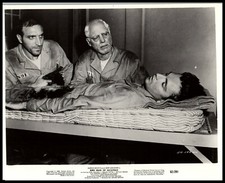
Burt Lancaster + Len Lesser in Birdman of Alcatraz (1962) ORIGINAL PHOTO M 91
$19.99
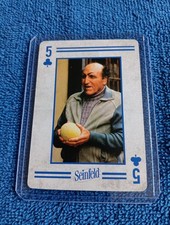
Len Lesser (Uncle Leo) Playing Card Trading Card Seinfeld Actor Comedian
$11.04