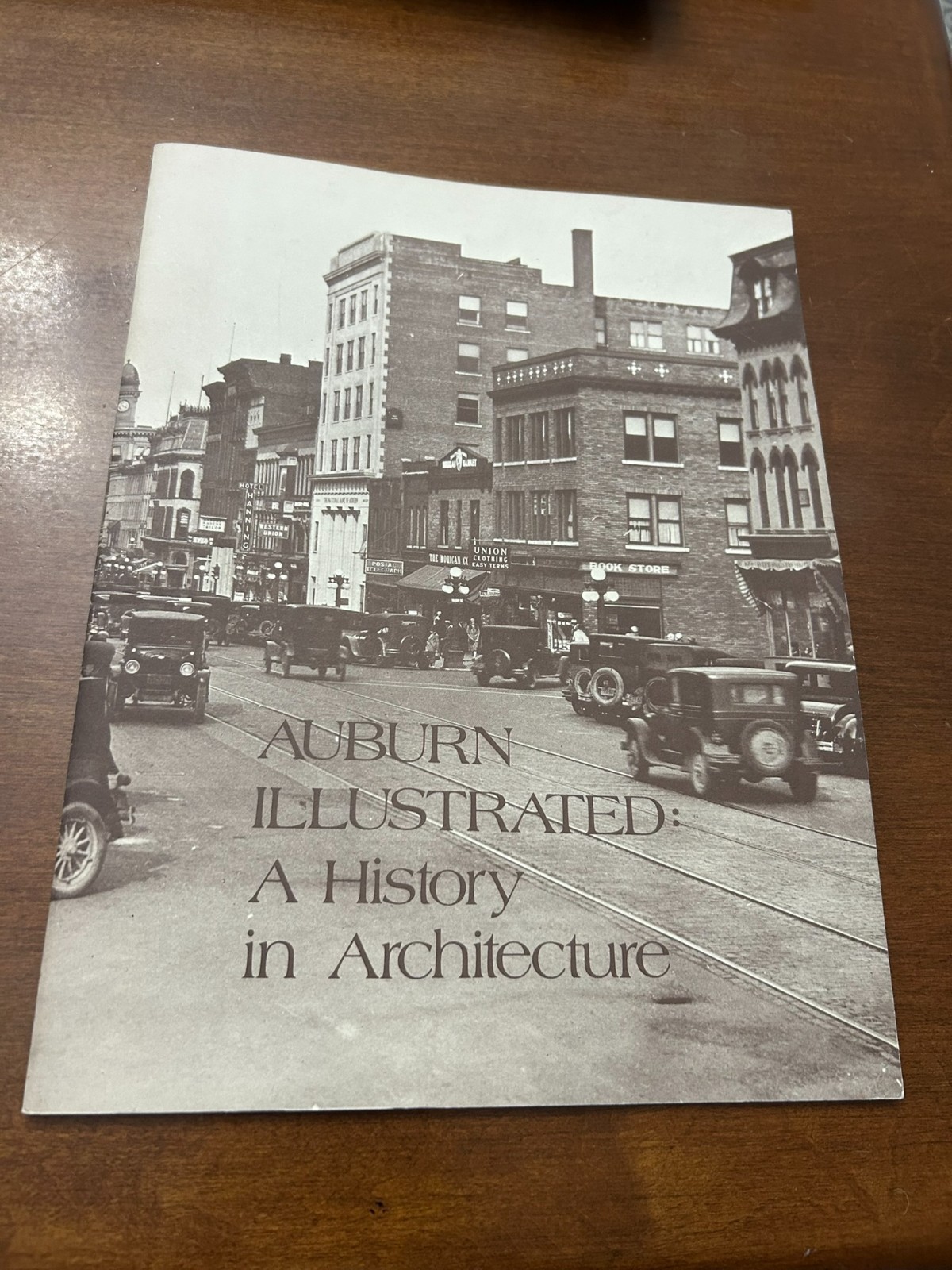
Auburn New York NY Auburn Illustrated A History in Architecture Rare Book
Great used cond!
Check my listings for more rare Auburn, NY stuff that you can\'t find anywhere else.... yearbooks, rare books, etc!
--
Auburn, New York boasts a remarkably rich architectural landscape that spans from the early federal period through the late nineteenth-century industrial boom, reflecting its status as a prominent nineteenth-century manufacturing and cultural hub in the Finger Lakes region. As the seat of Cayuga County, the city attracted ambitious builders, master architects, and wealthy industrialists who left behind an enduring built environment characterized by stately civic buildings, grand residences, and historic commercial blocks. This diverse architectural heritage serves as a tangible timeline of upstate New York\'s economic evolution, showcasing how design trends shifted from utilitarian frontier structures to high-style monuments of civic pride.
Among the city\'s most celebrated architectural landmarks is the William H. Seward House Museum, an exquisite example of Federal and Greek Revival domestic architecture originally constructed in 1816 and later expanded with Italianate styling. The residence features classic symmetrical lines, elegant porticos, and period-accurate interior detailing that housed the prominent statesman and abolitionist. Similarly, the historic Willard Memorial Chapel stands as an architectural masterpiece, renowned worldwide as the only complete, unaltered interior designed by Louis Comfort Tiffany and Tiffany Glass and Decorating Company, featuring stunning art glass windows, intricate mosaic work, and hand-carved oak woodwork.
The residential neighborhoods of Auburn are particularly noted for their remarkable concentrations of mid-to-late nineteenth-century styles, including Italianate villas, Gothic Revival cottages, and exuberant Queen Anne Victorians. Wealthy mill owners, local merchants, and civic leaders constructed grand homes along historic thoroughfares like Genesee Street, utilizing local stone, fine brickwork, and decorative millwork that highlighted the craftsmanship of the era. These domestic structures often incorporate sprawling wrap-around porches, steeply pitched roofs, and ornate bracketed cornices that define the picturesque streetscapes of the historic district.
Commercial and civic architecture in downtown Auburn further underscores the city\'s nineteenth-century prosperity, highlighted by robust Italianate and Romanesque Revival business blocks constructed after major fires necessitated urban rebuilding. Buildings feature heavy masonry load-bearing walls, decorative cast-iron storefront pilasters, arched window hoods, and ornate brick corbeling that give the central business district its cohesive, nineteenth-century character. County courthouse complexes and civic institutions erected during this period reinforced the city\'s administrative dominance in Cayuga County through imposing neoclassical facades, grand staircases, and durable cut-stone masonry.
Today, the preservation of Auburn\'s historic architecture is actively championed by local historical societies, preservation groups, and municipal initiatives dedicated to protecting the city\'s architectural legacy. Designated historic districts and landmark properties provide residents and visitors with a window into the past, ensuring that nineteenth-century engineering marvels, ecclesiastical masterpieces, and vernacular homes remain intact. Through careful stewardship and adaptive reuse, Auburn\'s historic buildings continue to anchor the community\'s cultural identity while honoring its pivotal role in Upstate New York history.

Related Items:
Auburn New York NY Auburn Illustrated A History in Architecture Rare Book
$29.99

Santa's Workshop Auburn University ornament "War Eagle for Life" NWT
$14.99
Auburn New York NY. North Street Busy Wagon Tram Bus Hadselle's Postcard 57772
$4.99