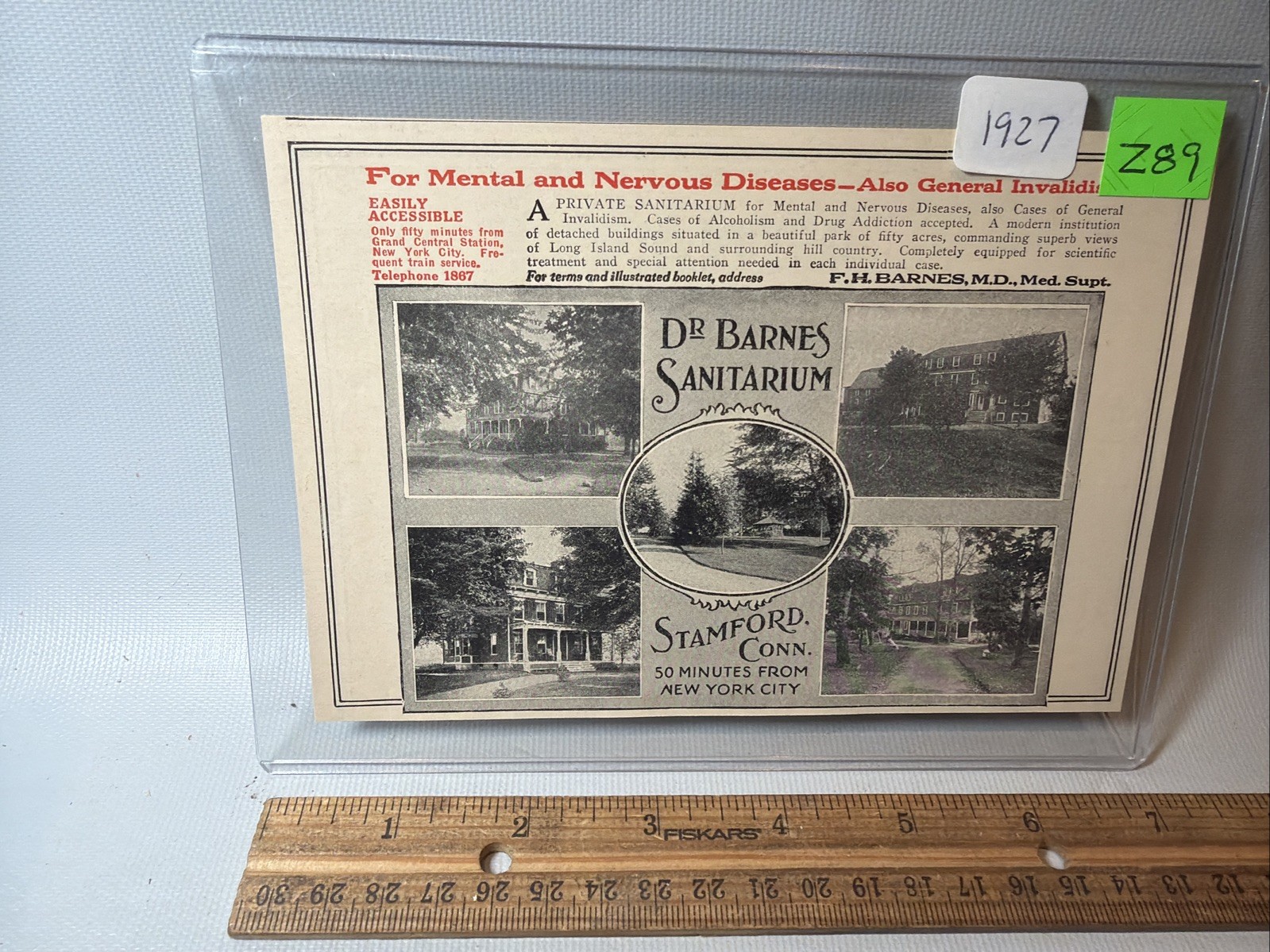
Antique Insane Asylum Sanitarium AD
Dr. Barnes Sanitarium- Stamford Connecticut
Original Advertisement from a medical Magazine for DoctorsSize Ad - 6 1/2" Wide x 4 1/2 Tall Includes Clear Plastic Protective Sleeve
ConditionAd is in Nice condition.Please see pictures for the condition.Thanks, for looking!
The Dr. Barnes Sanitarium, located in Stamford, Connecticut, was established in 1894. It was situated on a 50-acre park overlooking Long Island Sound and was designed to treat patients with mental illnesses, as well as those recovering from alcohol and narcotic addictions. The facility included multiple buildings, allowing for thorough patient classification, and even had a farm to provide fresh produce and outdoor work opportunities for patients. Dr. F. H. Barnes, a neurologist associated with the New York Post-Graduate Hospital, served as the medical superintendent.Insane asylums have a long, unsavory history — but they weren’t originally intended as sites of horror.The origins of mental asylums — an antiquated and loaded term that is now retired from the field of mental health medicine — came from a wave of reforms that professionals tried to enact in the 19th century.These facilities catered to mentally ill people with treatments that were supposed to be more humane than what was previously available. But mental health stigmatization coupled with an increase in diagnoses led to severely overcrowded hospitals and increasingly cruel behavior toward patients.These “insane asylums” subsequently turned into prisons where society’s “undesirable citizens” — the “incurables,” criminals, and those with disabilities — were put together as a way to isolate them from the public.Patients endured horrifying “treatments” like ice baths, electric shock therapy, purging, bloodletting, straitjackets, forced drugging, and even lobotomies — all of which were considered legitimate medical practices at the time. It wasn’t until the terrifying conditions at these mental health facilities were revealed through undercover investigations and patient witnesses that they were brought to light.Given the severe overcrowding, patients were no longer given private rooms of their own and shared a single bedroom with five to six other patients. There were not enough beds and there was no heating system. Patients deemed unruly were locked in cages in the open halls, a cruel means to regain order by the staff while freeing up space in the bedrooms for less troublesome patients.Patients at the hospital were locked up, neglected, and lobotomized.The staff was vastly outnumbered and overworked, which led to chaos in the halls as patients roamed free with little supervision. The facilities were overrun with squalor, the wallpaper was torn, and the furniture was grimy and dusty. Much like the facilities, the patients were no longer cared for frequently and sometimes even went without treatment or food.In addition to the facility’s declined sanitation and patient care, a new horror reared its head: an experimental lobotomy laboratory run by Walter Freeman, the infamous surgeon who was a top proponent of the controversial practice.His “ice pick” method involved slipping a thin pointed rod into the patient’s eye socket and using a hammer to force it to sever the connective tissue in the brain’s prefrontal cortex.The abandoned hospital now hosts ghost tours, which have drawn ghost hunters and fans of the supernatural.It’s unclear exactly how many victims suffered at Freeman’s hands, but it’s estimated that he carried out a total of 4,000 lobotomies in his lifetime. His lobotomies left many patients with lasting physical and cognitive damage — and some even died on the operating table.The abuse and neglect of patients inside the Asylum remained largely unknown to the public.The sanitarium system Guests, staff, and buildings
Along with high numbers of patrons, there was a large number of staff at the Sanitarium". They comprised of physicians, nurses, helpers etc." There were physicians on staff. The sanitarium became a destination for both prominent and middle-class American citizens.Therapeutic system
A composite physiologic method comprising hydrotherapy, phototherapy, thermotherapy, electrotherapy, mechanotherapy, dietetics, physical culture, cold-air cure, and health training. To assist with diagnostics and evaluation of therapeutic efficacy, various measures of physiological integrity were utilised to obtain numerous vital coefficients, "especially in relation to the integrity and efficiency of the blood, the heart, the lungs, the liver, the kidneys, stomach, intestines, brain, nerves and muscles.
Physical training
Physical exercise was an important part of the Battle Creek system, facilitating not just the improvement of muscle tone, but also of posture, respiration, and of circulation and the facilitation of anabolic and catabolic functions enabled by circulatory processes. Exercise included such components as postural, calisthetics, gymnastics, swimming, and passive methods such as mechanotherapy, vibrotherapy, mechanical massage.
Food required careful prescriptive preparation, with care also taken to ensure appetiveness and palatability were recognized. The diet lists included "scores of special dishes and hundreds of special food preparations, each of which has been carefully studied in relation to its nutritive and therapeutic properties," with the diet lists used "by the physicians in arranging the diet prescriptions of individual patients.
List of Sanatoria in the United StatesEst. Name Location Notes Ref.
1853 Batavia Institute Batavia, Illinois [1]
1866 Battle Creek Sanitarium Battle Creek, Michigan [2]
1881 Brooklyn Home for Consumptives Brooklyn, New York [3]
1881 Rockhaven Sanitarium Crescenta Valley, California [4]
1884 Montefiore Home for Chronic Invalids Manhattan, New York [5]
1885 Adirondack Cottage Sanitarium Saranac Lake, New York [6]
1887 Sierra Madre Villa Pasadena, California [7]
before 1894 Camp Harding Colorado Springs [8]
1896 River Crest Sanitarium Astoria, New York [9]
1899 National Jewish Health Denver, Colorado [10]
1900 Bromley Sanitarium Sonora, California [11]
1902 Barlow Respiratory Hospital Los Angeles, California
1903 Pottenger Sanatorium Monrovia, California [12]
1904 Temple Sanitarium Temple, Texas
1904 Las Encinas Sanitarium Pasadena, California [13]
1904 Paradise Valley Hospital California National City, California
1905 Swedish Medical Center Englewood, Colorado
1905 Portland Open-Air Sanatorium Milwaukie Heights, Oregon [14]
1905 Oregon State Tuberculosis Hospital Salem, Oregon [15]
1907 Boston Consumptives Hospital Boston, Massachusetts
1907 Missouri State Sanatorium Mount Vernon, Missouri [16]
1907 Maryland Tuberculosis Sanitorium Sabillasville, Maryland
1907 Edward Sanitorium Naperville, Illinois
1907 Minnesota State Sanatorium for Consumptives Walker, Minnesota
1907 Wisconsin State Tuberculosis Sanatorium Wales, Wisconsin [17]
1907 Vermont Sanatorium Pittsford, Vermont [18]
1909 Arkansas Tuberculosis Sanatorium Booneville, Arkansas [10]
1909 Catawba Sanatorium Roanoke, Virginia [19]
1909 La Vina Sanitarium Altadena, California [20]
1909 San Haven Sanatorium Dunseith, North Dakota [21]
1910 Undercliff State Hospital Meriden, Connecticut
1910 Waverly Hills Sanatorium Jefferson County, Kentucky [22]
1910 Pine Camp Tuberculosis Hospital Richmond, Virginia [23]
1911 Firland Sanatorium Seattle, Washington [24]
1911 Lima Tuberculosis Hospital Lima, Ohio
1912 Blackburn Sanitarium Klamath Falls, Oregon [25]
1912 Pine Bluff State Hospital Salisbury, Maryland
1913 Sample Sanitarium Fresno, California [26]
1913 State Tuberculosis Sanitarium Galen, Montana [27]
1914 Belgum Sanitarium Richmond, California [28]
1914 Saratoga County Homestead Providence, New York
1915 Chicago Municipal Tuberculosis Sanitarium Chicago, Illinois
1915 Enid Government Springs Sanatorium Enid, Oklahoma
1915 Muirdale Tuberculosis Sanatorium Milwaukee County, Wisconsin
1916 Glen Lake Sanatorium Hennepin County, Minnesota
1916 Cresson Tuberculosis Sanatorium Cresson, Pennsylvania
1917 Hot Lake Sanitorium Hot Lake, Oregon [29]
1917 Piedmont Sanatorium Burkeville, Virginia [30]
1918 Bancroft's Castle Groton, Massachusetts
1919 Cranberry Specialty Hospital Hanson, Massachusetts
1919 Fairview Sanatorium Normal, Illinois [31]
1919 Washington County Tuberculosis Hospital Barre, Vermont [32]
1920 Olive View Sanitarium Los Angeles, California [33]
1920 Pureair Sanatorium Bayfield County, Wisconsin
1922 Deborah Heart and Lung Center Browns Mills, New Jersey
1922? El Sausal Sanitarium Salinas, California [34]
1922 Henryton State Hospital Marriottsville, Maryland
1923 Halifax County Home and Tubercular Hospital Halifax, North Carolina
1923 Caverly Preventorium Pittsford, Vermont [35]
1926 National Methodist Sanatorium Colorado Springs, Colorado
1927 Hassler Health Farm San Carlos, California
1928 King County Tuberculosis Hospital Seattle, Washington [36]
1930 Lake View Sanatorium Madison, Wisconsin [37]
1933 Sioux San Hospital Rapid City, South Dakota
1934 Arizona State Tuberculosis Sanatorium Tempe, Arizona [38]
1934 Glenn Dale Hospital Glenn Dale, Maryland
1936 Dr. Hudson Sanitarium Newton County, Arkansas [39]
1939 University Tuberculosis Hospital Portland, Oregon [15]
1940 Edgewood State Hospital Deer Park, New York
Key Words
Hospital Medicine is the fasting growing field of Medicine, and the importance of hospitalists in the delivery of care and success of hospitals continues to increase. The practice of hospital medicine is both rewarding and challenging: hospitalists need to provide high-quality care using the best available evidence in an efficient, cost-effective manner. In recognition of the need for rapid access to essential information, this text provides a concise yet comprehensive source for busy clinicians. Essentials of Hospital Medicine provides detailed reviews of all clinical topics in inpatient medicine, including common diagnoses, hospital-acquired conditions, medical consultation, and palliative care, as well as key non-clinical topics, such as quality improvement tools, approach to medical errors, the business of medicine, and teaching tips. It is the single source needed for hospitalists striving to deliver outstanding care and provide value to their patients and hospitals. Hospital Medicine provides practical, concise evidence-based information on the diagnosis and treatment across the spectrum of illness and injury in the hospital setting. This book features a simple, accessible template for each subject, and quick and easy references to the relevant literatureDisplay Art Picture sign decor Antique State Medical Book Doctor Ads Medicine Dr Book, Magazine

Related Items:
Atq 1927 Dr Barnes Sanitarium Insane Asylum Stamford Connecticut NYC Picture AD
$29.99
Atq 1927 ACME Precision X-Ray Physical Therapy Medical Equipment Picture AD
$34.99
Atq 1927 Petrolager Pharmaceutica Medicine Chronic Constipation Chicago Picture
$34.99