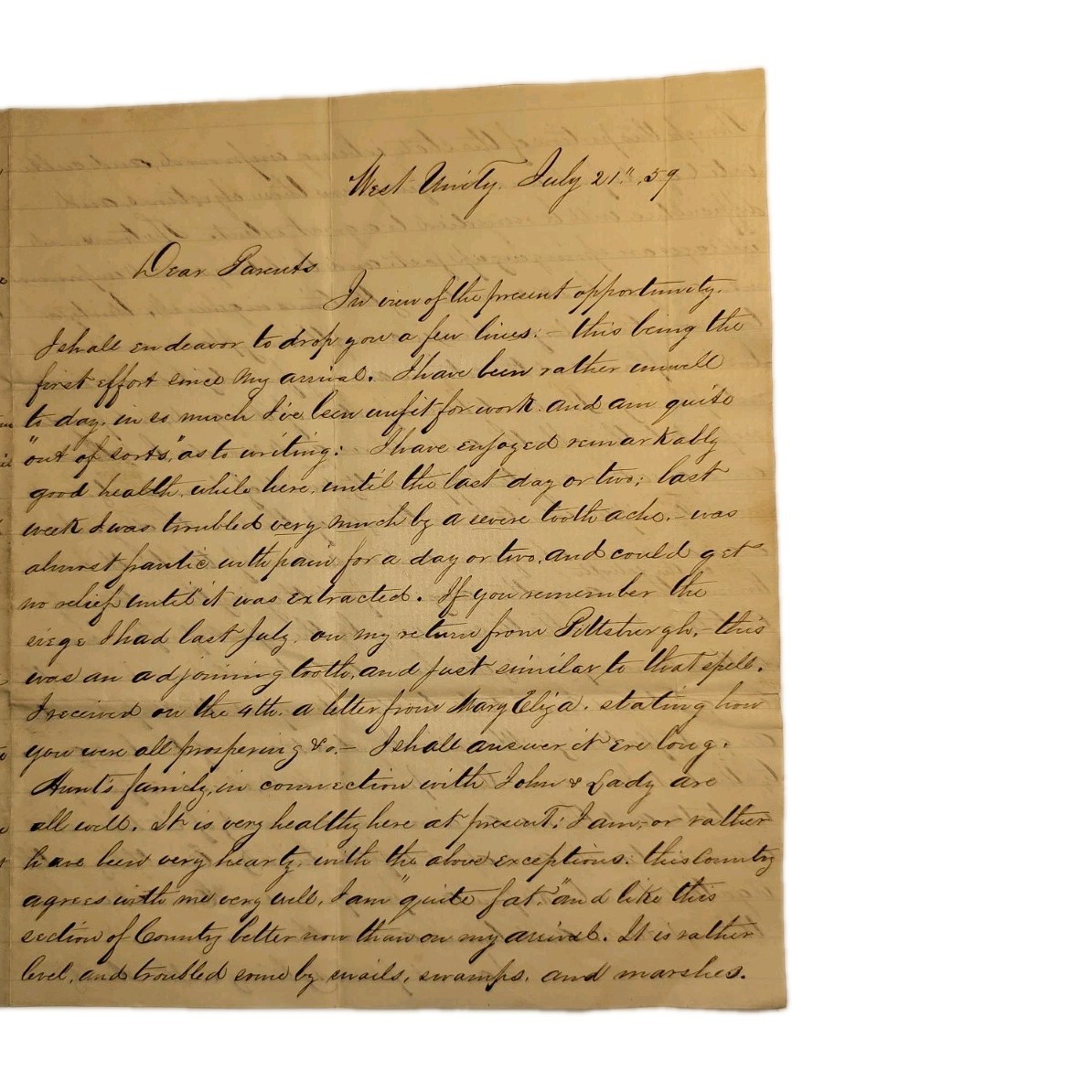
The letter is notable for its combination of early Ohio settlement observations, artistic career content, Methodist moral commentary, family history, and an unusually vivid eyewitness account of domestic violence inside the Daniel Cook household.
James was staying with his aunt Rebecca Kenney Cook and her husband Daniel Cook near West Unity. The family can be reconstructed through Washington County, Pennsylvania and Williams County, Ohio records. James was the son of Rev. Wesley Kenney, a Methodist Episcopal minister connected with the Pittsburgh Conference, making Rebecca Kenney Cook his paternal aunt.
This is not a routine family letter. James gives a detailed, private description of Daniel Cook violently attacking his own son Bentley, threatening another son, John, and terrorizing the household. James then asks his parents not to reveal that he had written about the incident.
Summary of the Letter
James begins by reporting that he has been somewhat ill and recently suffered an agonizing toothache requiring extraction. He compares it with a similar episode following a previous trip to Pittsburgh.
He mentions receiving a letter from Mary Eliza, likely his sister, and reports that his aunt\'s family and John\'s family are well.
He then gives a useful description of northwestern Ohio in 1859. James comments on:
- the flat terrain and marshy ground
- rapid cultivation and settlement
- growing towns and villages
- the business activity of West Unity
- local Sabbath observance and violations
- wheat and corn crops
- corn already in tassel and reportedly reaching about twelve feet
- improving economic conditions
James was living with his aunt and uncle in a large new frame house that was not yet fully finished. He compares its arrangement and design to the house of J. P. Ailes, a reference his parents evidently would have immediately recognized from their home region in southwestern Pennsylvania.
James expected to paint the Cook house and was also pursuing his own artistic work.
Extraordinary Domestic Violence Account
The most historically important portion of the letter concerns James\'s uncle, Daniel \"Dan\" Cook.
James writes that he dislikes the way Cook treats his family and describes him in extraordinarily harsh language as:
“a tyrant, brute, or a devil in the form of flesh”
He then recounts an incident occurring on the previous Sabbath.
According to James, Cook became enraged at his son Bentley Cook, who was about James\'s size, and violently attacked him. James states that Cook:
- broke a broom over Bentley
- seized a heavy board
- struck him with it
- attempted to obtain another club
- beat him “ungodly for nothing”
James says John W. Cook then came over to calm the situation, resulting in a major confrontation between John and his father.
James further states that Daniel Cook had threatened to kill John, had beaten his children “worse than brutes,” and sometimes behaved “as a maniac.”
He concludes this section with the striking confidential instruction:
“for my sake say, never let any of the folks know I wrote this”
This passage makes the letter a particularly compelling primary-source record of domestic abuse in a mid-19th-century American household.
James A. Kenney and His Artistic Career
James describes himself as actively working as an artist and painter.
He writes that he has:
- several pictures on his easel
- visitors coming to see his work
- prospective customers asking for pictures
- specimens that he considers better than anything he had previously painted
He also writes:
“I learned considerable while in Cincinnati.”
James hoped to return to Cincinnati in the fall and obtain a position with an unnamed:
“Eminent Artist”
who had apparently already promised him employment or instruction.
He praises this artist as:
“far ahead of anything in Pitt.”
James also planned to seek work in West Unity and Bryan, Ohio.
This gives the letter unusual interest for the history of itinerant American artists, portrait painters, decorative painters, and regional art training before the Civil War.
Biography: James A. Kenney
James A. Kenney, born circa 1838–1840 in Pennsylvania, was the son of Rev. Wesley Kenney and Eliza Kenney.
He was approximately nineteen to twenty-one years old when this letter was written.
James appears to have pursued both fine-art painting and practical painting work. His references to easel paintings, “specimens,” potential customers, Cincinnati artistic instruction, and possible employment with an established artist suggest that he was attempting to build a professional career.
His closing remarks reveal the influence of his Methodist upbringing. He reassures his parents that he intends to:
“select my company, avoid all bad habits”
and spends considerable space criticizing local violations of Sabbath observance.
Biography: Rev. Wesley Kenney
Rev. Wesley Kenney, born circa 1808 in Washington County, Pennsylvania, was a Methodist Episcopal minister and a son of Benjamin Kenney and Elizabeth Blair Kenney.
He was associated with the Pittsburgh Conference and served within the Methodist Episcopal ministry during a period of rapid denominational expansion in western Pennsylvania.
His ministerial career helps explain James\'s strong religious language, concern with Sabbath observance, and moral tone throughout the letter.
The Kenney family had longstanding ties to Washington County and the Pittsburgh region, which also helps explain James\'s reference to returning from Pittsburgh in 1858.
Biography: Rebecca Kenney Cook
Rebecca Kenney Cook was a daughter of Benjamin Kenney and Elizabeth Blair and a sister of Rev. Wesley Kenney.
She married Daniel Cook and moved west to the West Unity/Brady Township area of Williams County, Ohio.
She is the “Aunt” with whom James was staying in July 1859.
During the violent scene described in the letter, Rebecca becomes distressed and leaves the immediate confrontation while John attempts to intervene.
Biography: Daniel Cook
Daniel Cook, born around 1805 in Germany, was a miller and later landowner in the West Unity / Brady Township area of Williams County, Ohio.
He married Rebecca Kenney and raised a large family.
In this letter, however, he is portrayed in extremely disturbing terms by his nephew James, who accuses him of repeated violence against his children and severe abuse within the household.
Because James was writing privately to his parents and specifically asked them to keep the disclosure secret, the passage has particular value as an intimate contemporary testimony.
Biography: Bentley Cook
Bentley Cook, born circa 1841–1842, was a son of Daniel and Rebecca Cook.
He was approximately seventeen years old at the time of the letter.
James specifically describes Bentley as being “about my size” and gives a detailed eyewitness account of Daniel Cook assaulting him with a broom and heavy board.
Bentley\'s age and identity strongly correspond with the known Cook family household.
Biography: John W. Cook
John W. Cook, born December 8, 1834, in Washington County, Pennsylvania, was another son of Daniel and Rebecca Cook.
He married Minerva W. Sharpless on April 28, 1859, only a few months before this letter was written.
This explains James\'s reference to:
“John & family”
John had already established his own household nearby.
In the letter, John comes to intervene during Daniel Cook\'s violent outburst and argues intensely with his father.
Historical Importance
This manuscript is valuable for several overlapping areas of historical interest:
Early Ohio settlement and agriculture
James describes West Unity and surrounding Williams County during a period of rapid growth and cultivation.
American art history
He provides a rare first-person glimpse into the life of a young itinerant painter moving between Pennsylvania, Cincinnati, and northwestern Ohio.
Methodist social culture
James\'s language reflects the moral and religious environment of a Methodist minister\'s household.
Domestic violence history
The Cook episode is an unusually explicit and private 1859 eyewitness account of physical abuse within a family.
Genealogy
The letter connects the Kenney family of Washington County, Pennsylvania with the Cook family of Williams County, Ohio.
Condition
Original four-page manuscript letter with expected folds, toning, edge wear, and age-related handling consistent with an 1859 document.
Please examine photographs carefully for exact condition.
A compelling pre-Civil War Ohio manuscript combining genealogy, art history, frontier settlement, Methodist culture, and a remarkable confidential account of domestic violence.

Related Items:
1859 President James Buchanan Secretarial Signed Land Deed Military Document
$175.00
1859 James Buchanan Land Patent War Of 1812 Tennessee
$595.00
1859 James A. Kenney ALS West Unity Ohio Artist Cincinnati Domestic Violence
$755.25