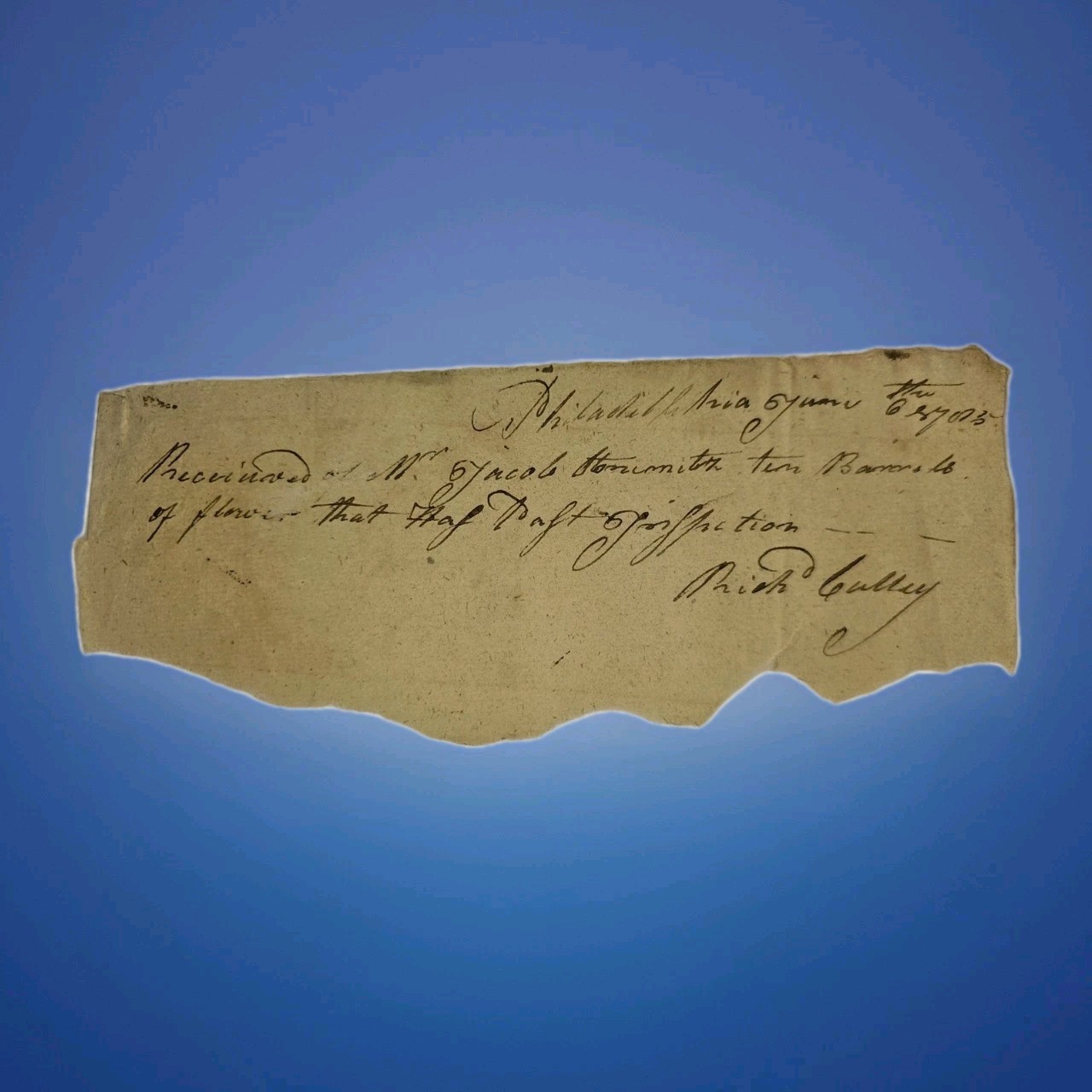
1785 PHILADELPHIA MERCHANT RECEIPT — TEN BARRELS OF FLOUR — SIGNED BY RICH CALLEY — MADE OUT TO THE OTHERWISE UNRECORDED JACOB STONSMITH
Offered here is an original June 24, 1785 handwritten commercial receipt from Philadelphia, dating to the early post-Revolutionary era when the young United States was still governed under the Articles of Confederation. Documents from this exact period (1783–1789) are notably scarce, especially outside of government or military contexts.
The receipt reads:
> “Philadelphia, June the 24th 1785
Received of Mr. Jacob Stonsmith ten Barrels of flower, that has my full satisfaction —
Rich Calley”
This is a classic early American flour-trade receipt—a vital part of Philadelphia’s economy. In the 1780s, Philadelphia was the largest flour-exporting port in North America, and merchants, haulers, and mill workers frequently exchanged handwritten receipts exactly like this as part of daily commerce. Very few survive today.
---
🔍 Who Were the Men Mentioned?
Jacob Stonsmith
No well-documented person by this name appears in surviving Pennsylvania records, making this a rare unrecorded working-class tradesman from the Philadelphia supply chain. The surname Stonsmith (a variant of “stone-smith,” an occupational name used by Pennsylvania German families for stonecutters, millstone makers, and haulers) fits perfectly with someone delivering 10 barrels of flour into the city.
This document may represent one of the only surviving traces of his activity.
Rich Calley
“Rich Calley” (Richard Calley) appears in Philadelphia around this period and is very likely connected with the waterfront and commercial hauling trades. A man of this name later appears in Philadelphia shipping notices as a ship’s master in the 1790s, consistent with someone accustomed to handling commercial cargos and issuing receipts.
This 1785 signature is an early example of his recorded activity.
---
📌 Historical Significance
1785 is a prime date—only two years after the Treaty of Paris ended the Revolution and four years before the US Constitution.
Philadelphia was the commercial capital of the new nation.
Flour was its largest export, making this a direct artifact of America’s most important early industry.
Working-class merchant receipts rarely survive due to heavy use and low perceived importance, making this an unusually scarce example.
The document is written on hand-cut rag paper with strong iron-gall ink, showing normal period wear along the lower edge and otherwise very good condition for 239 years old.
---
📏 Size
Approx. 9.5 x 3 inches (hand-cut).
---
📦 Shipping
Ships well-protected with archival backing, rigid mailer, and full insurance.

Related Items:
1785 Philadelphia Shipping Receipt – Sloop Hope – 24 Barrels Flour – Rich Calley
$225.58
1785 Philadelphia Bank Draft Signed by Josiah and Samuel Coates to John Rudle
$315.88
1785 Philadelphia Flour Receipt – Jacob Stonsmith to Rich Calley – Rare Early...
$166.25