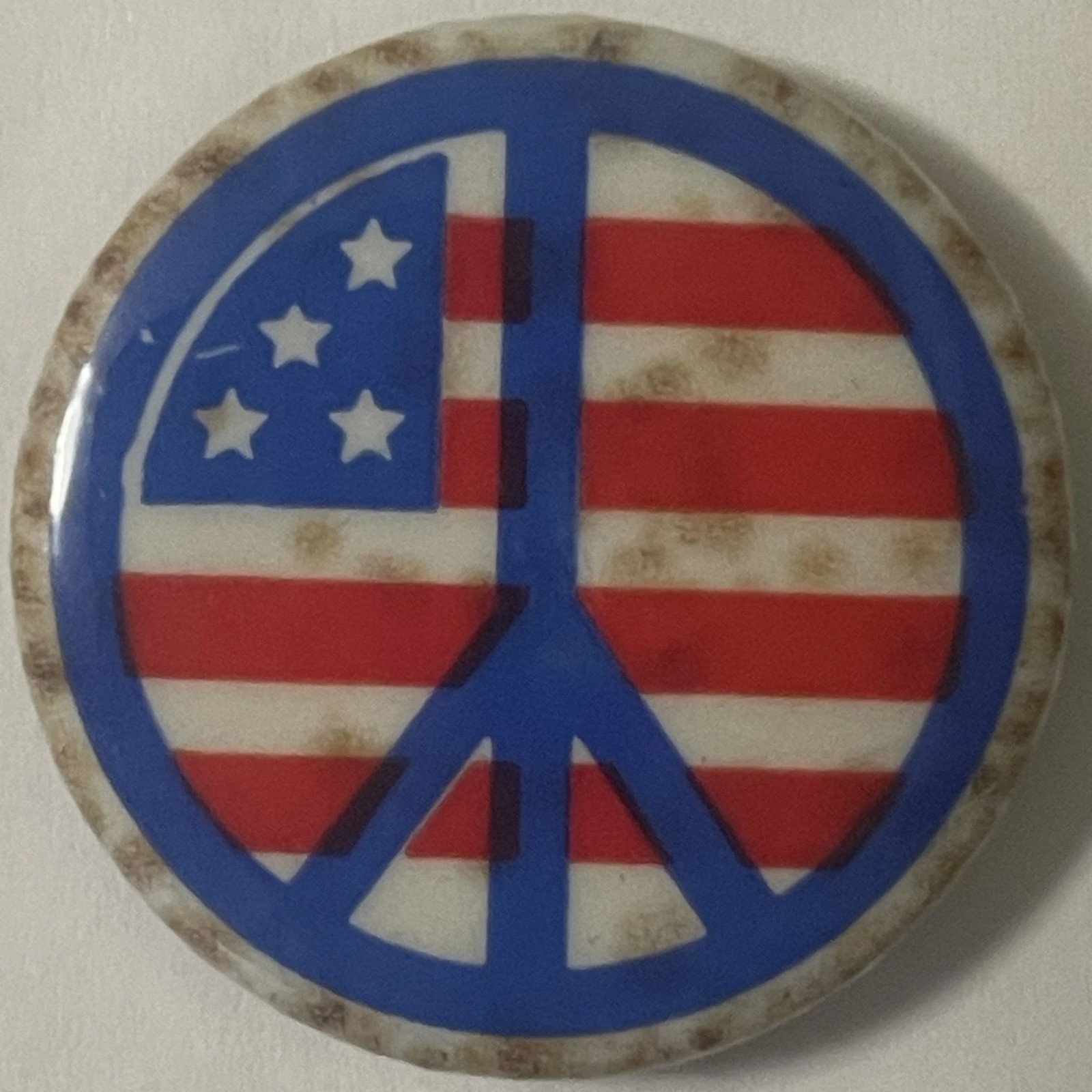
✌️ The man who drew this symbol spent the rest of his life wishing he had drawn it upside down.
He never got his wish — and he never took a penny for the design either, which is the only reason a cheap little pin like this one could exist at all. A blue peace sign laid straight across the Stars and Stripes, new old stock, never worn.
1 1/4 inches across ~ about a quarter and a bit.
📋 SPECIFICATIONS
- What it is: round lithographed tin pinback button
- Design: blue peace symbol over an American flag ground — stars in the canton, red and white stripes running through
- Size: 1 1/4 inches across ~
- Back: plain grey metal shell, rolled rim, one straight wire pin soldered across
- Markings: none. No maker, no union bug, no copyright line — face or curl. A small embossed oval is stamped into the back shell and it will not resolve under magnification, so no maker is claimed
- Era: the Vietnam years — the peace symbol reached American campuses in 1960 and this flag pairing ran right through the decade and past it
🔎 CONDITION
New old stock. This one never went out on a lapel — it sat in a box instead, which is why the color still reads this strong. Pin is present, straight and closed. My pictures seriously don't do it justice; the blue is deeper in the hand than it photographs. Please look at the pictures and judge for yourself.
☮️ IT IS NOT A SYMBOL — IT IS A MAN SPELLING TWO LETTERS
Look at the face as a figure instead of a shape. That vertical stroke is the flag-semaphore signal for the letter D. The two strokes angling down are the letter N. N and D — Nuclear Disarmament, written in the old maritime alphabet sailors used to talk ship to ship without a word between them, then ringed in a circle.
Gerald Holtom drew it in February 1958 for the very first Aldermaston march — a working designer, a Royal College of Art graduate, a conscientious objector. He said the rest out loud himself: he was in deep despair over the bomb, and drew himself as a figure with the palms stretched out and down, in the manner, he said, of Goya's peasant standing in front of the firing squad in The Third of May 1808.
Then he regretted the posture. He redrew it with the arms raised — semaphore U, for unilateral disarmament — because he felt the arms-down figure spoke only of despair when he had wanted to give people hope. The story handed down is that he asked for the raised version on his own gravestone and never got it. The arms-down one became the most recognised protest mark on earth instead. And he never copyrighted any of it. CND says it plain: quite deliberately never copyrighted, nobody has to pay or ask. That is why this mark could cross an ocean and land inside a flag it was never drawn for.
🇺🇸 TWO SETS OF COLORS, ARGUING
The peace symbol's first colors were church colors. Over the Easter weekend of 1958 five hundred cardboard lollipop signs went up the road, half black on white and half white on green, so the march turned with the calendar — mourning into Easter, winter into spring, death into life.
The flag's colors were spoken for long before that. Charles Thomson, Secretary of the Continental Congress, set them out in 1782 with the Great Seal: white for purity and innocence, red for hardiness and valour, blue for vigilance, perseverance and justice.
So somebody laid a mark drawn out of one man's despair, in Easter colors, straight across a field that officially means valour and justice. No slogan. No caption. Just color on color — the whole argument of those years, on something you pin on with one hand.
🎓 HOW IT REACHED AMERICA
In 1960 a University of Chicago freshman named Philip Altbach went to England as a delegate of the Student Peace Union, saw British campaigners handing out buttons carrying the mark, and brought a stack home in his luggage. He talked the SPU into adopting it, and between 1960 and 1964 that student group sold thousands of these buttons on campuses across the country. For most Americans, that was the first peace sign they ever laid eyes on.
The SPU was started in the spring of 1959 in Chicago, Illinois by Ken Calkins, who had already had his pelvis fractured sitting down in front of a truck at the first Atlas missile site twenty miles northwest of Cheyenne, Wyoming. About a hundred members at the end of 1959; fifteen hundred by December 1961; thirty-five hundred a year after that. The group came apart in a factional fight in the spring of 1964, got refounded that fall, and merged into the Independent Students' Union in 1967 — by which time the symbol belonged to everybody, exactly as refusing a copyright had guaranteed it would.
⚛️ THE COINCIDENCE NOBODY MENTIONS
The Student Peace Union worked out of Hyde Park, beside the University of Chicago. On 2 December 1942, in a squash court under the west stands of old Stagg Field on that same campus, Enrico Fermi's team brought Chicago Pile-1 critical — the world's first self-sustaining nuclear chain reaction. Manhattan Project scientists at that same university founded the Bulletin of the Atomic Scientists in 1945, and in 1947 the Bulletin gave the world the Doomsday Clock, first set at seven minutes to midnight. Henry Moore's bronze Nuclear Energy stands on the reactor site today, unveiled at 3:36 in the afternoon on 2 December 1967, twenty-five years to the minute.
So the first peace buttons printed on American soil came off a press a short walk from where the atom was first split to a chain, in the city that had just built a clock counting down to midnight. It takes hours to run a thing like that down. Little neat facts like that are why I bother.
🕯️ THE LORE
- Badges built to outlive the bomb. The first wearable peace badges were made by Eric Austin of Kensington CND from white clay with the symbol painted on in black, and they went out with a note explaining that in a nuclear war these fired pottery badges would be among the few human-made things left to survive it.
- The Button Man. Collectors trace this design — symbol laid over the flag rather than beside it — back to Larry Fox, known through the movement simply as the Button Man, who turned out buttons for the Student Peace Union, SDS and the Mobilization and copyrighted a Peace Flag design in 1965 out of Hempstead, New York. Fox's own buttons carry his name round the curl. This one carries nothing, so take that as the story collectors tell about the design and not a claim about this pin.
- The upside-down one. Run into enough collectors and one of them will insist the correct peace sign has its arms up. He is quoting Holtom, and he is right about what the man wanted.
🎯 GOOD FOR
- A denim jacket collar, a lapel or a tote strap — worn the way it was meant to be worn
- A shadow box of movement-era pins, armbands and campaign buttons
- Teaching how a semaphore code out of Berkshire became an American household mark inside ten years
- Anybody who wore one of these in 1969 and has not held one since
Grab it while I still have a few. Packed carefully and out to you quickly — and thank you for helping me keep this stuff from disappearing. ✌️

Related Items:
Vintage 1970s IKE Cast Brass Bronze Peace Symbol Ankh Cross Ashtray Incense Base
$295.00
Vintage Peace sIgn Light up Ceramic Santa 6"
$19.75
Vintage 1999 Westinghouse Peace Sign Daisy Hippie Spinning Carousel Lamp *READ*
$39.99