|
|
|
|
Classic Car Parts Home >
Vintage 1962 Actors Equity Contract Unsinkable Molly Brown Iva Withers Signed for sale

When you click on links to various merchants on this site and make a purchase, this can result in this site earning a commission. Affiliate programs and affiliations include, but are not limited to, the eBay Partner Network.

Vintage 1962 Actors Equity Contract Unsinkable Molly Brown Iva Withers Signed:
$222.00
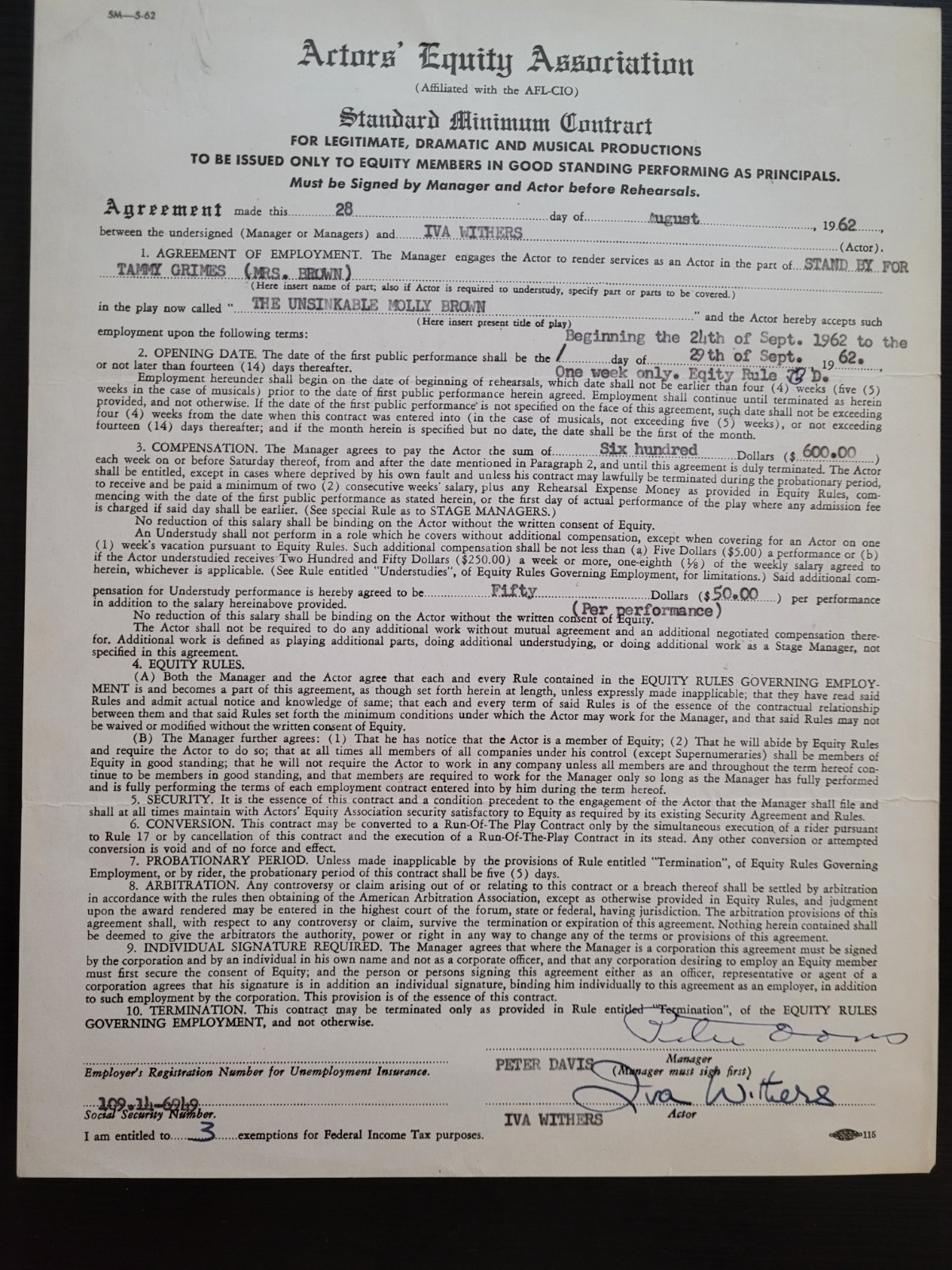
Full Transcription of the Document (Header) Actors' Equity Association (Affiliated with the AFL-CIO) Standard Minimum Contract FOR LEGITIMATE, DRAMATIC AND MUSICAL PRODUCTIONS TO BE ISSUED ONLY TO EQUITY MEMBERS IN GOOD STANDING PERFORMING AS PRINCIPALS. Must be Signed by Manager and Actor before Rehearsals.
(Agreement Section) Agreement made this 28 day of August, 19 62, between the undersigned (Manager or Managers) and IVA WITHERS (Actor). 1. AGREEMENT OF EMPLOYMENT. The Manager engages the Actor to render services as an Actor in the part of STAND BY FOR TAMMY GRIMES (MRS. BROWN) (Here insert name of part; also if Actor is required to understudy, specify part or parts to be covered.) in a play now called "THE UNSINKABLE MOLLY BROWN" (Here insert present title of play) and the Actor hereby accepts such employment upon the following terms: Beginning the 24th of Sept. 1962 to the One week only. Equity Rule 70b. 2. OPENING DATE. The date of the first public performance shall be the 29th day of Sept., 19 62, or not later than fourteen (14) days thereafter. 3. COMPENSATION. The Manager agrees to pay the Actor the sum of Six hundred Dollars ($ 600.00 ) each week on or before Saturday thereof...
(Signatures & Bottom Sections) ## History of the Item The Document: This is an original, vintage Actors' Equity Association Standard Minimum Contract dated August 28, 1962. The Production: It engages Broadway actress Iva Withers to act as a "stand-by" for the legendary Tammy Grimes (who played the title role of Molly Brown) in the hit musical The Unsinkable Molly Brown. The Signatories & Context: The contract features the ink signatures of actress Iva Withers (known for her extensive Broadway career, including roles in Oklahoma!, Carousel, and The Music Man) and manager Peter Davis. It details a weekly salary of $600.00 plus $50.00 per performance for understudy duties, capturing a fascinating piece of 1960s Broadway theater Iva Edith Withers (July 7, 1917 – October 7, 2014) was a Canadian-born American actress and singer, best remembered as a replacement player who had long runs in some of Rodgers and Hammerstein's biggest musical theatre hits. From 1945 to 1970, she worked almost continuously on Broadway or in national tours, generally as a replacement.
Withers was first hired about 1943 to understudy the leading ladies in the Broadway casts of Oklahoma! and Carousel. She soon replaced the original star of Carousel, playing Julie Jordan more than 600 times on Broadway and becoming the first Julie in London in 1950. She was next a replacement for Adelaide in Guys and Dolls. She was a replacement or standby in more than a half dozen other Broadway shows throughout the 1950s and 1960s, and she also toured North America in the leading roles in Carousel, South Pacific and Gentlemen Prefer Blondes. Her last Broadway role was in Forty Carats (1968–1970), after which she left show business.
Early life and careerWithers was born in Rivers, Manitoba, Canada, the daughter of Roy and Edith Withers, an insurance salesman and a seamstress, respectively, who had emigrated from Ireland around 1913. As a child in Winnipeg, Manitoba, she appeared in local vaudeville productions and continued to sing in church during her teenage years.[1] She moved to New York in 1940 to study singing "so she could improve her voice when she performed in church". She spent seven months in 1942 in wartime England searching for her brother and boyfriend, both of whom had been killed.[2][3] She took voice lessons from Estelle Liebling.[4]
Withers returned to New York to audition for roles on Broadway, shortening her name to Iva Withers. About 1943, she was hired by Rodgers and Hammerstein in the ensemble of Oklahoma!. She later understudied the leading soprano roles in Oklahoma! and Carousel.[1][5] She recalled, "There was even a Saturday that summer [of 1945] where I played Julie in Carousel at the matinee and Laurey in Oklahoma! in the evening and had to hurry from the Majestic Theatre to the St. James Theatre in between."[6] This feat made Withers the first actress ever to play the lead in two different Broadway hits in one day.[7] She played Laurey during the month of September 1945.
Broadway leads and later years
Withers as Julie in Carousel in 1947Withers replaced Jan Clayton on January 1, 1946,[8] eventually playing Julie Jordan more than 600 times on Broadway, and was the first Julie in the original London production of Carousel in 1950. The English critic Philip Hope-Wallace wrote that she achieved real pathos in the role.[9] She next was a replacement for Adelaide in Guys and Dolls in the original Broadway production. She also played in American national tours as Julie in Carousel, Nellie in South Pacific and Lorelei Lee in Gentlemen Prefer Blondes. Other Broadway roles included Janette in Make a Wish (1951, as standby), May in Redhead (1959, as replacement), Molly in The Unsinkable Molly Brown (1960 as standby), Cyrenne in the stage version of Rattle of a Simple Man (1963, as understudy), Elvira in High Spirits (1964, as standby) and Suzanne and Felice in The Happy Time (1968, as standby).[10]
Her last Broadway role (1968–70) as "Mrs. Adams" in Forty Carats, the only role that she ever created,[1] and also as standby to Julie Harris, and later Zsa Zsa Gabor, in the leading role of Ann Stanley.[10] In August 1970, she went on for a matinee show when Gabor was too upset to perform after having been robbed of $600,000 in jewels at gunpoint that morning. Gabor returned for the evening performance.[11] She left show business after Forty Carats, fed up with fighting the show's producers over the "extra $75″ she was supposed to be paid when actually filling in at a performance.[2][3]
DeathIva Withers died in Englewood, New Jersey at age 97 on October 7, 2014, at the Lillian Booth Actors Home.[1]
FamilyIn 1943 Withers married Robert Strom. While on tour in Carousel in 1946, she met Kazimir Kokich, a former Ballet Russe de Monte Carlo ballet dancer turned Broadway actor-dancer. He was also married at the time. In 1949, both annulled their marriages and married.[1] His first wife was ballerina Alexandra Danilova,[6] who remained friendly with the family after he remarried.[12]
Kokich was an American World War II veteran who increasingly struggled with alcoholism; by the late 1960s, this prevented him from working, and he eventually returned to his native Croatia. After leaving the stage, Withers supported herself and their two children by doing clerical work for physicians, retiring at age 77.[6] Their daughter, Kim Alexandra Kokich, is a reporter with NPR.[12][13] Their son is Jerry Kokich, a ballet coach and former dancer with the Joffrey Ballet.[1][14]
Rodgers and Hammerstein was a theater-writing team of composer Richard Rodgers (1902–1979) and lyricist-dramatist Oscar Hammerstein II (1895–1960), who together created a series of innovative and influential American musicals. Their musical theater writing partnership has been called the greatest of the 20th century.[1]
Their popular Broadway productions in the 1940s and 1950s initiated what is considered the "golden age" of musical theater.[2] Five of their Broadway shows, Oklahoma!, Carousel, South Pacific, The King and I and The Sound of Music, were outstanding successes, as was the television broadcast of Cinderella (1957). Of the other four shows the pair produced on Broadway during their lifetimes, Flower Drum Song was well-received, and none was a critical or commercial flop. Most of their shows have received frequent revivals around the world, both professional and amateur. Among the many accolades their shows (and film versions of them) garnered were 34 Tony Awards,[3] fifteen Academy Awards, two Pulitzer Prizes (for Oklahoma!, 1944, and South Pacific, 1950) and two Grammy Awards.
Previous work and partnerships
Program for Fly With Me, 1920At Columbia University, Rodgers and Hammerstein collaborated on the 1920 Varsity Show, Fly With Me. The songs for the show were originally written by Rodgers (a freshman) and Lorenz Hart. Hammerstein, who was on the judging committee, added two songs in the revising stage. The three men collaborated again on the 1921 Varsity Show, You'll Never Know, with Hammerstein as "Director of Production".[4] Although Rodgers did not work with Hammerstein again until Oklahoma!, they achieved success independently from each other. Rodgers continued to collaborate for more than two decades with Hart. Among their many Broadway hits were the shows A Connecticut Yankee (1927), Babes in Arms (1937), The Boys from Syracuse (1938), Pal Joey (1940), and By Jupiter (1942), as well as many successful film projects.[5]
Hammerstein, a co-writer of the popular Rudolf Friml 1924 operetta Rose-Marie, and Sigmund Romberg operettas The Desert Song (1926) and The New Moon (1928), began a successful collaboration with composer Jerome Kern on Sunny (1925), which was a hit. Their 1927 musical Show Boat is considered to be one of the masterpieces of the American musical theater.[6] Other Hammerstein/Kern collaborations include Sweet Adeline (1929) and Very Warm for May (1939). Although the last of these was panned by critics, it contains one of Kern and Hammerstein's best-loved songs, "All the Things You Are".[7]
By the early 1940s, Hart had sunk deeper into alcoholism and emotional turmoil, and he became unreliable, prompting Rodgers to approach Hammerstein to ask if he would consider working with him.[8]
Early workOklahoma!Main article: Oklahoma!Independent of each other, Rodgers and Hammerstein had been attracted to making a musical based on Lynn Riggs' stage play Green Grow the Lilacs. When Jerome Kern declined Hammerstein's offer to work on such a project and Hart refused Rodgers' offer to do the same, Rodgers and Hammerstein began their first collaboration. The result, Oklahoma! (1943), marked a revolution in musical drama. Although not the first musical to tell a story of emotional depth and psychological complexity, Oklahoma! introduced a number of new storytelling elements and techniques. These included its use of song and dance to convey and advance both plot and character, rather than act as a diversion from the story, and the firm integration of every song into the plot-line.
Oklahoma! was originally called Away We Go! and opened at the Shubert Theatre in New Haven on March 11, 1943. Only a few changes were made before it opened on Broadway, but three would prove significant: the addition of a show-stopping number, "Oklahoma!"; the deletion of the musical number "Boys and Girls Like You and Me", which was soon replaced with a reprise of "People Will Say We're in Love"; and the decision to re-title the musical after the song.
The original Broadway production opened on March 31, 1943, at the St. James Theatre. Although the typical musical of the time was usually written around the talents of a specific performer, such as Ethel Merman or Fred Astaire, no stars were used in the production. Ultimately the original cast included Alfred Drake (Curly), Joan Roberts (Laurey), Celeste Holm (Ado Annie), Howard Da Silva (Jud Fry), Betty Garde (Aunt Eller), Lee Dixon (Will Parker) and Joseph Bulloff (Ali Hakim). Marc Platt danced the role of "Dream Curly", and Katharine Sergava danced the part of "Dream Laurey". In Oklahoma!, the story and the songs were considered more important than sheer star power. Nevertheless, the production ran for a then-unprecedented 2,212 performances, finally closing on May 29, 1948. Many enduring musical standards come from this show, among them "Oh, What a Beautiful Mornin'", "The Surrey with the Fringe on Top", "I Cain't Say No", the aforementioned "People Will Say We're in Love", and "Oklahoma!". The popularity of these songs prompted Decca Records to have the original cast record the music from the show with the original orchestrations. This became the first musical to have an original cast recording, which is now a standard practice.[9]
In 1955, it was made into an Academy Award-winning musical film, the first feature shot with the Todd-AO 70 mm widescreen process. The film starred Gordon MacRae and Shirley Jones, and its soundtrack was No. 1 on the 1956 album charts.[10][11]
After their initial success with Oklahoma!, the pair took a break from working together and Hammerstein concentrated on the musical Carmen Jones, a stage version of Bizet's Carmen with the characters changed to African Americans in the contemporary South, for which he wrote the book and lyrics. The musical was adapted to the screen in 1954, and scored a Best Actress Oscar nomination for leading lady Dorothy Dandridge. Rodgers and Hammerstein also received a special Pulitzer Prize in 1944 for Oklahoma!.[12]
CarouselMain article: Carousel (musical)
"What's the Use of Wond'rin' " from Carousel (1947)The original production of Carousel was directed by Rouben Mamoulian and opened at Broadway's Majestic Theatre on April 19, 1945, running for 890 performances and closing on May 24, 1947. The cast included John Raitt, Jan Clayton, Jean Darling, Christine Johnson and Bambi Linn. From this show came the hit musical numbers "The Carousel Waltz" (an instrumental), "If I Loved You", "June Is Bustin' Out All Over", and "You'll Never Walk Alone".
Carousel was also revolutionary for its time – adapted from Ferenc Molnár's play Liliom, it was one of the first musicals to contain a tragic plot about an antihero;[13] it also contained an extended ballet that was crucial to the plot, and several extended musical scenes containing both sung and spoken material, as well as dance. The 1956 film version of Carousel, made in CinemaScope 55, again starred Gordon MacRae and Shirley Jones, the same leads as the film version of Oklahoma!
Carousel is also unique among the Rodgers and Hammerstein musicals for not having an overture; both the stage and film versions began with the familiar Carousel Waltz. This music was included in John Mauceri's Philips Records CD of the complete overtures of Rodgers and Hammerstein with the Hollywood Bowl Orchestra. It was also included in Rodgers' rare 1954 album for Columbia Records with the composer conducting the New York Philharmonic Orchestra.[14]
State FairMain article: State Fair (1945 film)In 1945, a Technicolor musical film version of Phil Stong's novel State Fair, with songs and script by Rodgers and Hammerstein, was released. The film, a remake of a 1933 non-musical Will Rogers film of the same name, starred Jeanne Crain, Dana Andrews, Dick Haymes, and Vivian Blaine. This was the only time the pair ever wrote a score directly for film. It was a great success, winning Rodgers and Hammerstein their lone Oscar together, for the song "It Might as Well Be Spring",[15] but it was also unadventurous material for them, compared with several of their Broadway shows. In 1962, an unsuccessful remake of the musical film was released.
In 1969, the St. Louis Municipal Opera presented the world stage premiere of State Fair starring Ozzie and Harriet Nelson.[16] The production was directed by James Hammerstein, supervised by Richard Rodgers and choreographed by Tommy Tune. State Fair finally arrived on Broadway on March 27, 1996, with Donna McKechnie and Andrea McArdle, produced by David Merrick, and received five Tony Award nominations.
South Pacific and important subsequent worksSouth PacificMain article: South Pacific (musical)Emile and Nellie grasp hands as Emile's two children look on.The final tableau in South Pacific (1949)South Pacific opened on Broadway on April 7, 1949, and ran for over five years. Its songs "Bali Ha'i", "Younger Than Springtime", and "Some Enchanted Evening" have become standards. The play is based upon two short stories by James A. Michener from his book Tales of the South Pacific, which itself was the winner of the Pulitzer Prize for Fiction in 1948. For their adaptation, Rodgers and Hammerstein, along with co-writer Joshua Logan, won the Pulitzer Prize for Drama in 1950. The song "You've Got to Be Carefully Taught" was controversial due to its support of interracial marriage. Rodgers and Hammerstein refused to remove it from the show, even if it meant the show failing. When the show was touring in Atlanta, Georgia, it offended some Georgian lawmakers, who proposed a bill to outlaw any entertainment they deemed to be inspired by Moscow.[17]
In the original production, Mary Martin starred as the heroine Nellie Forbush, and opera star Ezio Pinza starred as Emile de Becque, the French plantation owner. Also in the cast were Juanita Hall, Myron McCormick and Betta St. John. The 1958 film version, also directed by Logan, starred Mitzi Gaynor, Rossano Brazzi, John Kerr, Ray Walston, and Juanita Hall. Brazzi, Kerr, and Hall had their singing dubbed by others.
The King and IMain article: The King and IBased on Margaret Landon's Anna and the King of Siam—the story of Anna Leonowens, governess to the children of King Mongkut of Siam in the early 1860s—Rodgers and Hammerstein's musical The King and I opened at the St. James Theatre on Broadway on March 29, 1951, starring Gertrude Lawrence as Anna and the mostly unknown Yul Brynner as the king. This musical featured the hit songs "I Whistle a Happy Tune", "Hello, Young Lovers", "Getting to Know You", "We Kiss in a Shadow", "Something Wonderful", "I Have Dreamed", and "Shall We Dance?"
The King and I was followed by Me and Juliet, which opened at the Majestic Theatre on May 28, 1953. When Oklahoma! returned to Broadway on August 31, 1953, with The King and I, Me and Juliet and South Pacific all still playing, Rodgers and Hammerstein had four shows appearing on Broadway at once.[18]
The King and I was adapted for film in 1956 with Brynner re-creating his role opposite Deborah Kerr (whose singing was largely dubbed by Marni Nixon). Brynner won an Oscar as Best Actor for his portrayal, and Kerr was nominated as Best Actress. Brynner reprised the role twice on Broadway in 1977 and 1985 and in a short-lived TV sitcom in 1972, Anna and the King.
CinderellaMain article: Cinderella
Stuart Damon, as the Prince, and Lesley Ann Warren, as Cinderella.Based on the fairytale character and story of Cinderella, Rodgers and Hammerstein created their only collaborative effort written for television. Cinderella aired on March 31, 1957, on CBS. More than 107 million viewers saw the broadcast, and Julie Andrews was nominated for an Emmy Award for her performance in the title role.[19][20][21] Rodgers and Hammerstein originally signed to work with NBC, but CBS approached them, offering the chance to work with Julie Andrews, and the two quickly agreed. Rodgers stated, "What won us over was the chance to work with Julie." Andrews played Cinderella, with Edith Adams as the Fairy Godmother, Kaye Ballard and Alice Ghostley as stepsisters Joy and Portia, and Jon Cypher as Prince Christopher. Though it was broadcast in color, and the major networks all had the new (B&W) videotape recorders from Ampex, a black and white kinescope is all that remains. It featured songs still treasured today, "In My Own Little Corner", "Ten Minutes Ago" and "Impossible: It's Possible." After the success of the 1957 production, another version was presented in 1965 and shown annually on CBS, starring Lesley Ann Warren, Stuart Damon, Celeste Holm and Walter Pidgeon. Yet another television version first aired in 1997 on ABC, produced by Walt Disney Television, starring Brandy, Whitney Houston, Bernadette Peters, and Whoopi Goldberg. Stage versions were also presented in London and elsewhere, and the musical was finally given a Broadway production, with a revised book by Douglas Carter Beane, and incorporating four songs from the Rodgers and Hammerstein catalog, in 2013.
Flower Drum SongMain article: Flower Drum SongBased on a 1957 novel by C. Y. Lee, Flower Drum Song takes place in San Francisco's Chinatown in the late 1950s. The original 1958 production was directed by dancer/singer/actor Gene Kelly. The story deals with a young Chinese woman who illegally comes to America in hopes of marrying a wealthy young Chinese-American man, who is already in love with a Chinatown nightclub dancer. The young man's parents are traditional Chinese and want him to marry the new Chinese immigrant, but he is hesitant until he falls in love with her. Though this musical did not achieve the popularity of the team's five most famous musicals, it was nevertheless a success and broke new ground by using a mostly Asian cast. The 1961 film adaptation was a lavish, but much criticized, Ross Hunter production released by Universal Studios.[22] A Broadway revival in 2002 starring Lea Salonga had a rewritten plot by playwright David Henry Hwang but retained the inter-generational and immigrant themes as well as most of the original songs.
The Sound of MusicMain article: The Sound of Music
Mary Martin and children in a publicity photo (1959)The Sound of Music, Rodgers and Hammerstein's last work together, is based on the story of the Austrian Von Trapp Family. Starring Mary Martin as Maria and Theodore Bikel as Captain von Trapp, it opened on Broadway at the Lunt-Fontanne Theatre on November 16, 1959, garnering much praise and numerous awards. It has been frequently revived ever since. The show was made into a film in 1965 starring Julie Andrews as Maria and Christopher Plummer as the Captain. It won five Oscars, including Best Picture and Best Director, Robert Wise. Hammerstein died in August 1960, before the film was made, so when Rodgers was asked to create two new songs for the film ("I Have Confidence" and "Something Good"), he wrote the lyrics as well as the music.[23] The Sound of Music contains more hit songs than any other Rodgers and Hammerstein musical, and the film version was the most financially successful film adaptation of a Broadway musical ever made. The most enduring of these include the title song, "Do-Re-Mi", "My Favorite Things", "Climb Ev'ry Mountain", "So Long, Farewell" and "Sixteen Going on Seventeen". "Edelweiss" was the last song that Rodgers and Hammerstein wrote together.[24]
LegacyRodgers and Hammerstein re-worked the musical theater genre. Early 20th-century musicals, except for the Princess Theatre musicals and a few important examples like Hammerstein and Jerome Kern's Show Boat, were usually whimsical or farcical, and typically built around a star. Because the efforts of Rodgers and Hammerstein were so successful, many musicals that followed contained thought-provoking plots with mature themes, and in which all the aspects of the play, dance, song, and drama were combined in an integrated whole. Stephen Sondheim has cited Rodgers and Hammerstein as having had a crucial influence on his work.[25]
Rodgers and Hammerstein also use the technique of what some call the "formula musical". While some hail this approach, others criticize it for its predictability. The term "formula musical" may refer to a musical with a predictable plot, but it also refers to the casting requirements of Rodgers & Hammerstein characters. Typically, any musical from this team will have the casting of a strong baritone lead, a dainty and light soprano lead, a supporting tenor lead, and a supporting alto lead. Although there are exceptions to this generalization, it simplifies the audition process and gives audiences an idea of what to expect vocally from a Rodgers and Hammerstein musical. However, this formula had been used in Viennese operetta, such as The Merry Widow.
William A. Everett and Paul R. Laird wrote that Oklahoma!, "like Show Boat, became a milestone, so that later historians writing about important moments in twentieth-century theatre would begin to identify eras according to their relationship to Oklahoma!"[26] In The Complete Book of Light Opera, Mark Lubbock adds, "After Oklahoma!, Rodgers and Hammerstein were the most important contributors to the musical-play form – with such masterworks as Carousel, The King and I and South Pacific. The examples they set in creating vital plays, often rich with social thought, provided the necessary encouragement for other gifted writers to create musical plays of their own."[1]
In 1950, the team of Rodgers and Hammerstein received The Hundred Year Association of New York's Gold Medal Award "in recognition of outstanding contributions to the City of New York."[citation needed] They were also honored in 1999 with a United States Postal Service stamp commemorating their partnership.[citation needed] The Richard Rodgers Theatre in New York City is named after Rodgers. Forbes named Rodgers and Hammerstein second on its list of top-earning dead celebrities in 2009 at $235 million.[27] In 2010, the original film arrangements of the team's music were restored and performed at the Proms concerts in London's Royal Albert Hall by the John Wilson Orchestra.[28]
A revue of Rodgers and Hammerstein's songs, A Grand Night for Singing, played on Broadway in 1993.[29]
On television and filmRodgers and Hammerstein appeared on live telecasts several times. They were guests on the very first broadcast of Toast of the Town, the original name of The Ed Sullivan Show, when it debuted on CBS in June 1948.[citation needed] In 1954, they appeared on a memorable TV musical special, General Foods 25th Anniversary Show: A Salute to Rodgers and Hammerstein.[citation needed] They were the mystery guests on episode number 298 of What's My Line, which first aired on February 19, 1956; blindfolded panelist Arlene Francis was able to correctly identify them.[30]
The pair made a rare feature film appearance in MGM's 1953 production Main Street to Broadway, in which Rodgers played the piano and Hammerstein sang a song they had written.[31] They also appeared in the trailer for the film version of South Pacific in 1958.[citation needed]
Social issuesWhile Rodgers and Hammerstein's work contains cheerful and often uplifting songs, they departed from the comic and sentimental tone of early 20th-century musicals by seriously addressing issues such as racism, sexism and classism in many of their works.[32][33] For example, Carousel concerns domestic violence,[34] while South Pacific addresses racism.[35] Based on the true story of the von Trapp family, The Sound of Music explores the views of Austrians on the Anschluss, the takeover of Austria by Nazi Germany in March 1938.[36]
Works1943 Oklahoma!1955 film version1945 Carousel1956 film version1967 TV version1945 State Fair (film)1962 remake1996 stage version1947 Allegro1949 South Pacific1958 film version2001 TV version1951 The King and I1956 film version1999 animation1953 Me and Juliet1955 Pipe Dream1957 Cinderella (television)1958 West End version (pantomime-style adaptation)1965 TV remake1997 TV remake2013 Broadway version (rewritten book with added songs)1958 Flower Drum Song1961 film version2002 revival (rewritten book with one new song)1959 The Sound of Music1965 film version2013 live television version2015 live television version (UK)
See also
Broadway theatre[nb 1] is a theatre genre that consists of the theatrical performances presented in 41 professional theaters, each with 500 or more seats, in the Theater District and Lincoln Center along Broadway, in Midtown Manhattan, New York City.[1][2] Broadway and London's West End together represent the highest commercial level of live theater in the English-speaking world.[3]
While the Broadway thoroughfare is eponymous with the district, it is closely identified with Times Square. Only three theaters are located on Broadway itself: the Broadway Theatre, Palace Theatre, and Winter Garden Theatre. The rest are located on the numbered cross streets, extending from the Nederlander Theatre one block south of Times Square on West 41st Street, north along either side of Broadway to 53rd Street, and Vivian Beaumont Theater, at Lincoln Center on West 65th Street. While exceptions exist,[which?] the term "Broadway theatre" is used predominantly to describe venues with seating capacities of at least 500 people. Smaller theaters in New York City are referred to as off-Broadway, regardless of location, while very small venues with fewer than 100 seats are called off-off-Broadway, a term that can also apply to non-commercial, avant-garde, or productions held outside of traditional theater venues.[4]
The Theater District is an internationally prominent tourist attraction in New York City. According to The Broadway League, shows on Broadway sold tickets worth about US$1.54 billion in the 2022–2023 season, repeating the feat the 2023–2024 season. About 12.3 million people attended per season.[5]
Most Broadway shows are musicals. Historian Martin Shefter argues that "Broadway musicals, culminating in the productions of Rodgers and Hammerstein, became enormously influential forms of American popular culture" and contributed to making New York City the cultural capital of the world.[6]
The Tony Awards presented annually by the American Theatre Wing and The Broadway League[7][8] recognize excellence in live Broadway theatre and are the American theatre industry's highest honor.
HistoryEarly theater in New York
The interior of Park Theatre, built in 1798New York City's first significant theatre was established in the mid-18th century, around 1750, when actor-managers Walter Murray and Thomas Kean established a resident theatre company at the Theatre on Nassau Street in Lower Manhattan, which held about 280 people. They presented William Shakespeare's plays and ballad operas such as The Beggar's Opera.[9] In 1752, William Hallam sent a company of twelve actors from Britain to the colonies with his brother Lewis as their manager. They established a theatre in Williamsburg, Virginia, and opened with The Merchant of Venice and The Anatomist. The company moved to New York in 1753, performing ballad operas and ballad-farces like Damon and Phillida.
During the Revolutionary War, theatre was suspended in New York City. But after the war's end, theatre resumed in 1798, when the 2,000-seat Park Theatre was built on Chatham Street on present-day Park Row.[9] A second major theatre, Bowery Theatre, opened in 1826,[10] followed by others.
By the 1840s, P.T. Barnum was operating an entertainment complex in Lower Manhattan. In 1829, at Broadway and Prince Street, Niblo's Garden opened and soon became one of New York's premier nightspots. The 3,000-seat theatre presented all sorts of musical and non-musical entertainments. In 1844, Palmo's Opera House opened and presented opera for only four seasons before bankruptcy led to its rebranding as a venue for plays under the name Burton's Theatre. The Astor Opera House opened in 1847. A riot broke out in 1849 when the lower-class patrons of the Bowery Theatre objected to what they perceived as snobbery by the upper-class audiences at Astor Place: "After the Astor Place Riot of 1849, entertainment in New York City was divided along class lines: opera was chiefly for the upper-middle and upper classes, minstrel shows and melodramas for the middle-class, variety shows in concert saloons for men of the working class and the slumming middle-class."[11]
The plays of William Shakespeare were frequently performed on the Broadway stage during the period, most notably by American actor Edwin Booth who was internationally known for his performance as Hamlet. Booth played the role for a famous 100 consecutive performances at the Winter Garden Theatre in 1865 (with the run ending just a few months before Booth's brother John Wilkes Booth assassinated Abraham Lincoln), and would later revive the role at his own Booth's Theatre (which was managed for a time by his brother Junius Brutus Booth Jr.). Other renowned Shakespeareans who appeared in New York in this era were Henry Irving, Tommaso Salvini, Fanny Davenport, and Charles Fechter.
Birth of the musical and post-Civil WarTheatre in New York moved from Downtown gradually to Midtown Manhattan, beginning around 1850, seeking less expensive real estate. At the beginning of the nineteenth century, the area that now comprises the Theater District was owned by a handful of families and comprised a few farms. In 1836, Mayor Cornelius Lawrence opened 42nd Street and invited Manhattanites to "enjoy the pure clean air."[12] Close to 60 years later, theatrical entrepreneur Oscar Hammerstein I built the iconic Victoria Theater on West 42nd Street.[12]
Broadway's first "long-run" musical was a 50-performance hit called The Elves in 1857. In 1870, the heart of Broadway was in Union Square, and by the end of the century, many theatres were near Madison Square. Theatres arrived in the Times Square area in the early 1900s, and the Broadway theatres consolidated there after a large number were built around the square in the 1920s and 1930s. New York runs continued to lag far behind those in London,[13] but Laura Keene's "musical burletta" The Seven Sisters (1860) shattered previous New York records with a run of 253 performances.The Black Crook (1866), considered by some historians to be the first musical.[14] Poster for the 1873 revival by The Kiralfy Brothers.The first theatre piece that conforms to the modern conception of a musical, adding dance and original music that helped to tell the story, is considered to be The Black Crook, which premiered in New York on September 12, 1866. The production was five-and-a-half hours long, but despite its length, it ran for a record-breaking 474 performances. The same year, The Black Domino/Between You, Me and the Post was the first show to call itself a "musical comedy".[14]
Tony Pastor opened the first vaudeville theatre one block east of Union Square in 1881, where Lillian Russell performed. Comedians Edward Harrigan and Tony Hart produced and starred in musicals on Broadway between 1878 (The Mulligan Guard Picnic) and 1890, with book and lyrics by Harrigan and music by his father-in-law David Braham. These musical comedies featured characters and situations taken from the everyday life of New York's lower classes and represented a significant step forward from vaudeville and burlesque, towards a more literate form. They starred high-quality professional singers (Lillian Russell, Vivienne Segal, and Fay Templeton), instead of the amateurs, often sex workers, who had starred in earlier musical forms.
As transportation improved, poverty in New York diminished, and street lighting made for safer travel at night, the number of potential patrons for the growing number of theatres increased enormously. Plays could run longer and still draw in the audiences, leading to better profits and improved production values. As in England, during the latter half of the century, the theatre began to be cleaned up, with less prostitution hindering the attendance of the theatre by women. Gilbert and Sullivan's family-friendly comic opera hits, beginning with H.M.S. Pinafore in 1878, were imported to New York (by the authors and also in numerous unlicensed productions). They were imitated in New York by American productions such as Reginald Dekoven's Robin Hood (1891) and John Philip Sousa's El Capitan (1896), along with operas, ballets, and other British and European hits.Sheet music to "Give My Regards to Broadway"Charles H. Hoyt's show A Trip to Chinatown (1891) became Broadway's long-run champion when it surpassed Adonis and its 603 total performances in 1893, holding the stage for 657 performances. Chinatown itself was surpassed by the musical Irene (1919) in 1921 as the longest-running Broadway musical, and even earlier, in March 1920, by Lightnin' (1918) as the longest-running Broadway show. In 1896, theatre owners Marc Klaw and A. L. Erlanger formed the Theatrical Syndicate, which controlled almost every legitimate theatre in the U.S. for the next sixteen years.[15] However, smaller vaudeville and variety houses proliferated, and Off-Broadway was well established by the end of the nineteenth century.
A Trip to Coontown (1898) was the first musical comedy entirely produced and performed by African Americans in a Broadway theatre (inspired largely by the routines of the minstrel shows), followed by the ragtime-tinged Clorindy: The Origin of the Cakewalk (1898), and the highly successful In Dahomey (1902). Hundreds of musical comedies were staged on Broadway in the 1890s and early 1900s made up of songs written in New York's Tin Pan Alley involving composers such as Gus Edwards, John Walter Bratton, and George M. Cohan (Little Johnny Jones (1904), 45 Minutes From Broadway (1906), and George Washington Jr. (1906)). Still, New York runs continued to be relatively short, with a few exceptions, compared with London runs, until World War I.[13] A few very successful British musicals continued to achieve great success in New York, including Florodora in 1900–01.
Early 20th century
Victor HerbertIn the early years of the twentieth century, translations of popular late-nineteenth century continental operettas were joined by the "Princess Theatre" shows of the 1910s, by writers such as P. G. Wodehouse, Guy Bolton, and Harry B. Smith. Victor Herbert, whose work included some intimate musical plays with modern settings as well as his string of famous operettas (The Fortune Teller (1898), Babes in Toyland (1903), Mlle. Modiste (1905), The Red Mill (1906), and Naughty Marietta (1910)).[16]
Beginning with The Red Mill, Broadway shows installed electric signs outside the theatres. Since colored bulbs burned out too quickly, white lights were used, and Broadway was nicknamed "The Great White Way". In August 1919, the Actors' Equity Association demanded a standard contract for all professional productions. After a strike shut down all the theatres, the producers were forced to agree. By the 1920s, the Shubert Brothers had risen to take over the majority of the theatres from the Erlanger syndicate.[17]
During this time, the play Lightnin' by Winchell Smith and Frank Bacon became the first Broadway show to reach 700 performances. From then, it would go on to become the first show to reach 1,000 performances. Lightnin' was the longest-running Broadway show until being overtaken in performance totals by Abie's Irish Rose in 1925.
Competing with motion pictures
Broadway north from 38th St., New York City, showing the Casino and Knickerbocker Theatres ("Listen, Lester", visible at lower right, played the Knickerbocker from December 23, 1918, to August 16, 1919), a sign pointing to Maxine Elliott's Theatre, which is out of view on 39th Street, and a sign advertising the Winter Garden Theatre, which is out of view at 50th Street. All but the Winter Garden are demolished. The old Metropolitan Opera House and the old Times Tower are visible on the left.The motion picture mounted a challenge to the stage. At first, films were silent and presented only limited competition. By the end of the 1920s, films like The Jazz Singer were presented with synchronized sound, and critics wondered if cinema would replace live theatre altogether. While live vaudeville could not compete with these inexpensive films that featured vaudeville stars and major comedians of the day, other theatres survived. The musicals of the Roaring Twenties, borrowing from vaudeville, music hall, and other light entertainment, tended to ignore plot in favor of emphasizing star actors and actresses, big dance routines, and popular songs.
Florenz Ziegfeld produced annual spectacular song-and-dance revues on Broadway featuring extravagant sets and elaborate costumes, but there was little to tie the various numbers together. Typical of the 1920s were lighthearted productions such as Sally; Lady Be Good; Sunny; No, No, Nanette; Harlem; Oh, Kay!; and Funny Face. Their books may have been forgettable, but they produced enduring standards from George Gershwin, Cole Porter, Jerome Kern, Vincent Youmans, and Rodgers and Hart, among others, and Noël Coward, Sigmund Romberg, and Rudolf Friml continued in the vein of Victor Herbert. Live theatre has survived since the invention of cinema.
Between the warsLeaving these comparatively frivolous entertainments behind and taking the drama a step forward, Show Boat premiered on December 27, 1927, at the Ziegfeld Theatre. It represented a complete integration of book and score, with dramatic themes, as told through the music, dialogue, setting, and movement, woven together more seamlessly than in previous musicals. It ran for 572 performances.[18]This February 21, 1925 Judge magazine cover by Ralph Barton features caricatures of various movie and theater personalities from the 1920s; click on a caricature to be taken to the corresponding person's Wikipedia article.The 1920s also spawned a new age of American playwright with the emergence of Eugene O'Neill, whose plays Beyond the Horizon, Anna Christie, The Hairy Ape, Strange Interlude, and Mourning Becomes Electra proved that there was an audience for serious drama on Broadway, and O'Neill's success paved the way for major dramatists like Elmer Rice, Maxwell Anderson, Robert E. Sherwood, Clifford Odets, Tennessee Williams, and Arthur Miller, as well as writers of comedy like George S. Kaufman and Moss Hart. Classical revivals also proved popular with Broadway theatre-goers, notably John Barrymore in Hamlet and Richard III, John Gielgud in Hamlet, The Importance of Being Earnest and Much Ado About Nothing, Walter Hampden and José Ferrer in Cyrano de Bergerac, Paul Robeson and Ferrer in Othello, Maurice Evans in Richard II and the plays of George Bernard Shaw, and Katharine Cornell in such plays as Romeo and Juliet, Antony and Cleopatra, and Candida.
In 1930, Theatre Guild's production of Roar, China! was Broadway's first play with a majority Asian cast.[19]
As World War II approached, a dozen Broadway dramas addressed the rise of Nazism in Europe and the issue of American non-intervention. The most successful was Lillian Hellman's Watch on the Rhine, which opened in April 1941.[20]
Postwar eraAfter the lean years of the Great Depression, Broadway theatre had entered a golden age with the blockbuster hit Oklahoma!, in 1943, which ran for 2,212 performances. According to John Kenrick's writings on Broadway musicals, "Every season saw new stage musicals send songs to the top of the charts. Public demand, a booming economy and abundant creative talent kept Broadway hopping. To this day, the shows of the 1950s form the core of the musical theatre repertory."[21]
Decline in late 1960sKenrick notes that "the late 1960s marked a time of cultural upheaval. All those changes would prove painful for many, including those behind the scenes, as well as those in the audience."[22] Of the 1970s, Kenrick writes: "Just when it seemed that traditional book musicals were back in style, the decade ended with critics and audiences giving mixed signals."[23]
Ken Bloom observed that "The 1960s and 1970s saw a worsening of the area [Times Square] and a drop in the number of legitimate shows produced on Broadway."[24] By way of comparison, in the 1950 to 1951 season (May to May), 94 productions opened on Broadway; in the 1969 to 1970 season (June to May), there were 59 productions (fifteen were revivals).[25][26] In the 1920s, there were 70–80 theaters; however, by 1969, there were 36 left.[27]
During this time, many Broadway productions struggled due to low attendance rates, which resulted in perceived mediocrity among such plays. For this reason, the Theatre Development Fund was created with the purpose of assisting productions with high cultural value that likely would struggle without subsidization, by offering tickets to those plays to consumers at reduced prices.[28]
Resurgence in early 1980sIn early 1982, Joe Papp, the theatrical producer and director who established The Public Theater, led the "Save the Theatres" campaign.[29] It was a not-for-profit group supported by the Actors Equity union to save the theater buildings in the neighborhood from demolition by monied Manhattan development interests.[30][31][32][33] Papp provided resources, recruited a publicist and celebrated actors, and provided audio, lighting, and technical crews for the effort.[31]
At Papp's behest, in July 1982, a bill was introduced in the 97th Congress, entitled "H.R.6885, A bill to designate the Broadway/Times Square Theatre District in the City of New York as a national historic site".[34] The legislation would have provided certain U.S. government resources and assistance to help the city preserve the district.[34] Faced with strong opposition and lobbying by Mayor Ed Koch's Administration and corporate Manhattan development interests, the bill was not passed. The Save the Theatres campaign then turned their efforts to supporting the establishment of the Theater District as a registered historic district.[35][36] In December 1983, Save the Theatres prepared "The Broadway Theater District, a Preservation Development and Management Plan", and demanded that each theater in the district receive landmark designation.[36] Mayor Ed Koch ultimately reacted by creating a Theater Advisory Council, which included Papp.[31]
2020s: COVID-19 and aftermathDue to the COVID-19 pandemic in New York City, Broadway theaters closed on March 12, 2020, shuttering 16 shows that were playing or were in the process of opening. The Broadway League shutdown was extended multiple times as 2020 passed into 2021.[37][38] Governor Andrew Cuomo announced that most sectors of New York would have their restrictions lifted on May 19, 2021, but he stated that Broadway theatres would not be able to immediately resume performances on this date due to logistical reasons. In May 2021, Cuomo set a target that Broadway theaters should be allowed to reopen on September 14. The League confirmed that performances would resume in the fall season.[39]
Springsteen on Broadway became the first full-length show to resume performances, opening on June 26, 2021, to 1,721 vaccinated patrons at the St. James Theatre.[40] Pass Over then had its first preview on August 4, and opened on August 22, 2021, becoming the first new play to open.[41][42] Hadestown and Waitress were the first musicals to resume performances on September 2, 2021.[43] The 74th Tony Awards were also postponed; the Tony nominations were announced on October 15, 2020,[44] and took place on September 26, 2021.[45] On July 30, 2021, it was announced that all Broadway theaters required attendees aged 12+ to provide proof of full COVID-19 vaccination. Those under age 12 were required to provide a negative COVID-19 test (PCR within 72 hours or antigen within six hours of the performance start time). Beginning November 8, those ages 5–11 also had the option to provide proof of at least one vaccination shot. Effective December 14, in accordance with NYC's vaccination mandate, guests ages 5–11 were required to have at least one vaccination shot until January 29, 2022, where they had to be fully vaccinated.[46] The vaccine mandate lasted until April 30,[47][48] and attendees were also required to wear face masks until July 1.[49]
During the COVID-19 shutdown, the Shubert Organization, the Nederlander Organization, and Jujamcyn had pledged to increase racial and cultural diversity in their theaters, including naming at least one theater for a Black theatrical personality.[50] The August Wilson Theatre, owned by Jujamcyn, had been renamed after Black playwright August Wilson in 2005.[51] The Shuberts announced in March 2022 that the Cort Theatre, which was under renovation at the time, would be renamed after actor James Earl Jones.[52][53] In June 2022, the Nederlanders announced that the Brooks Atkinson Theatre would be renamed after Lena Horne,[54][55][51] The James Earl Jones Theatre was rededicated in September 2022,[56] while the Lena Horne Theatre was rededicated that November.[57]
While existing musicals and revivals continued with acceptable returns post-2021, most newly-created musicals have struggled in the post-coronavirus era. As of January 2026, just four post-2021 musicals reported profits: MJ, & Juliet, Six, and The Outsiders. Various explanations have been offered. Putting on a musical is substantially more expensive than earlier, with more money tied up in salaries, equipment, rent, and fees; but ticket prices have not risen proportionately. The pandemic meant a glut of shows were written and waiting to be performed, then all competed with each other for attention in a short there are some exceptions, shows with open-ended runs generally have evening performances Tuesday through Saturday, with a 7:00 p.m. or 8:00 p.m. "curtain". The afternoon "matinée" performances are at 2:00 p.m. on Wednesdays and Saturdays and at 3:00 p.m. on Sundays. This makes for an eight-performance week. On this schedule, most shows do not play on Monday and the shows and theatres are said to be "dark" on that day.[59][60] The actors and the crew in these shows tend to regard Sunday evening through Monday evening as their weekend. The Tony award presentation ceremony is usually held on a Sunday evening in June to fit this schedule.
In recent years, some shows have moved their Tuesday show time an hour earlier to 7:00 pm.[59] The rationale for this move was that since fewer tourists take in shows midweek, Tuesday attendance depends more on local patrons. The earlier curtain makes it possible for suburban patrons to get home by a reasonable hour after the show. Some shows, especially those Disney produces, change their performance schedules fairly frequently depending on the season. This is done in order to maximize access to their target audience.
Producers and theatre ownersMost Broadway producers and theatre owners are members of The Broadway League (formerly "The League of American Theatres and Producers"), a trade organization that promotes Broadway theatre as a whole, negotiates contracts with the various theatrical unions and agreements with the guilds, and co-administers the Tony Awards with the American Theatre Wing, a service organization. While the League and the theatrical unions are sometimes at loggerheads during those periods when new contracts are being negotiated, they also cooperate on many projects and events designed to promote professional theatre in New York.
All four of the four non-profit theatre companies with Broadway theatres (Lincoln Center Theater, Manhattan Theatre Club, Roundabout Theatre Company, and Second Stage Theatre) belong to the League of Resident Theatres and have contracts with the theatrical unions which are negotiated separately from the other Broadway theatre and producers. (Disney also negotiates apart from the League, as did Livent before it closed down its operations.)
The majority of Broadway theatres are owned or managed by three organizations: the Shubert Organization, a for-profit arm of the non-profit Shubert Foundation, which owns seventeen theatres; the Nederlander Organization, which controls nine theatres; and ATG Entertainment, which owns seven Broadway houses.
PersonnelBoth musicals and straight plays on Broadway often rely on casting well-known performers in leading roles to draw larger audiences or bring in new audience members to the theatre. Actors from film and television are frequently cast for the revivals of Broadway shows or are used to replace actors leaving a cast. There are still, however, performers who are primarily stage actors, spending most of their time "on the boards", and appearing in screen roles only secondarily. As Patrick Healy of The New York Times noted:
Broadway once had many homegrown stars who committed to working on a show for a year, as Nathan Lane has for The Addams Family. In 2010, some theater heavyweights like Mr. Lane were not even nominated; instead, several Tony Awards were given for productions that were always intended to be short-timers on Broadway, given that many of their film-star performers had to move on to other commitments.[61]
According to Mark Shenton, "One of the biggest changes to the commercial theatrical landscape—on both sides of the Atlantic—over the past decade or so is that sightings of big star names turning out to do plays has [sic] gone up; but the runs they are prepared to commit to has gone down. Time was that a producer would require a minimum commitment from his star of six months, and perhaps a year; now, the 13-week run is the norm."[62]
The minimum size of the Broadway orchestra is governed by an agreement with the musicians' union (Local 802, American Federation of Musicians) and The Broadway League. For example, the agreement specifies the minimum size of the orchestra at the Minskoff Theatre to be eighteen, while at the Music Box Theatre it is nine.[63]
RunsSee also: List of the longest-running Broadway showsMost Broadway shows are commercial productions intended to make a profit for the producers and investors ("backers" or "angels"), and therefore have open-ended runs (duration that the production plays), meaning that the length of their presentation is not set beforehand, but depends on critical response, word of mouth, and the effectiveness of the show's advertising, all of which determine ticket sales. Investing in a commercial production carries a varied degree of financial risk. Shows need not make a profit immediately; should they make their "nut" (weekly operating expenses), or lose money at a rate acceptable to the producers, they may continue to run in the expectation that, eventually, they will pay back their initial costs and become profitable. In some borderline situations, producers may ask that royalties be temporarily reduced or waived, or even that performers—with the permission of their unions—take reduced salaries, to prevent a show from closing. Theatre owners, who are not generally profit participants in most productions, may waive or reduce rents, or even lend money to a show to keep it running.
Some Broadway shows are produced by non-commercial organizations as part of a regular subscription season—Lincoln Center Theatre, Roundabout Theatre Company, Manhattan Theatre Club, and Second Stage Theater are the four non-profit theatre companies that currently have permanent Broadway venues. Some other productions are produced on Broadway with "limited engagement runs" for several reasons, including financial issues, prior engagements of the performers, or temporary availability of a theatre between the end of one production and the beginning of another. However, some shows with planned limited engagement runs may, after critical acclaim or box office success, extend their engagements or convert to open-ended runs. This was the case with 2007's August: Osage County, 2009's God of Carnage, 2012's Newsies, and 2022's Take Me Out.[64]
Historically, musicals on Broadway tend to have longer runs than "straight" (i.e., non-musical) plays. On January 9, 2006, The Phantom of the Opera at the Majestic Theatre became the longest-running Broadway musical, with 7,486 performances, overtaking Cats.[65] The Phantom of the Opera closed on Broadway on April 16, 2023, soon after celebrating its 35th anniversary, after a total of 13,981 a Broadway show is a common tourist activity in New York. The TKTS booths sell same-day tickets (and in certain cases, next-day matinee tickets) for many Broadway and Off-Broadway shows at a discount of 20 to 50%.[68] The TKTS booths are located in Times Square, in Lower Manhattan, and at Lincoln Center. This service is run by Theatre Development Fund. Many Broadway theatres also offer special student rates, same-day "rush" or "lottery" tickets, or standing-room tickets to help ensure that their theatres are as full—and their grosses as high—as possible.[69]
According to The Broadway League, total Broadway attendance was 14.77 million in 2018–2019, compared to 13.79 million in 2017–2018.[70] The average age of the Broadway audience in the 2017–18 theater season was 40, the lowest it had been in nearly two decades.[71] By 2018, about 20% of Broadway tickets were sold to international visitors, although many visitors reported not being able to use their tickets.[72] In 2022–2023, the first full season since the COVID-19 pandemic, Broadway theaters sold 12.3 million tickets, of which 35% were to local residents and 17% to international visitors. At the time, the average age of theatergoers was 40.4; nearly two-thirds of the audience were women; and 29% identified as a racial minority.[73]
Off-Broadway and off-off-BroadwayMain articles: Off-Broadway and Off-off-BroadwayThe classification of theatres is governed by language in Actors' Equity Association contracts. To be eligible for a Tony, a production must be in a house with 500 seats or more and in the Theater District, which are the criteria that define Broadway theatre. Off-Broadway and off-off-Broadway shows often provide a more experimental, challenging, and intimate performance than is possible in the larger Broadway theatres. Some Broadway shows, however, such as the musicals Hair, Little Shop of Horrors, Spring Awakening, Next to Normal, Rent, Avenue Q, In the Heights, Fun Home, A Chorus Line, Dear Evan Hansen, and Hamilton, began their runs Off-Broadway and later transferred to Broadway, seeking to replicate their intimate experience in a larger theatre. Other productions are first developed through workshops and then out-of-town tryouts before transferring to Broadway. Merrily We Roll Along famously skipped an out-of-town tryout and attempted to do an in-town tryout—actually preview performances—on Broadway before its official opening, with disastrous results.[74][75]
Broadway national toursAfter, or even during, successful runs in Broadway theatres, producers often remount their productions with new casts and crew for the Broadway national tour, which travels to theatres in major cities across the country. Sometimes when a show closes on Broadway, the entire production, with most if not all of the original cast intact, is relaunched as a touring company, hence the name "Broadway national tour". Some shows may even have several touring companies out at a time, whether the show is still running in New York or not, with many companies "sitting down" in other major cities for their own extended runs. For Broadway national tours of top-tier cities, the entire Broadway production is transplanted almost entirely intact and may run for many months (or years) at each stop. For example, the first U.S. tour of The Phantom of the Opera required 26 53-foot-long (16.1 m) semi-trailers to transport all its sets, equipment, and costumes, and it took almost 10 days to properly unload all those trucks and install everything into a theater.[76]
Second-tier and smaller cities can also attract national tours, but these are more likely to be "bus and truck" tours.[76] These are scaled-down versions of the larger, national touring productions, historically acquiring their name because the casts generally traveled by bus instead of by air, while the sets and equipment traveled by truck. Tours of this type often run for weeks rather than months, and frequently feature a reduced physical production to accommodate smaller venues and tighter schedules, and to fit into fewer trucks.[76] A typical second-tier city can usually sell only up to about eight shows (one week) of tickets.[76] For cities smaller than that, a touring production might move twice a week ("split weeks") or every day ("one-nighters").[76] For "bus and truck" tours, the production values are usually less lavish than the typical Broadway national tour or national touring production, and the actors, while still members of the actors' union, are compensated under a different, less lucrative union contract. The Touring Broadway Awards, presented by The Broadway League, honored excellence in touring Broadway.
AwardsBroadway productions and artists are honored by the annual Antoinette Perry Awards (commonly called the "Tony Awards", or "Tonys"), given by the American Theatre Wing and The Broadway League, and that were first presented in 1947.[77] The Tony is Broadway's most prestigious award, comparable to the Academy Awards for Hollywood film productions. Their importance has increased since 1967 when the awards presentation show began to be broadcast on national television. In a strategy to improve the television ratings, celebrities are often chosen to host the show, some with scant connection to the theatre.[78] The most recent Tony Awards ceremony was held on June 7, 2026. Other awards given to Broadway productions include the Drama Desk Award, presented since 1955, the New York Drama Critics' Circle Awards, first given in 1936, and the Outer Critics Circle Award, initially presented in 1950.
Broadway theaters and current productionsMain article: List of Broadway theatersAn * after the opening date indicates that the listed production has yet to open and is scheduled for the given date at that theater.An * after the closing date indicates that there is another show scheduled for that theater.If the next show planned is not announced, the applicable columns are left blank.Capacity is based on the capacity given for the respective theater at the Internet Broadway Database.[79]Theater Address Capacity Owner/Operator Current production Type Opening ClosingAl Hirschfeld Theatre W. 45th St. (No. 302) 1424 ATG Entertainment Now You See Me Live[80] Special November 11, 2026* January 3, 2027*Ambassador Theatre W. 49th St. (No. 219) 1125 Shubert Organization Chicago Musical November 14, 1996 Open-endedAugust Wilson Theatre W. 52nd St. (No. 245) 1228 ATG Entertainment Paranormal Activity[81] Play August 25, 2026 January 3, 2027Belasco Theatre W. 44th St. (No. 111) 1018 Shubert Organization Maybe Happy Ending Musical November 12, 2024 Open-endedBernard B. Jacobs Theatre W. 45th St. (No. 242) 1078 Shubert Organization The Outsiders Musical April 11, 2024 Open-endedBooth Theatre W. 45th St. (No. 222) 766 Shubert Organization Downstate[82] Play November 15, 2026* TBABroadhurst Theatre W. 44th St. (No. 235) 1186 Shubert Organization Broadway Theatre W. 53rd St & Broadway (No. 1681) 1761 Shubert Organization The Great Gatsby Musical April 25, 2024 Open-endedCircle in the Square Theatre W. 50th St. (No. 235) 840 Independent Just in Time Musical April 26, 2025 Open-endedEthel Barrymore Theatre W. 47th St. (No. 243) 1096 Shubert Organization Here There Are Blueberries[83] Play November 9, 2026* January 10, 2027*Eugene O'Neill Theatre W. 49th St. (No. 230) 1066 ATG Entertainment The Book of Mormon Musical March 24, 2011 Open-endedGerald Schoenfeld Theatre W. 45th St. (No. 236) 1079 Shubert Organization Buena Vista Social Club Musical March 19, 2025 Open-endedGershwin Theatre W. 51st St. (No. 222) 1933 Nederlander Organization Wicked Musical October 30, 2003 Open-endedHayes Theater W. 44th St. (No. 240) 597 Second Stage Theater The Fantasticks[84] Musical November 16, 2026* February 7, 2027*Hudson Theatre W. 44th St. (No. 141) 970 ATG Entertainment Other Desert Cities[85] Play October 18, 2026* January 17, 2027Imperial Theatre W. 45th St. (No. 249) 1443 Shubert Organization 860[86] Play October 21, 2026* January 3, 2027James Earl Jones Theatre W. 48th St. (No. 138) 1084 Shubert Organization Wanted: The Legend of the Sisters Clarke[87] Musical November 8, 2026* Open-endedJohn Golden Theatre W. 45th St. (No. 252) 805 Shubert Organization Operation Mincemeat Musical March 20, 2025 Open-endedLena Horne Theatre W. 47th St. (No. 256) 1094 Nederlander Organization Six Musical October 3, 2021 January 3, 2027Longacre Theatre W. 48th St. (No. 220) 1091 Shubert Organization Two Strangers (Carry a Cake Across New York)[88] Musical November 20, 2025 Open-endedLunt-Fontanne Theatre W. 46th St. (No. 205) 1519 Nederlander Organization Warriors[89] Musical April 2027* Open-endedLyceum Theatre W. 45th St. (No. 149) 922 Shubert Organization Oh, Mary! Play July 11, 2024 Open-endedLyric Theatre W. 43rd St. (No. 214) 1622 ATG Entertainment Harry Potter and the Cursed Child Play April 22, 2018 Open-endedMajestic Theatre W. 44th St. (No. 245) 1645 Shubert Organization Purple Rain[90] Musical April 12, 2027* Open-endedMarquis Theatre W. 46th St. (No. 210) 1612 Nederlander Organization Stranger Things: The First Shadow Play April 22, 2025 January 3, 2027Minskoff Theatre W. 45th St. (No. 200) 1710 Nederlander Organization The Lion King Musical November 13, 1997 Open-endedMusic Box Theatre W. 45th St. (No. 239) 1009 Shubert Organization Inter Alia[91] Play December 1, 2026* February 21, 2027Nederlander Theatre W. 41st St. (No. 208) 1235 Nederlander Organization Schmigadoon![92] Musical April 20, 2026 April 4, 2027Neil Simon Theatre W. 52nd St. (No. 250) 1467 Nederlander Organization MJ the Musical Musical February 1, 2022 Open-endedNew Amsterdam Theatre W. 42nd St. (No. 214) 1747 Disney Theatrical Group Aladdin Musical March 20, 2014 Open-endedPalace Theatre W. 47th St. (No. 160) 1648 Nederlander Organization The Lost Boys[93] Musical April 26, 2026 Open-endedRichard Rodgers Theatre W. 46th St. (No. 226) 1400 Nederlander Organization Hamilton Musical August 6, 2015 Open-endedSt. James Theatre W. 44th St. (No. 246) 1709 ATG Entertainment Titanique[94] Musical April 12, 2026 September 20, 2026*Samuel J. Friedman Theatre W. 47th St. (No. 261) 650 Manhattan Theatre Club School Girls; Or, the African Mean Girls Play[95] Play September 28, 2026* November 1, 2026*Shubert Theatre W. 44th St. (No. 225) 1460 Shubert Organization Galileo[96] Musical December 6, 2026* Open-endedStephen Sondheim Theatre W. 43rd St. (No. 124) 1055 Roundabout Theatre Company & Juliet Musical November 17, 2022 January 3, 2027Studio 54 W. 54th St. (No. 254) 1006 Roundabout Theatre Company The Rocky Horror Show[97] Musical April 23, 2026 February 28, 2027Todd Haimes Theatre W. 42nd St. (No. 227) 740 Roundabout Theatre Company The Imaginary Invalid[98] Play October 22, 2026* November 22, 2026*Vivian Beaumont Theater W. 65th St. (No. 150) 1080 Lincoln Center Theatre A Few Good Men[99] Play October 29, 2026* January 10, 2027*Walter Kerr Theatre W. 48th St. (No. 219) 945 ATG Entertainment Hadestown Musical April 17, 2019 Open-endedWinter Garden Theatre W. 50th St. & Broadway (No. 1634) 1526 Shubert Organization Much Ado About Nothing[100] Play November 19, 2026* January 10, 2027*Upcoming productionsThe following shows are confirmed as future Broadway productions. The theater in which they will run is either not yet known or currently occupied by another show.
Production Type Theater Expected opening Ref.Awake and Sing! Play Samuel J. Friedman Theatre January 7, 2027 [101]Cat on a Hot Tin Roof Play TBA Spring 2027 [102]Damn Yankees Musical TBA Spring 2027 [103]Dolly: A True Original Musical Musical St. James Theatre January 19, 2027 [104]Evita Musical Winter Garden Theatre March 25, 2027 [105]The Full Monty Musical Todd Haimes Theatre April 25, 2027 [98]Gloria Play Hayes Theater April 5, 2027 [84]Mix and Master Play Todd Haimes Theatre January 27, 2027 [98]Montauk Play Samuel J. Friedman Theatre Spring 2027 [106]Paddington: The Musical Musical Al Hirschfeld Theatre April 18, 2027 [107]Small Mouth Sounds Play Ethel Barrymore Theatre March 18, 2027 [108]10 Things I Hate About You Musical TBA August 2027 [109]The Sound of Music Musical Vivian Beaumont Theater April 15, 2027 [99]Three Days of Rain Play TBA Spring 2027 [110]Notes
Related Items:
VINTAGE 1962 H-2 GILLETTE ADJUSTABLE 1-9 SAFETY RAZOR W/ORIGINAL CASE $39.95
VINTAGE 1962 TACO BELL PORCELAIN SIGN 10" $156.00
Vintage 1962 Dynamic Toy Inc. Walt Disney character jumbo trading card lot. $79.99
|
| |











