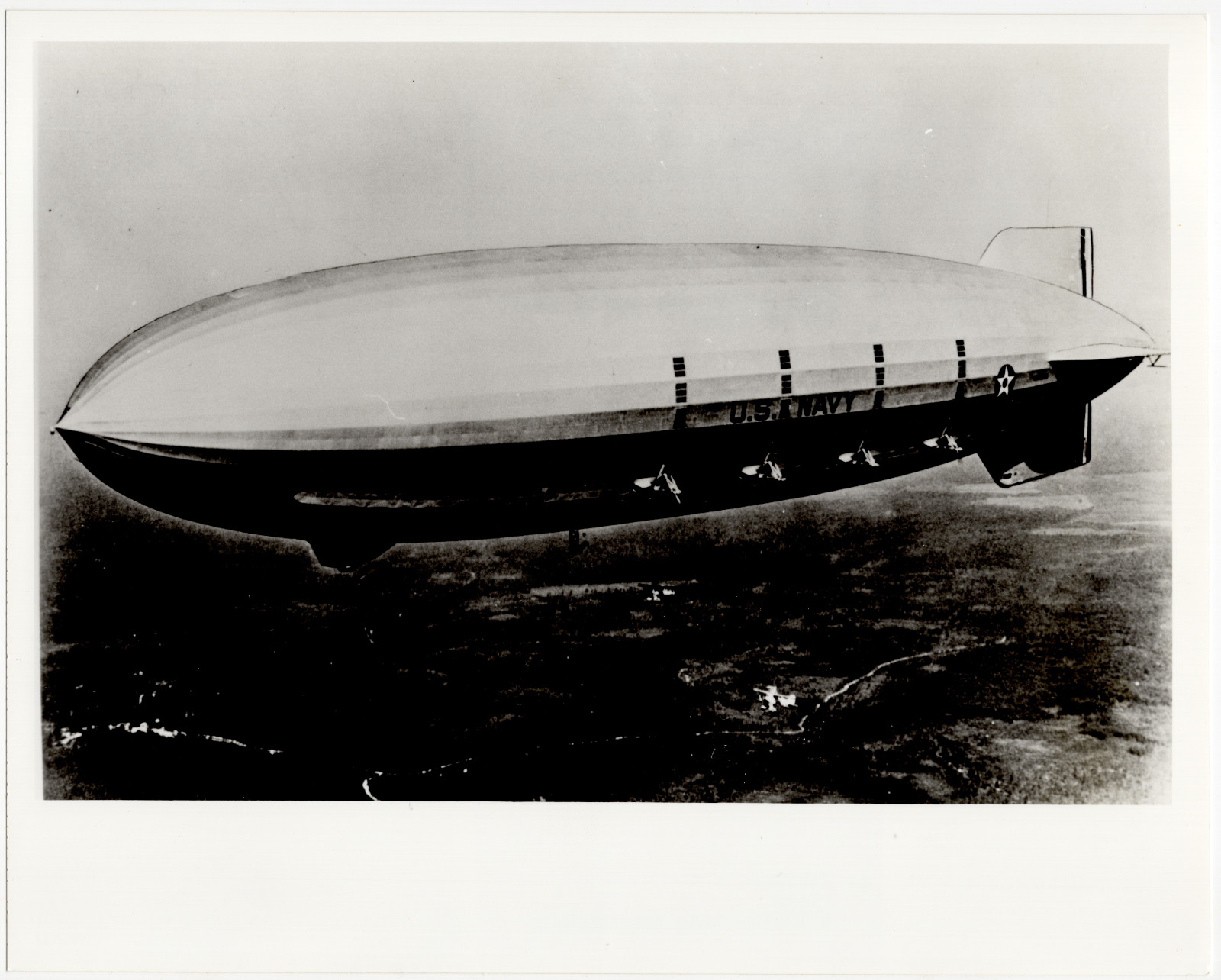
US Navy Airship USS Akron or Macon Dirigible
in Flight Vintage Photo 8x10 1930s
Navy Flying Aircraft Carrier, Both Ships Lost at SeaDESCRIPTIONThis is an 8x10 photograph of a U.S. Navy Akron-class rigid airship in flight, caught in a close side view over open country. The silver hull fills the frame, with U.S. NAVY lettered along the side, the national star insignia near the tail, a row of vertical bar markings along the hull, and four of the ship's eight engines visible along the lower keel with their propellers showing.The tail fins and the lower fin with its small landing wheel are clearly shown. Down on the ground, a winding road or river and two tiny pale shapes that resemble parked biplanes give a sense of just how big the ship was. The image area measures approximately 9.3 x 6.3 inches on a 10 x 8 inch sheet, and the listing photos are scans made at 600 dpi.Only two ships of this class were ever built, USS Akron (ZRS-4) and USS Macon (ZRS-5), and nothing on this print names which one it shows, so it is offered as an Akron-class airship. At 785 feet long, they were among the largest flying objects ever built, powered by eight Maybach engines, four along each side of the hull. They were the Navy's flying aircraft carriers, designed with an internal hangar and a trapeze that launched and recovered Curtiss F9C Sparrowhawk fighters in mid-air. Akron proved the idea on May 3, 1932, when Lieutenants Daniel Harrigan and Howard Young hooked on to the trapeze in a trainer and a Sparrowhawk prototype off the New Jersey coast.Both ships were lost at sea in under two years of service each. Akron went down in a storm off the New Jersey coast on April 4, 1933, killing 73 of the 76 men aboard, including Rear Admiral William A. Moffett, the chief of the Navy's Bureau of Aeronautics. Only three men survived, one of them Lieutenant Commander Herbert V. Wiley. Wiley then took command of Macon, and when she broke up in a storm off Point Sur, California, on February 12, 1935, he survived a second airship loss, this time with all but two of her crew. Four of her five Sparrowhawks went down with her, and the wreck, first located in Monterey Bay around 1990, was added to the National Register of Historic Places in 2010. The two losses effectively ended the Navy's rigid airship program, which makes a clear, full-frame image of one of these ships in flight a strong piece of that short chapter in American aviation.Every effort is made for fact checking and provenance, including background research through news and historical archives. If any listing is incorrect in any way and you're unsatisfied with the item, please connect with me and I'll make it right. Orders placed before Noon CDT ship same day via Ground Advantage with tracking, so you know exactly when it will arrive. Returns accepted on all items exceeding $25 in cost. All shipments receive rigid, professional packaging, sealed and protected in acid free sleeves. Shipping is free and already built into the price, so the BIN price is exactly what you pay, no surprise shipping costs at checkout.CONDITIONPrint with strong contrast and a bright, clean silver hull against a soft gray sky. The print appears to have been hand retouched in period, with inked outlines at the tail fins and hull edges and a darkened underside, a common press room practice that was meant to make the airship stand out for reproduction. A thin white hairline mark, about a third of an inch long, sits on the upper hull near the bow, and a few tiny specks show in the sky and along the lower ground area. The white borders are clean with only light handling marks. The reverse has light adhesive residue and small paper remnants from removal from an old album, none of which affects the image side. No tears, creases, or paper loss on the front.

Related Items:

US Navy Veteran DEPARTMENT OF WAR patch
$12.00
US Navy 4th Fleet Chief Military Ballcap - USN Prior Service Trucker Cap
$39.95
US Navy 2nd Fleet Chief Military Ballcap - USN Prior Service Trucker Cap
$39.95