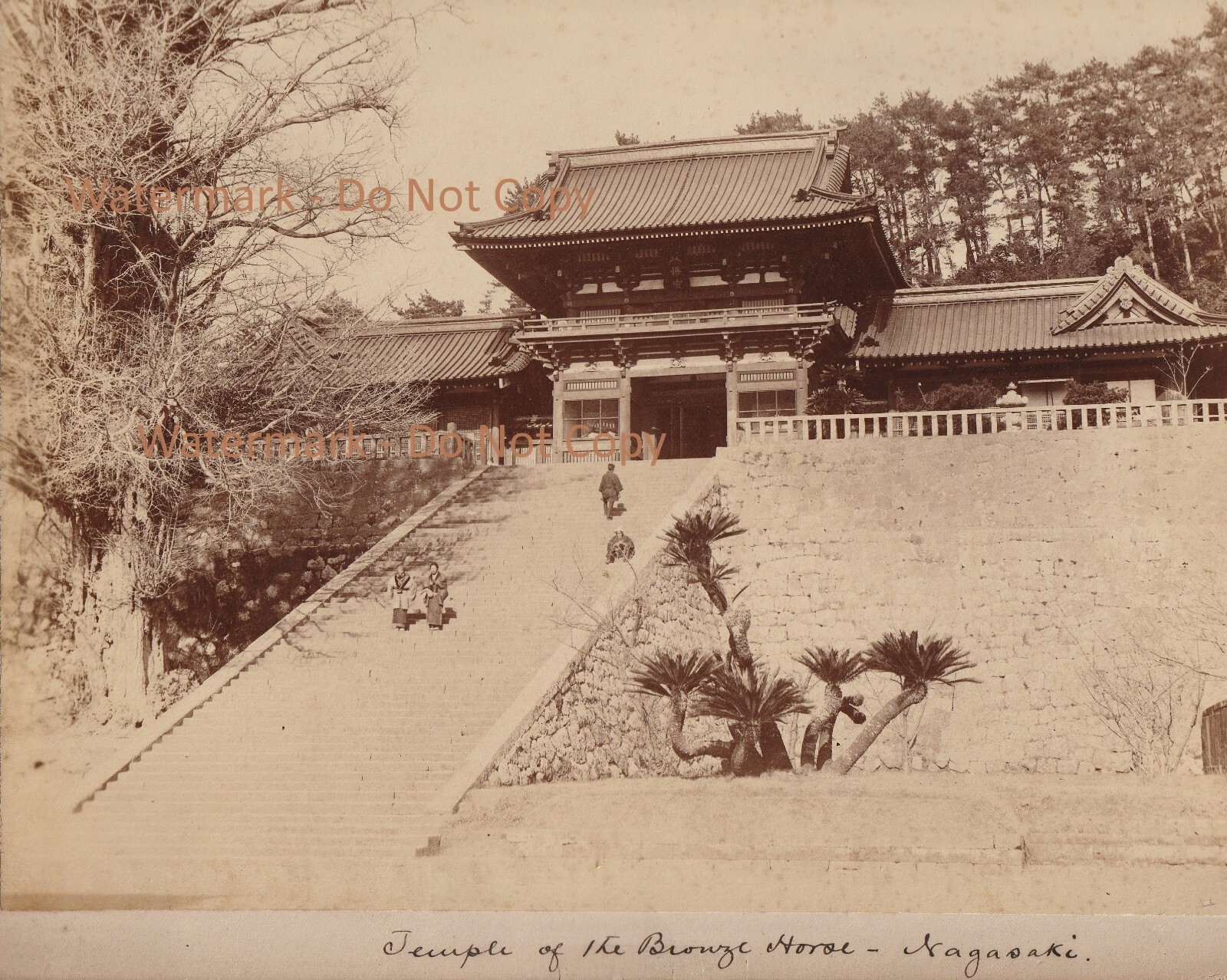
RARE ORIGINAL old Photograph
Mounted Albumen
Temple of the Bronze Horse
Attributed to Charles Leander Weedca 1860s
For offer, a nice old photograph! Fresh from a local estate - never offered on the market until now.Vintage, Old, Original, Antique, NOTa Reproduction - Guaranteed !!
This came from the collection of a prominent family who traveled the world over 100 years ago. Albumen on heavy board. Actual albumen measures 9 x 11 inches. Entire piece measures 10 x 12 inches. Identified at bottom in ink handwriting. In good to very good condition. As shown in photos. The albumen image itself is quite nice. Light chipping to edges of matte.Just as it was found. Please seephotos. If you collect 19th century Asian photography, rare images, etc.this is a treasureyou will not see again!Add this to your image orpaper/ ephemera collection. Combine shipping on multiple offer wins! 3205
Nagasaki (Japanese: 長崎, Hepburn: Nagasaki) (IPA: [naɡaꜜsaki]; lit. "Long Cape"), officially known as Nagasaki City (長崎市, Nagasaki-shi), is the capital and the largest city of the Nagasaki Prefecture on the island of Kyushu in Japan.
It became the sole port used for trade with the Portuguese and Dutch during the 16th through 19th centuries. The Hidden Christian Sites in the Nagasaki Region have been recognized and included in the UNESCO World Heritage List. Part of Nagasaki was home to a major Imperial Japanese Navy base during the First Sino-Japanese War and Russo-Japanese War. Near the end of World War II, the American atomic bombings of Hiroshima and Nagasaki made Nagasaki the second city in the world to experience a nuclear attack. The city was rebuilt.[2]
As of 1 June 2020, Nagasaki has an estimated population of 407,624[1] and a population density of 1,004 people per km2. The total area is 405.86 km2 (156.70 sq mi).[3]HistoryFor a chronological guide, see Timeline of Nagasaki.Nagasaki as a Jesuit port of callMain articles: Portuguese Nagasaki and DejimaThe first contact with Portuguese explorers occurred in 1543. An early visitor was Fernão Mendes Pinto, who came from Sagres on a Portuguese ship which landed nearby in Tanegashima.
Soon after, Portuguese ships started sailing to Japan as regular trade freighters, thus increasing the contact and trade relations between Japan and the rest of the world, and particularly with mainland China, with whom Japan had previously severed its commercial and political ties, mainly due to a number of incidents involving wokou piracy in the South China Sea, with the Portuguese now serving as intermediaries between the two East Asian neighbors.
Despite the mutual advantages derived from these trading contacts, which would soon be acknowledged by all parties involved, the lack of a proper seaport in Kyūshū for the purpose of harboring foreign ships posed a major problem for both merchants and the Kyushu daimyōs (feudal lords) who expected to collect great advantages from the trade with the Portuguese.
In the meantime, Spanish Jesuit missionary St. Francis Xavier arrived in Kagoshima, South Kyūshū, in 1549. After a somewhat fruitful two-year sojourn in Japan, he left for China in 1552 but died soon afterwards.[4] His followers who remained behind converted a number of daimyōs. The most notable among them was Ōmura Sumitada. In 1569, Ōmura granted a permit for the establishment of a port with the purpose of harboring Portuguese ships in Nagasaki, which was finally set up in 1571, under the supervision of the Jesuit missionary Gaspar Vilela and Portuguese Captain-Major Tristão Vaz de Veiga, with Ōmura's personal assistance.[5]
The little harbor village quickly grew into a diverse port city,[6] and Portuguese products imported through Nagasaki (such as tobacco, bread, textiles and a Portuguese sponge-cake called castellas) were assimilated into popular Japanese culture. Tempura derived from a popular Portuguese recipe originally known as peixinhos da horta, and takes its name from the Portuguese word, 'tempero,' seasoning, and refers to the tempora quadragesima, forty days of Lent during which eating meat was forofferden, another example of the enduring effects of this cultural exchange. The Portuguese also brought with them many goods from other Asian countries such as China. The value of Portuguese exports from Nagasaki during the 16th century were estimated to ascend to over 1,000,000 cruzados, reaching as many as 3,000,000 in 1637.[7]
Due to the instability during the Sengoku period, Sumitada and Jesuit leader Alexandro Valignano conceived a plan to pass administrative control over to the Society of Jesus rather than see the Catholic city taken over by a non-Catholic daimyō. Thus, for a brief period after 1580, the city of Nagasaki was a Jesuit colony, under their administrative and military control. It became a refuge for Christians escaping maltreatment in other regions of Japan.[8] In 1587, however, Toyotomi Hideyoshi's campaign to unify the country arrived in Kyūshū. Concerned with the large Christian influence in Kyūshū, Hideyoshi ordered the expulsion of all missionaries, and placed the city under his direct control. However, the expulsion order went largely unenforced, and the fact remained that most of Nagasaki's population remained openly practicing Catholic.[citation needed]
In 1596, the Spanish ship San Felipe was wrecked off the coast of Shikoku, and Hideyoshi learned from its pilot[9] that the Spanish Franciscans were the vanguard of an Iberian invasion of Japan. In response, Hideyoshi ordered the crucifixions of twenty-six Catholics in Nagasaki on February 5 of the next year (i.e. the "Twenty-six Martyrs of Japan"). Portuguese traders were not ostracized, however, and so the city continued to thrive.
In 1602, Augustinian missionaries also arrived in Japan, and when Tokugawa Ieyasu took power in 1603, Catholicism was still tolerated. Many Catholic daimyōs had been critical allies at the Battle of Sekigahara, and the Tokugawa position was not strong enough to move against them. Once Osaka Castle had been taken and Toyotomi Hideyoshi's offspring killed, though, the Tokugawa dominance was assured. In addition, the Dutch and English presence allowed trade without religious strings attached. Thus, in 1614, Catholicism was officially banned and all missionaries ordered to leave. Most Catholic daimyo apostatized, and forced their subjects to do so, although a few would not renounce the religion and left the country for Macau, Luzon and Japantowns in Southeast Asia. A brutal campaign of persecution followed, with thousands of converts across Kyūshū and other parts of Japan killed, tortured, or forced to renounce their religion. Many Japanese and foreign Christians were executed by public crucifixion and burning at the stake in Nagasaki.[10][11] They became known as the Martyrs of Japan and were later venerated by several Popes.[12]
Catholicism's last gasp as an open religion and the last major military action in Japan until the Meiji Restoration was the Shimabara Rebellion of 1637. While there is no evidence that Europeans directly incited the rebellion, Shimabara Domain had been a Christian han for several decades, and the rebels adopted many Portuguese motifs and Christian icons. Consequently, in Tokugawa society the word "Shimabara" solidified the connection between Christianity and disloyalty, constantly used again and again in Tokugawa propaganda.[citation needed] The Shimabara Rebellion also convinced many policy-makers that foreign influences were more trouble than they were worth, leading to the national isolation policy. The Portuguese were expelled from the archipelago altogether. They had previously been living on a specially constructed artificial island in Nagasaki harbour that served as a trading post, called Dejima. The Dutch were then moved from their base at Hirado onto the artificial island.
Seclusion eraThe Great Fire of Nagasaki destroyed much of the city in 1663, including the Mazu shrine at the Kofuku Temple patronized by the Chinese sailors and merchants visiting the port.[13]
In 1720 the ban on Dutch books was lifted, causing hundreds of scholars to flood into Nagasaki to study European science and art. Consequently, Nagasaki became a major center of what was called rangaku, or "Dutch learning". During the Edo period, the Tokugawa shogunate governed the city, appointing a hatamoto, the Nagasaki bugyō, as its chief administrator. During this period, Nagasaki was designated a "shogunal city". The number of such cities rose from three to eleven under Tokugawa administration.[14]
Consensus among historians was once that Nagasaki was Japan's only window on the world during its time as a closed country in the Tokugawa era. However, nowadays it is generally accepted that this was not the case, since Japan interacted and traded with the Ryūkyū Kingdom, Korea and Russia through Satsuma, Tsushima and Matsumae respectively. Nevertheless, Nagasaki was depicted in contemporary art and literature as a cosmopolitan port brimming with exotic curiosities from the Western world.[15]
In 1808, during the Napoleonic Wars, the Royal Navy frigate HMS Phaeton entered Nagasaki Harbor in search of Dutch trading ships. The local magistrate was unable to resist the crew’s demand for food, fuel, and water, later committing seppuku as a result. Laws were passed in the wake of this incident strengthening coastal defenses, threatening death to intruding foreigners, and prompting the training of English and Russian translators.
The Tōjinyashiki (唐人屋敷) or Chinese Factory in Nagasaki was also an important conduit for Chinese goods and information for the Japanese market. Various Chinese merchants and artists sailed between the Chinese mainland and Nagasaki. Some actually combined the roles of merchant and artist such as 18th century Yi Hai. It is believed that as much as one-third of the population of Nagasaki at this time may have been Chinese.[16] The Chinese traders at Nagasaki were confined to a walled compound (Tōjin yashiki) which was located in the same vicinity as Dejima island; and the activities of the Chinese, though less strictly controlled than the Dutch, were closely monitored by the Nagasaki bugyō.
Meiji JapanWith the Meiji Restoration, Japan opened its doors once again to foreign trade and diplomatic relations. Nagasaki became a treaty port in 1859 and modernization began in earnest in 1868. Nagasaki was officially proclaimed a city on April 1, 1889. With Christianity legalized and the Kakure Kirishitan coming out of hiding, Nagasaki regained its earlier role as a center for Roman Catholicism in Japan.[17]
During the Meiji period, Nagasaki became a center of heavy industry. Its main industry was ship-building, with the dockyards under control of Mitsubishi Heavy Industries becoming one of the prime contractors for the Imperial Japanese Navy, and with Nagasaki harbor used as an anchorage under the control of nearby Sasebo Naval District. During World War II, at the time of the nuclear attack, Nagasaki was an important industrial city, containing both plants of the Mitsubishi Steel and Arms Works, the Akunoura Engine Works, Mitsubishi Arms Plant, Mitsubishi Electric Shipyards, Mitsubishi Steel and Arms Works, Mitsubishi-Urakami Ordnance Works, several other small factories, and most of the ports storage and trans-shipment facilities, which employed about 90% of the city's labor force, and accounted for 90% of the city's industry. These connections with the Japanese war effort made Nagasaki a major target for strategic bombing by the Allies during the war.[18][19]
Charles Leander Weed was an American photographer, who was born in New York state on July 17, 1824, and died in Oakland, California on August 31, 1903.[1] He is perhaps best known for being one of the earliest photographers, if not the first photographer, to enter and photograph what is now Yosemite National Park.[2][3]
In 1854, during the California Gold Rush, Weed moved to Sacramento, California, and was a camera operator in the daguerreotype portrait studio of George J. Watson. In 1855, Weed adopted the wet collodion technique, and his photographs of Gold Rush miners and settlement were much admired.[1]
Entrepreneur James Hutchings and others ventured into the area of what is now known as Yosemite Valley in 1855, becoming the Valley's first tourists. After returning to Mariposa Hutchings wrote an article about his experience which appeared in the August 9, 1855 issue of the Mariposa Gazette and was later published in various forms nationally.[4]
Hutchings brought Weed to the Valley in the summer of 1859.[1] Weed took the first known photographs of the Valley's features, and a September exhibition in San Francisco presented them to the public. Hutchings published four installments of "The Great Yo-semite Valley" from October 1859[5] to March 1860 in his magazine; these articles contained woodcuts based on Weed's photographs. A book by Hutchings titled Scenes of Wonder and Curiosity in California collected these articles and the book stayed in print well into the 1870s.[6]
Beginning in 1860, Weed started extensive traveling, including trips to Hong Kong (where he briefly established a studio) and Hawaii. [7] During his travels, he also visited Shanghai and Japan. He made two separate trips to Japan, one in 1867 and another in 1868. [8] He is believed to be the first photographer to use a mammoth camera in Japan, and took photographs of Nagasaki, Edo, Yokohama and Kamakura. There are currently 72 of Weed's photographs of Japan known to survive, including 32 in public collections in Japan (20 half-stereo photographs at the Yokohama Archives of History; 3 mammoth size at Nihon University; and 9 stereo photographs at JCII Camera Museum), 31 portfolio size in a private collection in Japan (Okayama Yoji collection), and 9 in public collections outside of Japan (7 at the Canadian Centre for Architecture, all mammoth size; 2 at the Freer Gallery of Art, mammoth size; and 1 at the Wilson Centre for Photography, London, mammoth size). An exhibition of Weed's photographs of Japan was organized at the Yokohama Archives of History Jan. 28-March 12, 2023. There is an exhibition catalog.
Weed presented his work at the Paris Exposition Universelle, where he won an award for landscape photography.[1]
In 1872, Weed made another visit to Yosemite, probably in the company of well-known Yosemite photographer Eadweard Muybridge. Weed concluded his career by working as a photoengraver.[1]
FamilyCharles Leander Weed was born 1824 in Conesus, Livingston or Elmira, New York, the son of Royal Newland Weed and Ruth Austin. He married Sarah P. Irish on May 1, 1876, in Oakland, Alameda, California. He died August 31, 1903. Both are buried in Oakland. They had one known child Mary E Weed.[9]

Related Items:
Japan 1860s Studio Portraits of Japanese Women Hand-Colored Albumen Prints
$13.49
Photo:Japan 1860s Japanese Families Bridesmaid Teahouse Felice Beato
$13.49
Kyoto Temple Stereoview S. Iwasaki Tokio Japan 1860s Albumen Print
$129.99