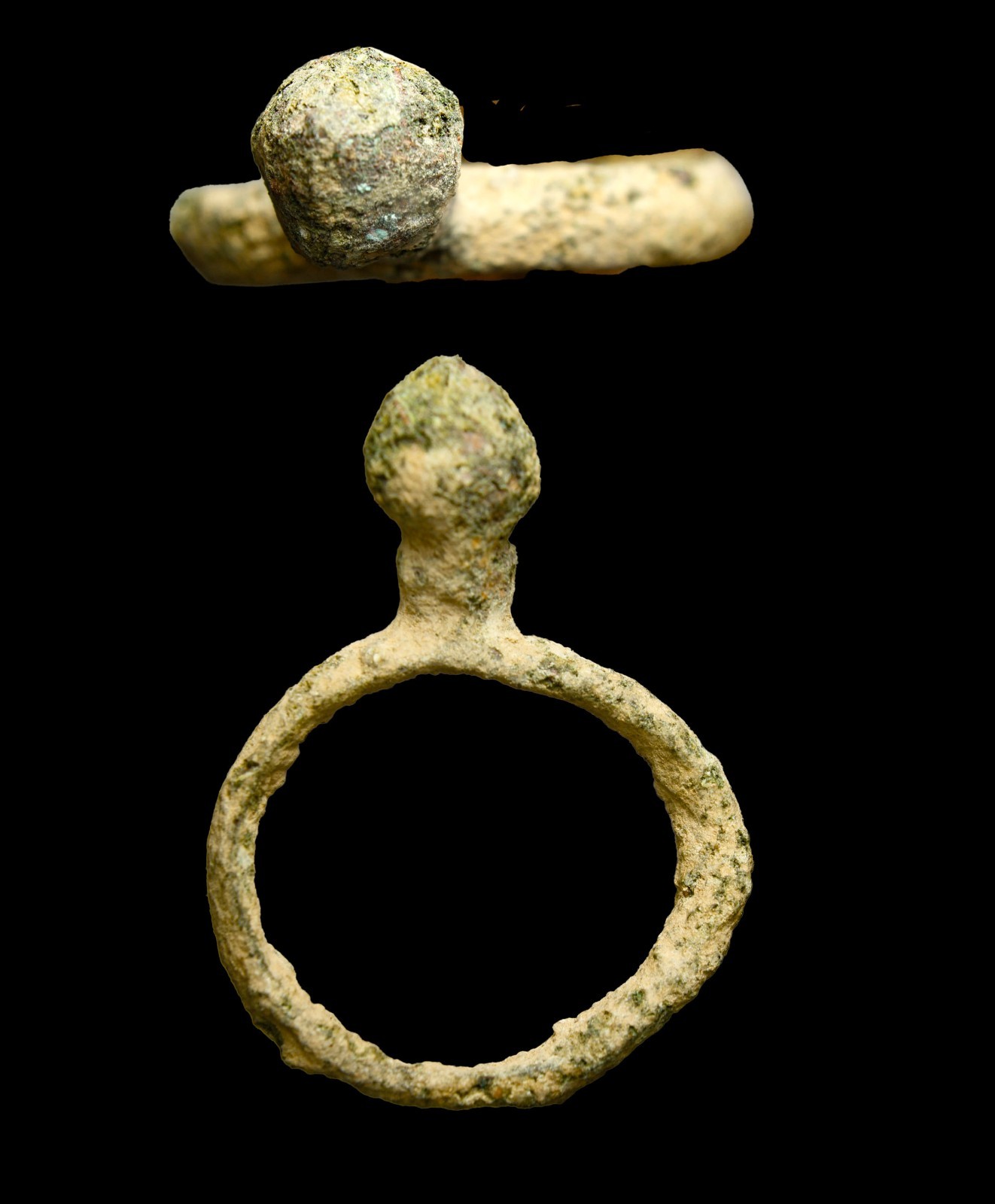
Crusader Period Bronze Raised Pyramidal / Teardrop High-Bezel Ring (Circa 11th–13th Century AD) US Size 5 Authentic
Authenticity Notice
This artifact is certified authentic and will be accompanied by a Certificate of Authenticity and Provenance. All professional inventory is vetted through recognized platforms to ensure legal standing.
Details
Object: High-Bezel Pilgrimage / Talismanic Bronze Ring
Culture: Crusader Period Levant / Outremer
Date: Circa 1096–1291 AD
Material: Bronze (Copper-alloy)
Form: Distinctive architectural form featuring a prominent, raised conical/pyramidal high bezel on a slender rounded hoop
Ring Size: US Size 5
Region: Holy Land / Levantine Crusader States
Iconographic & Typological Analysis
This US Size 5 bronze ring exhibits a striking high-profile architectural design typical of medieval Levantine metalwork.
The defining feature of this ring is its tall, elevated bezel rising sharply above the hoop into a pointed pyramidal or teardrop terminal. In medieval military and pilgrim traditions across Outremer, high raised bezels allowed for the mounting of small Cabochon stones, glass pastes, or religious relics, while solid cast variants functioned as tactile talismans and personal seals.
During the Crusader era, personal jewelry crafted in the Holy Land combined Western European chivalric styles with Byzantine and Levantine casting techniques. Rings with pronounced raised bezels were particularly popular among noble women, pilgrims, and high-status individuals residing in urban strongholds like Acre, Jerusalem, and Antioch.
Cast in bronze, the raised projection gave the piece a distinct, high-status silhouette on the hand while protecting the central element from wear during daily use.
Overview and Historical Context
The 12th and 13th centuries in the Latin East saw a flourishing trade in personal devotional objects and wearable art. Smaller-sized rings like this US Size 5 example were worn by women or young pilgrims journeying through the Holy Land. The dramatic, elevated profile provided a bold visual impact, making it both a personal adornment and an enduring symbol of faith and pilgrimage in the medieval Mediterranean.
Authenticity Check
Displays a thick, authentic archaeological crust of sandy cream-colored earthen caliche and desert patina over an underlying oxidized bronze core.
Heavy natural mineralization, copper-carbonate crystallization, and authentic surface encrustations are present across the entire hoop and raised bezel, consistent with centuries of burial in Levantine soils.
Solid single-piece ancient casting showing organic asymmetry and hand-finishing along the raised collar and band.
Comparable Examples
The British Museum, London: Accession No. 1917,0501.768 (Medieval bronze finger rings with raised conical and pyramidal bezels).
The Israel Museum, Jerusalem: Accession No. IAA 1998-2341 (Crusader and medieval Levantine personal ornaments with high-profile bezels).
The Metropolitan Museum of Art, New York: Accession No. 22.139.12 (Collection of medieval Byzantine and Levantine bronze rings).
Condition
Fine archaeological condition. Structurally complete with an exceptionally thick, untouched natural soil patina and stable mineralization throughout.
2-2

Related Items:
Knight Templar Antiquity Crusader Period Solid Silver Ring Jerusalem Find 1200AD
$217.75
Ancient Crusader Period Bronze Square Weight 5.55g Inscribed Patriarchal Cross
$237.85
RARE Ayyubid Bronze Seal Military Crusader Period Lil Tahir Diya' Certified COA
$245.22