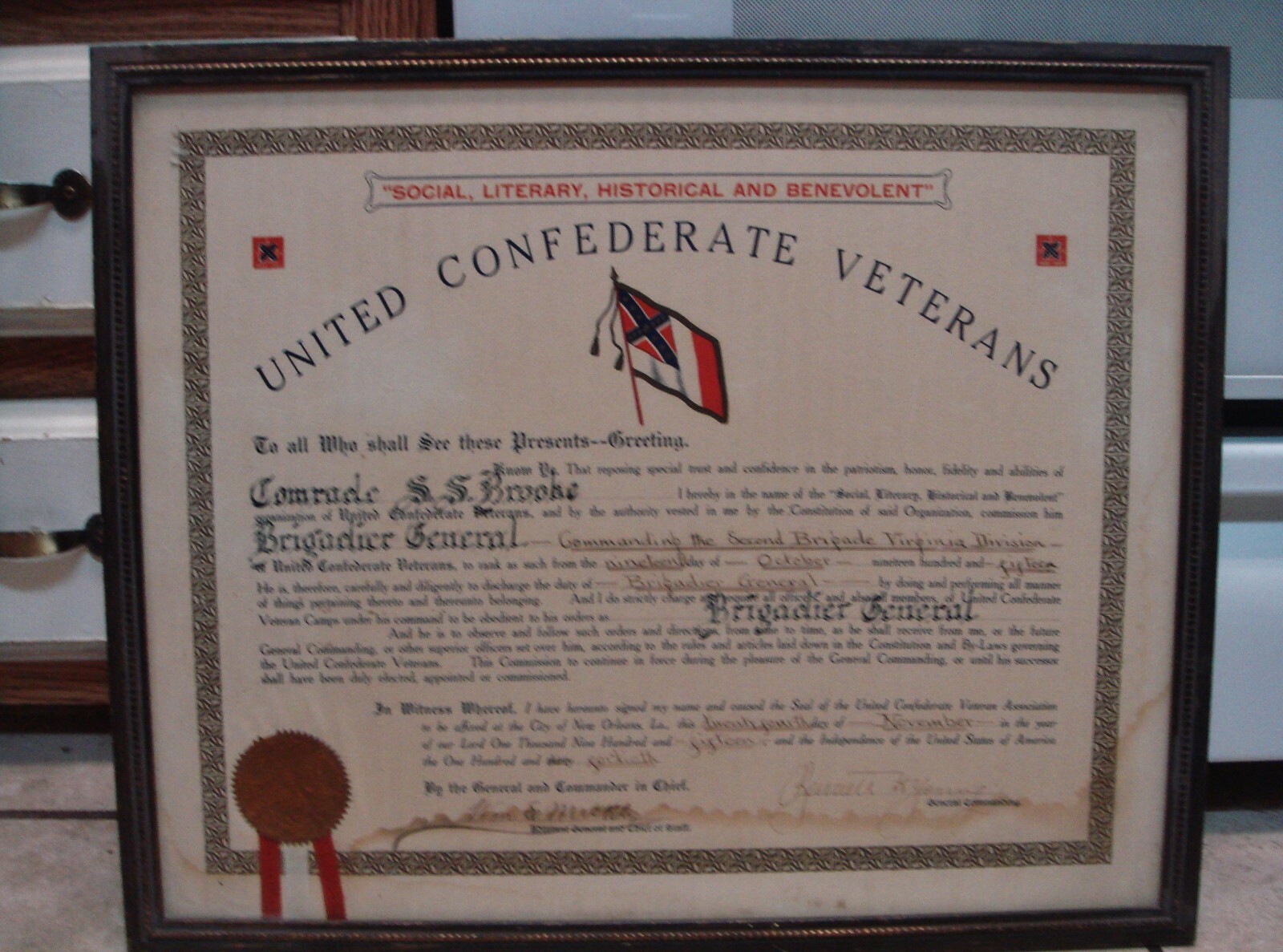
for sale very RARE rare nice historical collectible peaceUnited Confederate Veterans documentsize with frame about 21 x 17 inches.Original signature was signed in 1916
some informationfromnumismatic-mall side
MICKLE, MAJOR GENERAL WILLIAM ENGLISH For the Civil War numismatic specialist on Confederate States of America memorabilia and C. S. A. money and stamps, here is a biographical sketch of one of the most important specialists and dealers -- Major General William English Mickle. Mickle is a contemporary of the thirteen-year younger Luther Brown Tuthill (1859-1930) who also specialized in Confederate Paper Money as a dealer in South Creek, North Carolina (q.v.).William English Mickle (1846-1920),was born the son of Joseph Thomas Mickle (-1898) and Nancy C. Gandy Mickle, on October 31, 1846 in Columbia, Richland County, South Carolina. He is the grandson of Major Joseph and Martha Belton Mickle of Kershaw County, South Carolina. His father was a very successful merchant and banker who moved to Mobile, Alabama in 1852. His father organized the "Merchants Guard" during the Civil War.Start confederate service Ausust 20. 1864 , as a private 3rd Alabamainfantry , Army for NorthernVirginia wounded twice at Battle of CEDAR CREEK,October 19. 1864Served to close of War,e was educated at Summerville Institute, Noxubee County, Mississippi. On August 20, 1864, he went from school directly in the Confederate Army in the Mobile Cadets, Company A , 3rd Alabama Infantry, Army of Northern Virginia (of Battle's Brigade, near Winchester, Virginia). His urgency to enlist was prompted by the death of his brother Joseph English Mickle who was killed in battle at Warrenton Junction, October 14, 1863. He was severely wounded twice at the Battle of Cedar Creek, October 19, 1864. He was hit by shrapnel and as he was being carried off the field was shot in the right ankle. He only experienced two months of active duty in the field during the Civil War. He was furloughed home only to return to duty on crutches the following February 1865. The Confederate medical examiner retired him for nine months, during which time the War had ended. After the War he worked as a teacher in the school system at Barton Academy in Mobile, Alabama. He became the school principal of the Boys' Senior Grammar School.He married Ellie Squire Woodhull (born in Branford, Connecticut), daughter of John F. Woodhull (d. 1894), now of Mobile on October 8, 1867, at Mobile, Alabama.
In 1869, he left the field of education entering the book trade at New Orleans, Louisiana, and at Mobile, Alabama. He established one of the most noted Bookstores in the South located on Dauphin Street, Mobile, Alabama.He specialized on southern literature and history, especially regarding the Civil War and the Confederacy as well as the money and stamps of the Confederacy. His collection of Civil War memorabilia is considered to have been the largest known.
from WikipediaConfederate General Bennett H. YoungEarly life[edit]Young's birthplace near Nicholasville
Young was born inNicholasville, Kentucky;his birthplaceis now on theNational Register of Historic Places. He was 18 years old when he enlisted as a private in the Confederate 8th Kentucky Cavalry, a unit that became a part of GeneralJohn Hunt Morgan'scavalry command.
St. Albans raid[edit]
Young had been captured in John Hunt Morgan's 1863raid in Ohio, but escaped toCanadain the fall of that year. Young went to the south via Nova Scotia and Bermuda, where he proposed Canada-based raids on the Union as a means of building the Confederatetreasuryand forcing theUnion armyto protect their northern border as a diversion. Young wascommissionedas alieutenantand returned to Canada, where he recruited other escaped rebels to participate in the October 19, 1864 raid on St. Albans, Vermont, a quiet town 15 miles (25km) from the Canada–US border.
Young and two others checked into a localhotelon October 10, saying that they had come fromSt. John'sin Canada for a "sporting vacation." Every day, two or three more young men arrived. By October 19, there were 21cavalrymenassembled; just before 3:00p.m. the group simultaneously staged anarmed robberyof the three banks in St. Albans. They announced that they were Confederate soldiers and stole a total of $208,000. As the banks were being robbed, eight or nine of the Confederates held the townspeople prisoner on thevillage greenas their horses were stolen. One townsperson was killed and another wounded. Young ordered his troops to burn the town down, but the four-ounce bottles ofGreek firethey had brought failed to work, and only oneshedwas destroyed.
The raiders fled with the money into Canada, where they were arrested by authorities and held in Montreal. There, the Lincoln administration retained prominent Irish-Canadian lawyer Bernard Devlin, QC, as counsel for the prosecution in the subsequent court case, which sought the raiders' extradition. The court ultimately decided that the soldiers were under military orders and that the officiallyneutralCanada could notextraditethem to America. They were freed, but the $88,000 the raiders had on them was returned to Vermont.
Later career[edit]
After the end of the Civil War, Young was excluded fromPresident Andrew Johnson'samnestyproclamation. He could not return home until 1868. Thus, he spent time studyinglawandliteratureinIrelandand at theUniversity of Edinburgh. After being permitted to return to theUnited States, he became a prominent attorney inLouisville, Kentucky. His philanthropic works were legion. Young founded the first orphanage for blacks in Louisville, a school for the blind, and did much pro bono work for the poor. He also worked as arailroadofficer as President of theLouisville Southern Railroad, author, and National Commander of theUnited Confederate Veterans. Young also served on the board of trustees of theConfederate Veteran.[1]
In 1878, Young joined thePolytechnic Society of Kentucky. The most important aspect to the Polytechnic Society was that it operated the city's library. Young and many other prominent citizens of Louisville helped to save the Society from closing due to financial problems generated by a lottery scam. In 1881, Young became president of the society after the death of Robinson.[2]
Nice to have for the collection or can be a great gift
thank you for looking and good luck
will ship to 48 continental states USAwith insurance and signature on deliveryFedEx don't ship to PO Box sorry.

Related Items:
The Confederate General, Complete 6 Volumes, Civil War, Historical Society, 1991
$125.00
RARE CIVIL WAR CONFEDERATE GENERAL ROBERT E. LEE'S 1864 CDV PHOTOGRAPH
$495.00
RARE Confederate Major General Joe Wheeler Signed Check
$350.00