A Museum-Worthy Survivor of Rome’s Celebrated Micromosaic Tradition
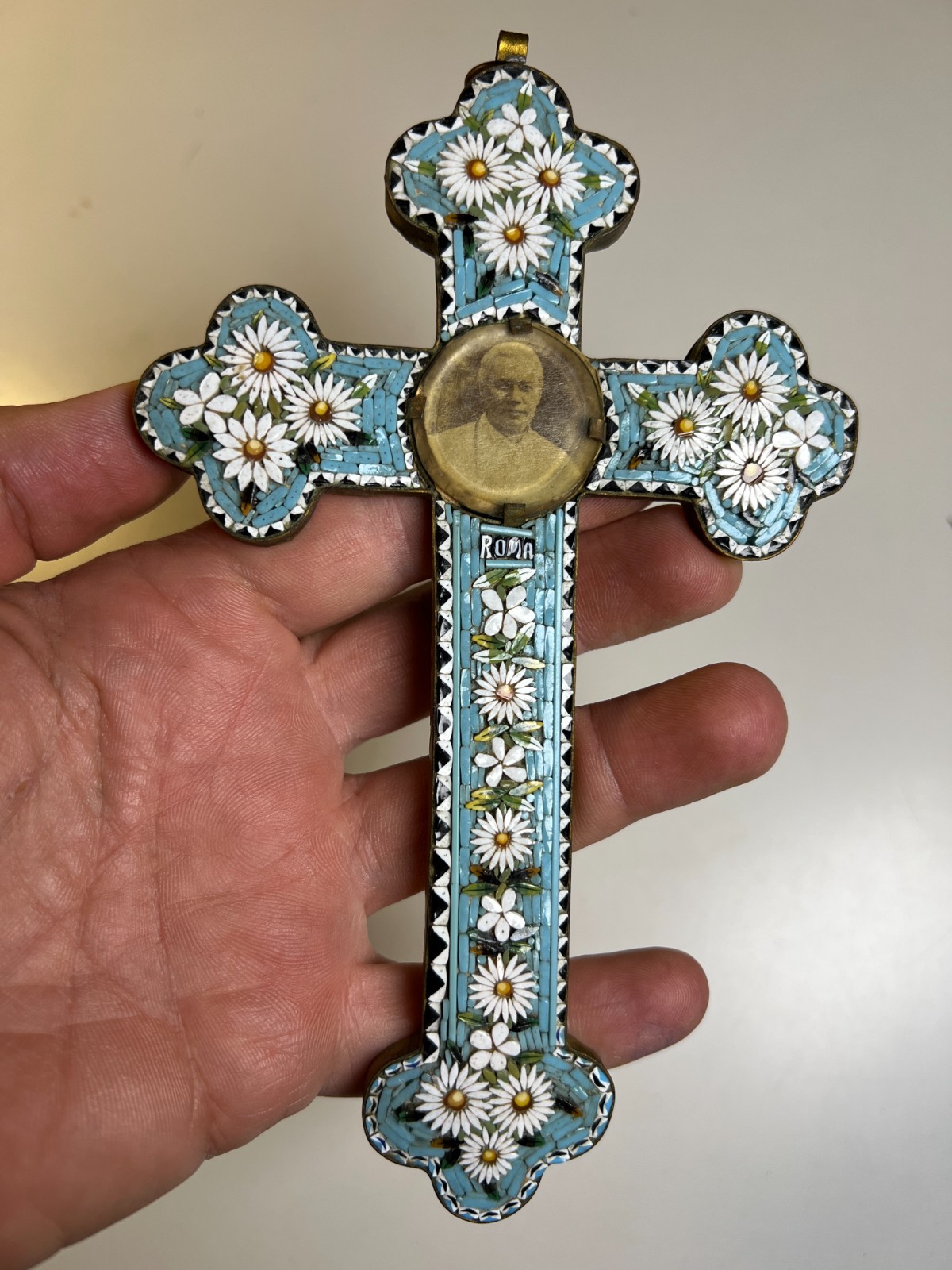
Offered here is an exceptional antique Roman micromosaic devotional cross, handcrafted in Rome, Italy, during the early 20th century. Measuring an impressive 6 1/2 inches tall by 4 inches wide, it is unusually large, extraordinarily detailed, and preserved in considerably better condition than most surviving examples.
At the center is an original period portrait believed to depict Pope Saint Pius X, surrounded by an astonishing garden of individually assembled glass flowers. Immediately beneath the portrait is a tiny mosaic plaque reading:
ROMA
This was not simply decoration—it proudly identified the cross as a treasured remembrance of Rome.
Hundreds of Tiny Pieces of Glass—Placed One at a Time
Although the finished surface can resemble exceptionally fine painting or enamel, every flower, leaf, border, letter, and line is constructed from minute pieces of colored glass called tesserae.
Roman mosaic workers began with intensely colored enamel glass. The softened glass was drawn into extremely slender rods or filaments, traditionally called filati. These rods could be made in different colors, thicknesses, and profiles. The artisan then cut or snapped the filati into tiny sections and, using fine tweezers, carefully pressed each tessera into a prepared adhesive or cement bed.
One misplaced fragment could disrupt an entire flower or border. Creating a piece of this size required immense patience, keen eyesight, a steady hand, and an instinctive understanding of color and pattern.
The craftsmanship becomes even more remarkable under magnification. The white daisies are not molded inserts: their narrow petals were individually cut, shaped, and arranged around shaded golden and amber centers. Green glass fragments form delicate leaves, while elongated turquoise tesserae create the elaborate geometric groundwork. A remarkably crisp black-and-white triangular border follows nearly the entire outline of the cross.
Even the tiny word ROMA was assembled from separate white tesserae set into a black field.
Why This Example Is Better Than Most
Micromosaic workmanship varies tremendously. Many later tourist examples use larger, more widely spaced pieces of glass, simplified flowers, uneven backgrounds, and generous amounts of visible setting compound.
This cross is different.
The tesserae are unusually fine, tightly placed, and remarkably numerous. Its flowers have individually articulated petals rather than crude clusters. The centers employ multiple shades of amber, yellow, and brown to give them dimension. The turquoise background is not merely filled in—it is carefully organized into chevrons, frames, and directional geometric patterns that follow the architecture of the cross.
The artisan also adjusted the shapes and orientations of the tesserae around curves, corners, petals, and borders. That precision gives the surface its wonderfully rich, almost textile-like appearance.
At 6 1/2 inches tall, it is considerably larger and more visually commanding than the small micromosaic pendants commonly encountered. It was made to be seen and admired, whether hung in a private devotional space or displayed as a miniature work of Italian decorative art.
Most importantly, the micromosaic appears complete, without the losses so often found on antique examples. Considering the hundreds of tiny glass elements and more than a century of age, its survival is genuinely remarkable.
The Roman Micromosaic Tradition
Rome became the great center of European micromosaic production through work associated with the Vatican Mosaic Studio. The studio’s roots reach back to the late 16th century, when mosaic was employed to reproduce important paintings in a medium capable of surviving the damp interior conditions of Saint Peter’s Basilica.
During the 18th century, Roman craftsmen refined a new miniature form of the art using extremely slender enamel-glass filaments. The resulting tesserae could imitate brushstrokes and reproduce remarkably subtle details on a portable scale.
By the late 18th and 19th centuries, micromosaics had become coveted souvenirs of the Grand Tour. Wealthy travelers visiting Italy purchased brooches, pendants, boxes, paperweights, plaques, and crosses as tangible reminders of Rome. Unlike an ordinary souvenir, a fine micromosaic required specialized materials and many hours of painstaking handwork.
The grand age of extremely fine commercial micromosaic declined toward the end of the 19th century as tastes changed and inexpensive mass-produced souvenirs became available. Production did not suddenly vanish, however. Roman workshops continued making religious and pilgrimage pieces into the early 20th century, including crosses incorporating portraits of the reigning pope.
The Vatican Mosaic Studio itself remains active, but authentic antique examples made with the density, hand-cut character, and old-world construction seen here belong to a largely vanished artistic tradition.
Pope Saint Pius X
The central portrait is believed to depict Pope Pius X, born Giuseppe Melchiorre Sarto in Riese, Italy, in 1835. Coming from a modest family, Sarto advanced through the Church as a parish priest, bishop, cardinal, and Patriarch of Venice before being elected the 257th pope in 1903.
His relatively humble background and pastoral manner distinguished him from many earlier church leaders. His papal motto, Instaurare Omnia in Christo, expressed his desire to “restore all things in Christ.”
During his pontificate, Pius X:
Encouraged Catholics to receive Communion frequently rather than only on rare occasions.
Lowered the customary age for a child’s First Communion.
Promoted the restoration and wider use of Gregorian chant.
Reorganized portions of the Roman Curia.
Began the enormous project of organizing Catholic canon law into a unified code.
Founded the Pontifical Biblical Institute in Rome.
Strongly opposed the theological movement known as Modernism.
Led the Church through mounting European political tensions that culminated in the outbreak of World War I.
Pius X was deeply distressed by the beginning of the First World War in August 1914. He died on August 20, 1914, only weeks after the conflict began. Pope Pius XII canonized him in 1954, making him Saint Pius X.
The portrait and period construction place this cross most plausibly within or near his 1903–1914 pontificate, approximately circa 1905–1915.
Form and Materials
The cross is built upon a substantial shaped brass foundation with raised edges that form individual compartments for the micromosaic decoration. Its softly lobed terminals recall medieval and Byzantine cross forms, while the vibrant floral decoration reflects the Roman souvenir and devotional tradition.
A domed transparent cover protects the central papal portrait and is held in place by four original metal tabs. The back is finished in warm brass and retains its original upper loop and hanging ring.
The reverse was intentionally left undecorated, allowing the entire front surface to carry the visual impact. The brass has developed an attractive, honest patina consistent with 6 1/2 inches
Width: 4 inches
Origin: Rome, Italy
Date: Approximately circa 1905–1915
Materials: Brass, enamel-glass tesserae, photographic portrait and domed cover
Subject: Pope Saint Pius X
Marked in mosaic: ROMA
Exceptional Condition
This cross is in exceptional antique condition.
The remarkably fine micromosaic work appears complete, with no missing tesserae or visible losses found. The numerous delicate flower petals, shaded centers, leaves, turquoise geometric groundwork, lettering, and intricate black-and-white perimeter border remain beautifully intact.
That degree of preservation is particularly noteworthy. These crosses are frequently encountered with vacant patches, replaced tesserae, damaged borders, or missing floral elements. None of those problems were observed here.
The original central portrait remains clear and well defined beneath its domed protective cover. The original retaining tabs, brass backing, upper fitting, hanging ring, and miniature ROMA plaque are all present. The brass displays only gentle, age-appropriate patina.
Please examine the enlarged photographs carefully. They show both the extraordinary fineness of the work and its outstanding state of preservation.
A superb example for a serious collector of Roman micromosaics, Vatican and papal memorabilia, antique Catholic devotional objects, Italian Grand Tour souvenirs, miniature mosaics, or historic religious art.
This is far above the ordinary tourist cross: it is large, exceptionally intricate, remarkably complete, and visually spectacular—the sort of piece that rewards increasingly close inspection.

Related Items:
Antique (c. 1910) Jell-O Dish (Girl On Box, Green Dress, Teapot) Bone China Gold
$15.00

Antique Easter Three Rabbits"A Joyous Eastertide" Paper Postcard 3120 C 1910
$22.99

Antique Easter Postcard Rabbit Driving Red Car "May Easter Joys Be Yours" C 1910
$15.99